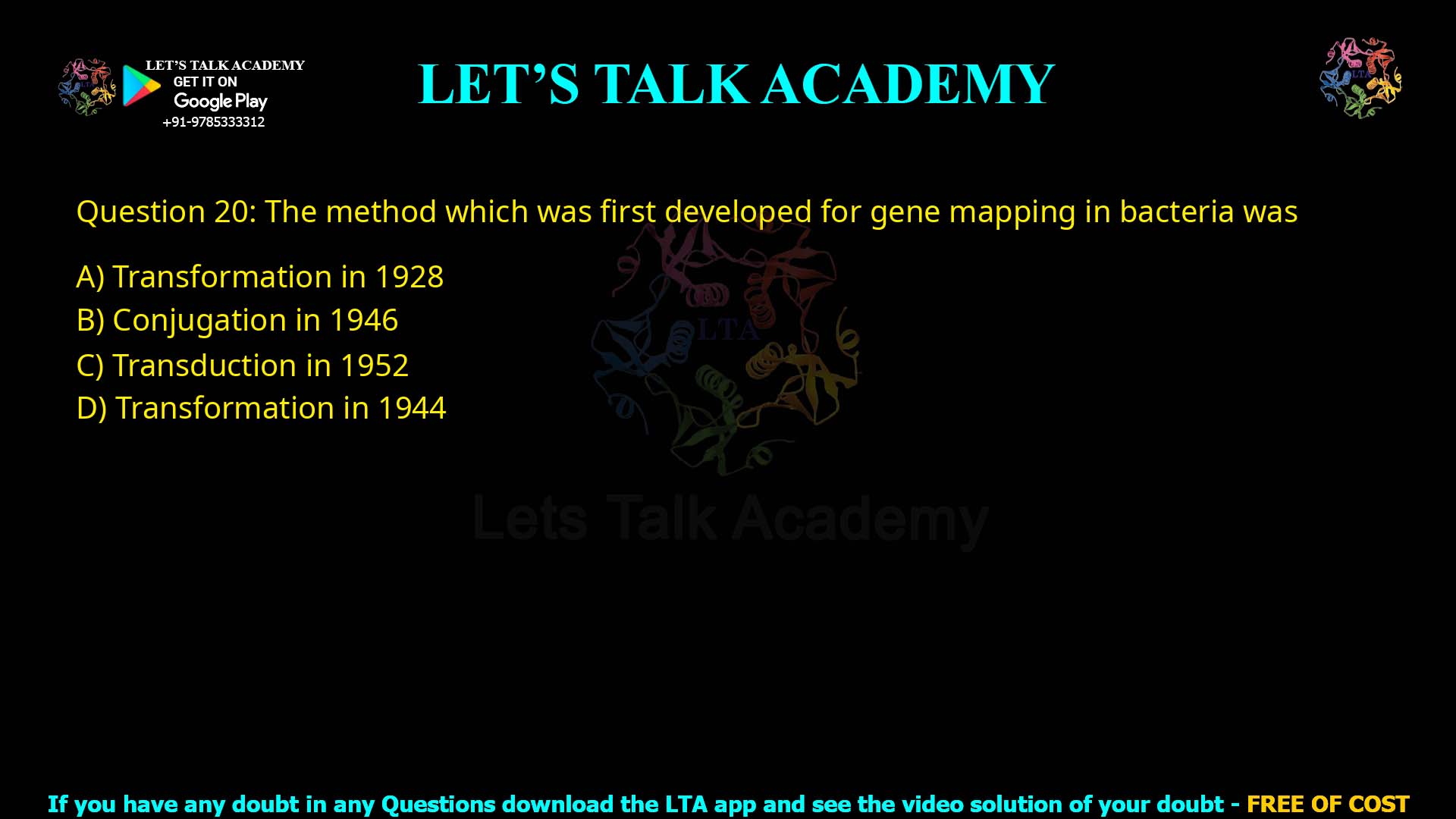
Q20.The method which was first developed for gene mapping in bacteria was
(A) Transformation in 1928
(B) Conjugation in 1946
(C) Transduction in 1952
(D) Transformation in 1944
The correct answer is (B) Conjugation in 1946.
This method marked the first systematic approach to gene mapping in bacteria by enabling scientists to order genes on the chromosome.
Option Analysis
Transformation in 1928: Frederick Griffith discovered transformation when he observed that non-virulent Streptococcus pneumoniae bacteria could take up DNA from heat-killed virulent strains, leading to a smooth (virulent) phenotype. While this proved DNA as genetic material, it did not involve mapping gene order or locations in bacteria.
Conjugation in 1946: Joshua Lederberg and Edward Tatum identified conjugation in E. coli, where genetic material transfers directly between cells via a pilus. Interrupted mating experiments measured transfer times of genes, creating the first linear genetic maps of the bacterial chromosome. This was the pioneering gene mapping technique.
Transduction in 1952: Norton Zinder and Joshua Lederberg found that bacteriophages transfer bacterial DNA between cells, as seen in Salmonella typhimurium. Useful for fine-scale mapping later, but developed after conjugation.
Transformation in 1944: Likely refers to Avery, MacLeod, and McCarty confirming DNA as the transforming principle, but still not for gene mapping purposes.
The first method developed for gene mapping in bacteria was conjugation in 1946, revolutionizing bacterial genetics. This technique, pioneered by Joshua Lederberg and Edward Tatum, allowed researchers to determine gene order on the bacterial chromosome through direct DNA transfer between cells.
Historical Development
Transformation in 1928 by Frederick Griffith showed bacteria uptake free DNA, proving its genetic role but not mapping genes. Conjugation in 1946 involved cell-to-cell contact via a pilus, with “interrupted mating” timing gene transfers for linear maps. Transduction in 1952, via bacteriophages by Zinder and Lederberg, followed for precise mapping.
Key Comparisons
| Method | Year | Discoverers | Role in Gene Mapping |
|---|---|---|---|
| Transformation | 1928 | Griffith | DNA uptake; no mapping |
| Conjugation | 1946 | Lederberg, Tatum | First linear maps via timing |
| Transduction | 1952 | Zinder, Lederberg | Phage-mediated; fine-scale |
Transformation in 1944 refined Griffith’s work but remained non-mapping. Conjugation’s impact endures in genomics today.


