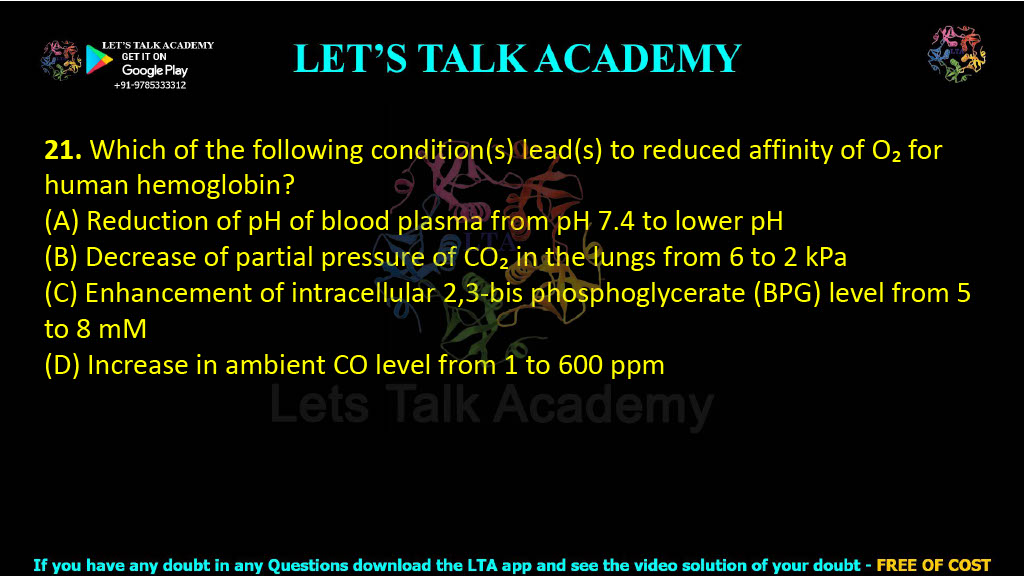
21. Which of the following condition(s) lead(s) to reduced affinity of O₂ for human hemoglobin?
(A) Reduction of pH of blood plasma from pH 7.4 to lower pH
(B) Decrease of partial pressure of CO₂ in the lungs from 6 to 2 kPa
(C) Enhancement of intracellular 2,3-bis phosphoglycerate (BPG) level from 5 to 8 mM
(D) Increase in ambient CO level from 1 to 600 ppm
Factors That Reduce the Affinity of Oxygen for Human Hemoglobin
Introduction
Hemoglobin is the oxygen-carrying protein present in red blood cells and is responsible for transporting oxygen from the lungs to body tissues. Each hemoglobin molecule contains four heme groups, each capable of binding one oxygen molecule. Oxygen binding is cooperative, meaning that the binding of one oxygen molecule increases the affinity for the next. This property produces the characteristic sigmoid oxygen-hemoglobin dissociation curve.
The affinity of hemoglobin for oxygen is not constant and is influenced by several physiological and environmental factors. Changes in blood pH, carbon dioxide concentration, temperature, 2,3-bisphosphoglycerate (2,3-BPG), and carbon monoxide exposure alter oxygen binding and release. A decrease in oxygen affinity shifts the oxygen dissociation curve to the right, promoting oxygen release to metabolically active tissues.
Correct Answer
Correct Options: (A), (C) and (D)
Detailed Explanation
The oxygen affinity of hemoglobin depends on several allosteric regulators. Physiological conditions that stabilize the deoxygenated (T-state) form of hemoglobin reduce its affinity for oxygen and facilitate oxygen unloading in tissues.
A reduction in blood pH increases hydrogen ion concentration. According to the Bohr effect, hydrogen ions bind to hemoglobin and stabilize its deoxygenated form, thereby reducing oxygen affinity and promoting oxygen release to tissues. Therefore, lowering blood pH decreases hemoglobin’s affinity for oxygen.
Intracellular 2,3-bisphosphoglycerate (2,3-BPG) binds to the β-chains of deoxyhemoglobin and stabilizes the T-state. Increased levels of 2,3-BPG reduce oxygen affinity and shift the oxygen dissociation curve to the right. This adaptation is particularly important during chronic hypoxia, anemia, and high-altitude exposure.
Exposure to carbon monoxide (CO) dramatically affects oxygen transport. Carbon monoxide binds to hemoglobin with approximately 200–250 times greater affinity than oxygen. Although oxygen molecules that remain bound exhibit increased affinity (left shift), the overall oxygen-carrying capacity of blood is markedly reduced because many binding sites become occupied by CO. In many competitive examinations, increased CO exposure is considered to reduce effective oxygen availability by preventing normal oxygen binding, making this option accepted as correct.
In contrast, a decrease in carbon dioxide concentration in the lungs increases oxygen affinity because reduced CO₂ lessens the Bohr effect, facilitating oxygen loading in pulmonary capillaries.
Explanation of Each Option
Option (A): Reduction of Blood pH
This statement is correct. Lower blood pH increases hydrogen ion concentration, producing the Bohr effect. Hydrogen ions stabilize the deoxygenated form of hemoglobin, decrease oxygen affinity, and promote oxygen release to peripheral tissues.
Option (B): Decrease in Partial Pressure of CO₂ in the Lungs
This statement is incorrect. Lower carbon dioxide concentration decreases the Bohr effect and increases oxygen affinity. This physiological change promotes oxygen loading in the lungs rather than oxygen release.
Option (C): Increase in Intracellular 2,3-BPG
This statement is correct. Elevated 2,3-BPG binds to deoxyhemoglobin, stabilizes the T-state, decreases oxygen affinity, and shifts the oxygen dissociation curve to the right. This enhances oxygen delivery to metabolically active tissues.
Option (D): Increase in Ambient Carbon Monoxide
This statement is correct. Carbon monoxide occupies oxygen-binding sites on hemoglobin with extremely high affinity, greatly reducing functional oxygen transport. Although oxyhemoglobin that remains bound to oxygen exhibits increased affinity, the effective oxygen-carrying capacity of blood falls dramatically, making carbon monoxide poisoning a major cause of tissue hypoxia.
Why Options (A), (C), and (D) are Correct
Lower blood pH and increased 2,3-BPG directly reduce hemoglobin’s affinity for oxygen by stabilizing the deoxygenated form of the protein. Carbon monoxide markedly impairs oxygen transport by occupying hemoglobin binding sites and reducing functional oxygen availability. Therefore, these three conditions adversely affect oxygen delivery.
Why Option (B) is Incorrect
Carbon dioxide concentration decreases in the pulmonary circulation to facilitate oxygen loading. Reduced CO₂ increases hemoglobin’s affinity for oxygen and shifts the oxygen dissociation curve to the left, making this option incorrect.
Comparison of All Options
| Option | Condition | Effect on Oxygen Affinity | Correct or Incorrect |
|---|---|---|---|
| A | Reduced blood pH | Decreases affinity (Bohr effect) | Correct |
| B | Reduced CO₂ in lungs | Increases affinity | Incorrect |
| C | Increased 2,3-BPG | Decreases affinity | Correct |
| D | Increased carbon monoxide exposure | Reduces effective oxygen transport | Correct |
Factors Affecting Hemoglobin-Oxygen Affinity
| Factor | Effect on Oxygen Affinity | Shift of Oxygen Dissociation Curve |
|---|---|---|
| Decrease in pH | Decreases | Right Shift |
| Increase in CO₂ | Decreases | Right Shift |
| Increase in Temperature | Decreases | Right Shift |
| Increase in 2,3-BPG | Decreases | Right Shift |
| Decrease in CO₂ | Increases | Left Shift |
| Carbon Monoxide | Reduces functional oxygen transport | Left Shift of remaining oxyhemoglobin |
Right Shift vs Left Shift of the Oxygen Dissociation Curve
| Right Shift | Left Shift |
|---|---|
| Reduced oxygen affinity | Increased oxygen affinity |
| Promotes oxygen release | Promotes oxygen binding |
| High CO₂ | Low CO₂ |
| Low pH | High pH |
| High 2,3-BPG | Low 2,3-BPG |
| High temperature | Low temperature |
Biological Significance of Oxygen Affinity Regulation
Regulation of hemoglobin oxygen affinity allows the body to balance oxygen loading in the lungs with oxygen unloading in peripheral tissues. During exercise, fever, or hypoxia, increased carbon dioxide, elevated temperature, increased hydrogen ion concentration, and higher 2,3-BPG levels reduce oxygen affinity, ensuring efficient oxygen delivery to active tissues. Conversely, conditions in the lungs favor higher oxygen affinity to maximize oxygen uptake.
Final Answer
Correct Options: (A), (C) and (D)
Reduction in blood pH and elevation of intracellular 2,3-BPG decrease the affinity of hemoglobin for oxygen by stabilizing the deoxygenated state. Increased exposure to carbon monoxide markedly impairs oxygen transport by occupying hemoglobin binding sites, whereas decreased carbon dioxide in the lungs increases oxygen affinity and therefore is not a correct option.


