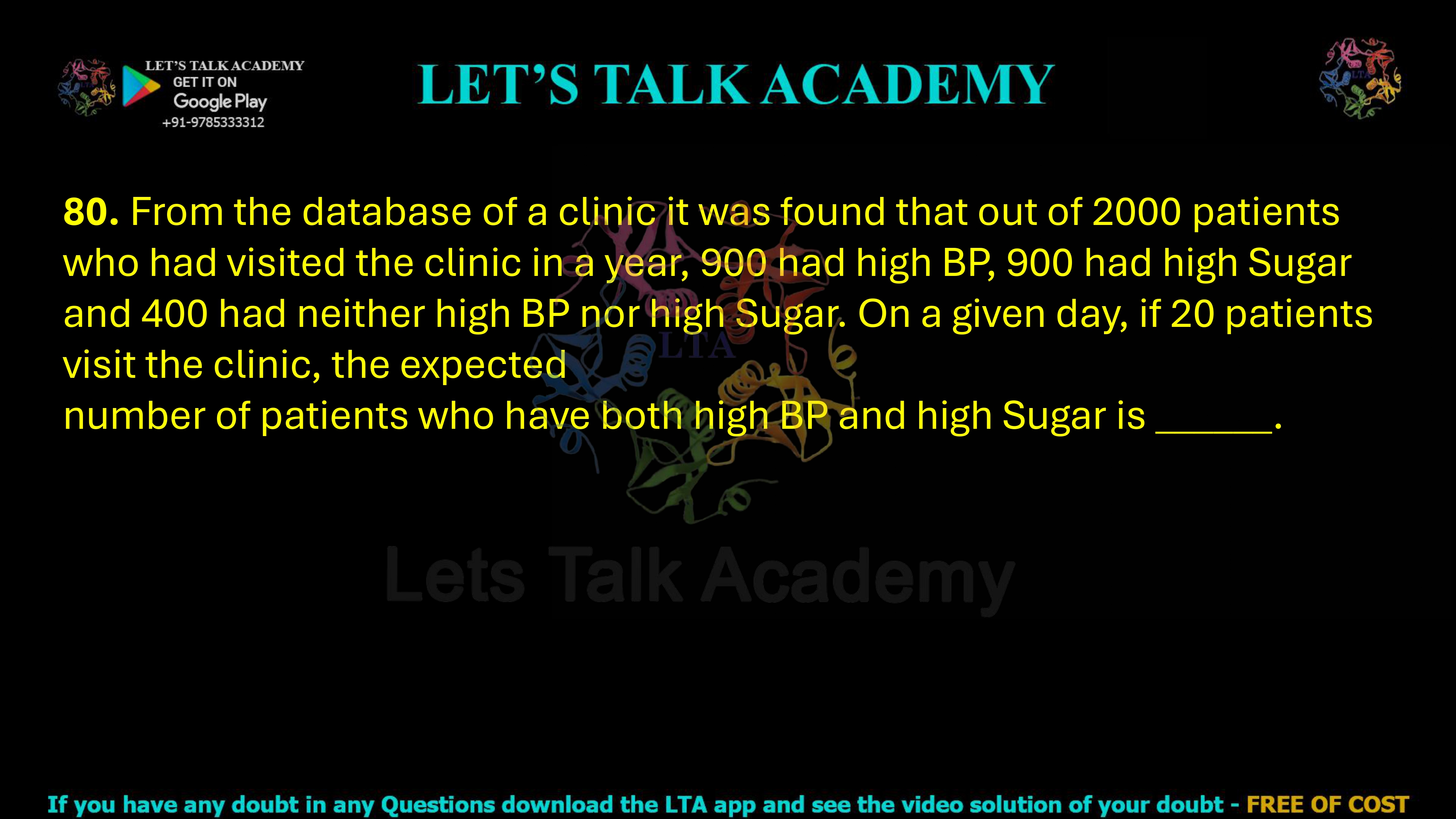
80. From the database of a clinic it was found that out of 2000 patients who had visited the clinic in a year, 900 had high BP, 900 had high Sugar and 400 had neither high BP nor high Sugar. On a given day, if 20 patients visit the clinic, the expected number of patients who have both high BP and high Sugar is ______.
Expected Number of Patients Having Both High BP and High Sugar
The present question is based on a medical database and requires the use of the Inclusion-Exclusion Principle followed by the concept of Mathematical Expectation. Although the problem appears lengthy, it can be solved systematically by first determining the number of patients having both high BP and high Sugar and then calculating the expected number among a sample of twenty patients.
Correct Answer
2
Understanding the Concept
The problem involves two important mathematical concepts:
- The Inclusion-Exclusion Principle to determine how many patients have both conditions.
- The Expected Value formula to calculate the average number of such patients among twenty randomly selected visitors.
The key idea is that before calculating the expectation, we must first determine the probability that a randomly chosen patient has both high BP and high Sugar.
Step 1: Find the Number of Patients Having at Least One Disease
Total patients = 2000.
Patients having neither disease = 400.
Therefore, the number of patients having at least one of the two diseases is
2000 − 400 = 1600.
Step 2: Apply the Inclusion-Exclusion Principle
Let
B = Patients having high BP
S = Patients having high Sugar
According to the Inclusion-Exclusion Principle,
n(B ∪ S) = n(B) + n(S) − n(B ∩ S)
Substituting the given values,
1600 = 900 + 900 − n(B ∩ S)
1600 = 1800 − n(B ∩ S)
Therefore,
n(B ∩ S) = 200.
Hence, 200 patients had both high BP and high Sugar.
Step 3: Calculate the Probability
The probability that a randomly selected patient has both diseases is
200 / 2000 = 1/10.
Thus, every patient has a probability of 0.1 of belonging to this category.
Step 4: Calculate the Expected Number
The expected value is calculated using the formula
Expected Number = n × p
where
- n = 20 patients
- p = 1/10
Therefore,
Expected Number = 20 × (1/10)
= 2.
Hence, on average, 2 patients among the twenty visitors are expected to have both high BP and high Sugar.
Mathematical Verification
Total patients = 2000 ✔
Patients with neither disease = 400 ✔
Patients with at least one disease = 1600 ✔
Patients with both diseases = 900 + 900 − 1600 = 200 ✔
Probability = 200/2000 = 1/10 ✔
Expected number = 20 × 1/10 = 2 ✔
The calculation is completely verified.
Why the Inclusion-Exclusion Principle Is Used
If we simply added the number of patients with high BP and high Sugar, we would obtain
900 + 900 = 1800.
However, patients having both diseases would be counted twice. The Inclusion-Exclusion Principle removes this double counting by subtracting the intersection once. This principle is one of the most frequently tested concepts in probability and set theory.
Alternative Method
After determining that 200 patients have both diseases, immediately compute the proportion:
200/2000 = 10%.
Since 10% of all patients have both conditions, among 20 randomly selected patients the average number is simply
10% of 20 = 2.
This shortcut is particularly useful during competitive examinations.
Related Practice Example
In a class of 100 students, 60 study Mathematics, 50 study Physics, and 20 study neither subject. If 10 students are selected at random, find the expected number studying both Mathematics and Physics.
Students studying at least one subject = 100 − 20 = 80.
Students studying both subjects = 60 + 50 − 80 = 30.
Probability = 30/100 = 0.3.
Expected number = 10 × 0.3 = 3.
This example uses exactly the same reasoning as the present question.
Key Takeaways
Whenever a problem provides the number of individuals possessing two different characteristics along with those having neither characteristic, first apply the Inclusion-Exclusion Principle to determine the size of the intersection. Then compute the probability of the desired event and finally multiply it by the sample size to obtain the expected number. This systematic approach is widely applicable to probability and statistics problems.
Final Answer
The number of patients having both high BP and high Sugar is
200.
The probability that a randomly selected patient has both conditions is
1/10.
Therefore, among 20 patients, the expected number is
20 × 1/10 = 2.
Final Answer: 2


