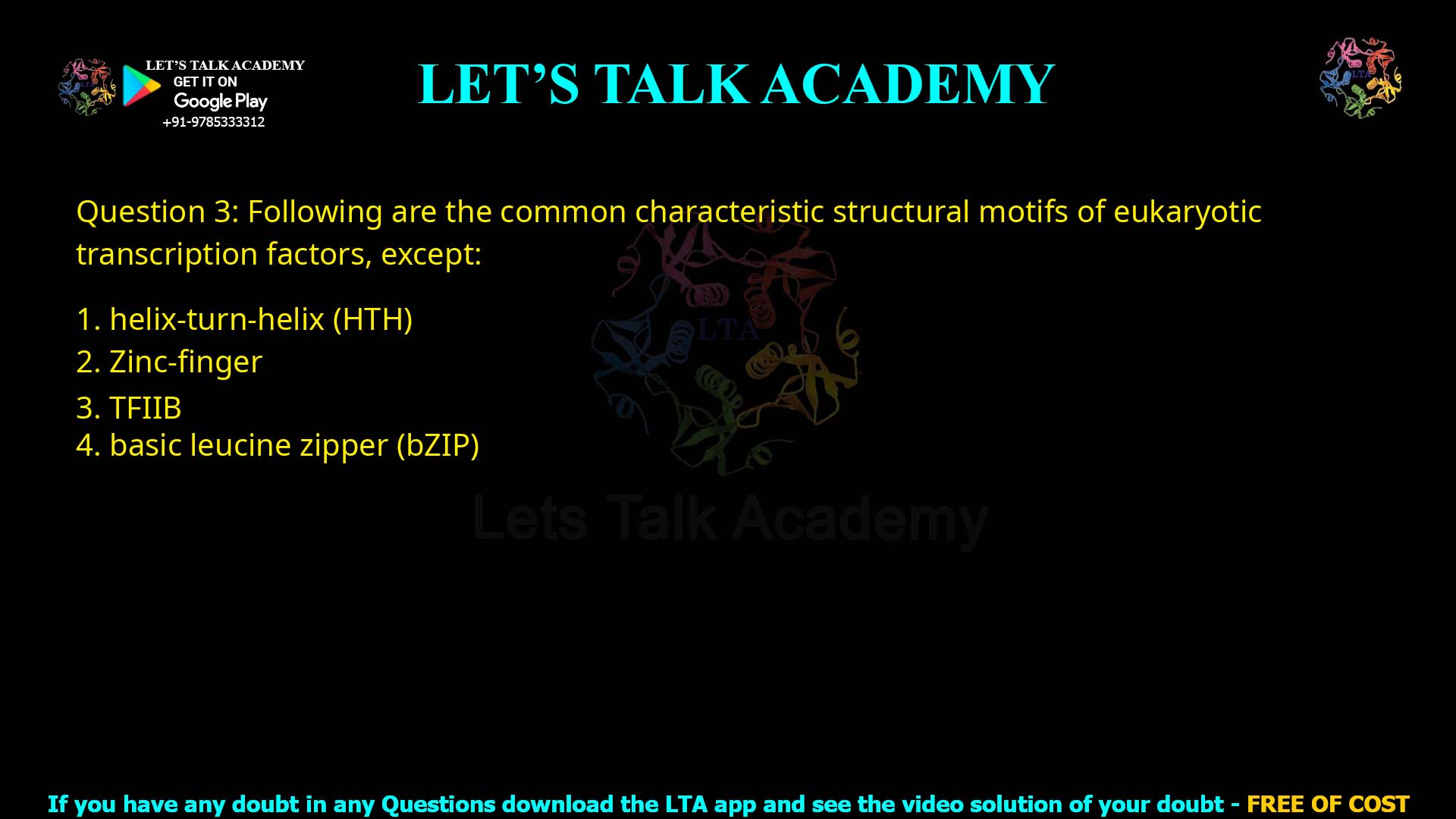
Q.3 Following are the common characteristic structural motifs of eukaryotic transcription factors, except:
- Helix-turn-helix (HTH)
- Zinc-finger
- TFIIB
- Basic leucine zipper (bZIP)
TFIIB is not a structural motif of eukaryotic transcription factors; it is a general transcription factor protein itself.
Question Breakdown
Eukaryotic transcription factors (TFs) contain specific DNA-binding domains called structural motifs that enable sequence-specific recognition of promoter/enhancer regions. The question identifies the exception among listed options, which are common motifs except one.
Option Analysis
Helix-Turn-Helix (HTH)
HTH is a classic DNA-binding motif with two alpha-helices connected by a short turn; the recognition helix inserts into the DNA major groove. Common in homeodomain TFs like Hox proteins for developmental gene regulation.
Zinc-Finger
Zinc-finger motifs use zinc ions to stabilize finger-like loops (Cys2His2 type) that bind DNA bases. Found in TFs like TFIIIA and Sp1, allowing multi-site binding for combinatorial control.
TFIIB
TFIIB is a general transcription initiation factor (GTF), not a structural motif. It bridges TBP (TATA-binding protein) and RNA Pol II, recognizing the BRE (TFIIB recognition element) but lacking a defining DNA-binding domain like the others.
Basic Leucine Zipper (bZIP)
bZIP features a basic DNA-contacting region adjacent to a leucine zipper dimerization domain (leucines every 7 residues). Dimerizes to bind palindromic sites, as in AP-1 (Fos/Jun) for stress response genes.
Correct Answer: TFIIB – It is a protein, not a motif shared by TFs.
Common characteristic structural motifs of eukaryotic transcription factors include HTH, zinc-finger, and bZIP, enabling DNA binding for gene expression control. TFIIB stands out as the exception, being a general transcription factor rather than a motif.
Key Structural Motifs
These motifs define TF DNA-binding domains:
-
Helix-turn-helix (HTH): Recognition helix in major groove.
-
Zinc-finger: Zn-stabilized loops grip DNA.
-
Basic leucine zipper (bZIP): Dimerizes via zipper, binds via basic region.
-
Exception: TFIIB: Protein that recruits Pol II, no motif role.
Motifs allow combinatorial regulation, tying into your genetics and molecular biology focus.
Functional Relevance
HTH suits prokaryote-like specificity; zinc-fingers enable multifinger arrays for broad targets; bZIP homodimerizes/heterodimerizes. TFIIB lacks such structure, acting post-motif binding in PIC assembly.
Motif/Option Type Function HTH DNA-binding Major groove insertion Zinc-finger DNA-binding Multi-site recognition TFIIB GTF protein Pol II recruitment bZIP DNA-binding Dimerized palindromic sites -


