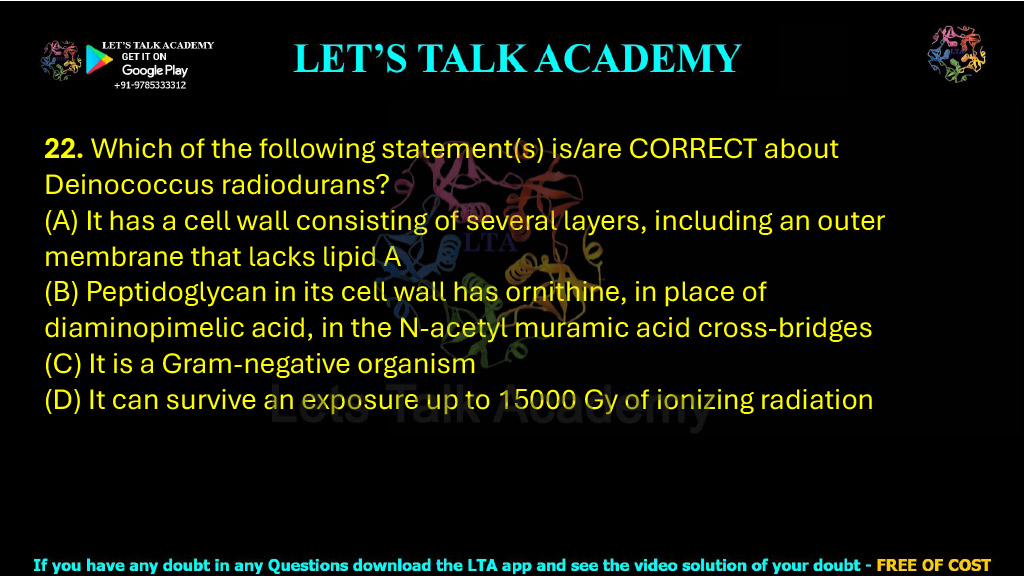
22. Which of the following statement(s) is/are CORRECT about Deinococcus radiodurans?
(A) It has a cell wall consisting of several layers, including an outer membrane that lacks lipid A
(B) Peptidoglycan in its cell wall has ornithine, in place of diaminopimelic acid, in the N-acetyl muramic acid cross-bridges
(C) It is a Gram-negative organism
(D) It can survive an exposure up to 15000 Gy of ionizing radiation
Deinococcus radiodurans: Cell Wall Structure, Radiation Resistance, and Important Characteristics
Introduction
Deinococcus radiodurans is one of the most extraordinary bacteria known in microbiology because of its exceptional ability to survive extremely high doses of ionizing radiation, ultraviolet radiation, desiccation, and oxidative stress. Often referred to as the “world’s toughest bacterium”, it has become a model organism for studying DNA repair mechanisms, stress tolerance, genome stability, and microbial survival under extreme environmental conditions.
Although Deinococcus radiodurans stains Gram-positive due to its thick peptidoglycan layer, its cell envelope is structurally unusual because it possesses an outer membrane resembling that of Gram-negative bacteria. However, unlike typical Gram-negative bacteria, this outer membrane lacks lipid A, the toxic component of lipopolysaccharide (LPS). Another unique feature is that its peptidoglycan contains L-ornithine instead of meso-diaminopimelic acid (DAP) in the peptide cross-bridges. These distinctive structural adaptations, combined with highly efficient DNA repair systems, contribute to its remarkable resistance to environmental stress.
Correct Answer
Correct Options: (A), (B) and (D)
Detailed Explanation
Deinococcus radiodurans belongs to the phylum Deinococcota and exhibits several structural and physiological characteristics that distinguish it from most bacteria. Its multilayered cell envelope contains a thick peptidoglycan layer and an outer membrane, but unlike classical Gram-negative bacteria, the outer membrane lacks lipid A, the endotoxic component of lipopolysaccharide. Therefore, statement (A) is correct.
The peptidoglycan composition is also highly unusual. Instead of the commonly occurring meso-diaminopimelic acid (DAP), the peptide side chains contain L-ornithine. This uncommon amino acid contributes to the unique architecture of its cell wall, making statement (B) correct.
Although the organism possesses an outer membrane, it is not considered a true Gram-negative bacterium. It generally stains Gram-positive because of its thick peptidoglycan layer and belongs to a completely separate bacterial lineage. Therefore, statement (C) is incorrect.
The most remarkable feature of D. radiodurans is its extraordinary resistance to ionizing radiation. It can survive acute radiation doses approaching 15,000 Gy, whereas a dose of approximately 5 Gy is lethal for humans. This remarkable resistance results from highly efficient DNA repair systems, multiple genome copies, antioxidant defense mechanisms, and protective proteins that minimize oxidative damage. Hence, statement (D) is correct.
Explanation of Each Option
Option (A): Cell Wall Has an Outer Membrane That Lacks Lipid A
This statement is correct. The outer membrane of Deinococcus radiodurans differs from that of Gram-negative bacteria because it lacks lipid A, making its cell envelope structurally unique.
Option (B): Peptidoglycan Contains Ornithine Instead of Diaminopimelic Acid
This statement is correct. L-ornithine replaces meso-diaminopimelic acid in the peptide cross-links of its peptidoglycan, representing a characteristic biochemical feature of this bacterium.
Option (C): It Is a Gram-Negative Organism
This statement is incorrect. Although it possesses an outer membrane, Deinococcus radiodurans stains Gram-positive and is not classified as a true Gram-negative bacterium.
Option (D): It Can Survive Up to 15000 Gy of Ionizing Radiation
This statement is correct. Its exceptional DNA repair machinery enables survival after exposure to radiation doses that are thousands of times higher than those tolerated by humans.
Why Options (A), (B) and (D) are Correct
The organism has a unique multilayered cell envelope lacking lipid A, possesses ornithine-containing peptidoglycan, and demonstrates extraordinary resistance to ionizing radiation due to highly efficient DNA repair mechanisms.
Why Option (C) is Incorrect
The presence of an outer membrane does not automatically classify a bacterium as Gram-negative. Deinococcus radiodurans stains Gram-positive and belongs to the phylum Deinococcota, which is distinct from classical Gram-negative bacteria.
Comparison of All Options
| Option | Statement | Status |
|---|---|---|
| A | Outer membrane lacks lipid A | Correct |
| B | Peptidoglycan contains ornithine | Correct |
| C | It is Gram-negative | Incorrect |
| D | Survives up to 15000 Gy radiation | Correct |
Unique Characteristics of Deinococcus radiodurans
| Characteristic | Description |
|---|---|
| Gram Reaction | Gram-positive staining |
| Cell Envelope | Multilayered with outer membrane lacking lipid A |
| Peptidoglycan | Contains L-ornithine instead of DAP |
| Radiation Resistance | Survives up to approximately 15,000 Gy |
| Habitat | Extreme environments, soil, irradiated materials |
Mechanisms Behind Radiation Resistance
| Mechanism | Function |
|---|---|
| Efficient DNA Repair | Reconstructs fragmented chromosomes |
| Multiple Genome Copies | Provides templates for DNA repair |
| Antioxidant Systems | Protect proteins from oxidative damage |
| Manganese Complexes | Reduce oxidative stress during irradiation |
| Protein Protection | Maintains enzyme activity after radiation exposure |
Comparison with Typical Gram-Negative Bacteria
| Feature | Deinococcus radiodurans | Typical Gram-negative Bacteria |
|---|---|---|
| Outer Membrane | Present | Present |
| Lipid A | Absent | Present |
| Peptidoglycan Amino Acid | L-Ornithine | meso-Diaminopimelic acid |
| Radiation Resistance | Extremely High | Generally Low |
Applications of Deinococcus radiodurans
Because of its exceptional stress tolerance, Deinococcus radiodurans has become an important organism in biotechnology and environmental microbiology. It is being explored for the bioremediation of radioactive waste, heavy metal contamination, and toxic industrial pollutants. Its DNA repair mechanisms are also widely studied to understand genome stability, oxidative stress, aging, and radiation biology.
Final Answer
Correct Options: (A), (B) and (D)
Deinococcus radiodurans possesses a multilayered cell envelope with an outer membrane lacking lipid A, contains L-ornithine in its peptidoglycan cross-links instead of diaminopimelic acid, and can survive exposure to approximately 15,000 Gy of ionizing radiation due to its extraordinary DNA repair capability. However, it is not considered a true Gram-negative bacterium.


