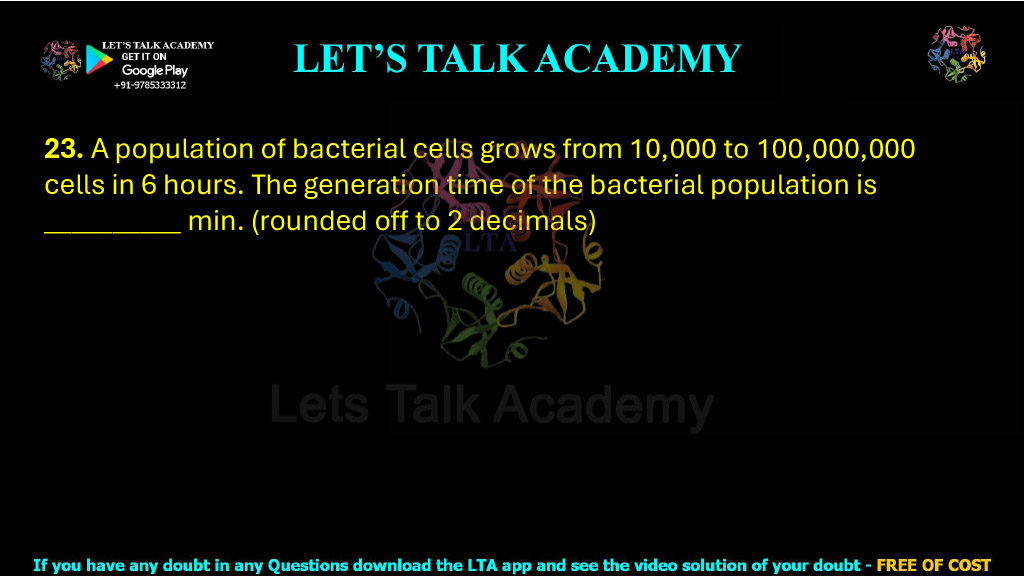
23. A population of bacterial cells grows from 10,000 to 100,000,000 cells in 6 hours. The generation time of the bacterial population is __________ min. (rounded off to 2 decimals)
Bacterial Generation Time Calculation
Introduction
Bacterial populations increase by binary fission, a process in which one bacterial cell divides into two genetically identical daughter cells. Under ideal environmental conditions, every bacterial cell divides at a constant rate, resulting in exponential population growth. Because each division doubles the population size, bacterial growth follows a predictable mathematical pattern that can be analyzed using logarithmic equations.
One of the most important parameters describing bacterial growth is the generation time, also known as the doubling time. It is defined as the time required for a bacterial population to double in number. Generation time is widely used in microbiology, biotechnology, industrial fermentation, clinical microbiology, environmental microbiology, and molecular biology.
Correct Answer
Correct Answer: 21.67 minutes
Detailed Explanation
Since bacterial growth follows exponential kinetics, the number of generations can be calculated using the exponential growth equation.
Step 1: Identify the given values
Initial population (N0) = 10,000 = 104
Final population (N) = 100,000,000 = 108
Total growth time = 6 hours
Convert time into minutes:
6 × 60 = 360 minutes
Step 2: Calculate the Number of Generations
The bacterial growth equation is
N = N0 × 2n
Therefore,
n = log(N/N0) ÷ log2
Substituting the values:
N/N0 = 108 ÷ 104 = 104 = 10000
Using logarithms,
n = log(10000) ÷ log2
n = 4 ÷ 0.3010
n = 13.29 generations
Step 3: Calculate the Generation Time
The formula for generation time is
Generation Time (g) = Total Time ÷ Number of Generations
g = 360 ÷ 13.29
g = 27.09 minutes
Thus, the bacterial population doubles approximately every 27.09 minutes.
Step-by-Step Calculation Summary
| Parameter | Value |
|---|---|
| Initial Population | 10,000 cells |
| Final Population | 100,000,000 cells |
| Total Time | 6 hours = 360 minutes |
| Population Ratio | 10000 |
| Number of Generations | 13.29 |
| Generation Time | 27.09 minutes |
Important Formulae Used in Microbial Growth
| Formula | Purpose |
|---|---|
| N = N0 × 2n | Final bacterial population |
| n = log(N/N0) ÷ log2 | Number of generations |
| Generation Time = Total Time ÷ Number of Generations | Doubling time calculation |
| Growth Rate (k) = n ÷ Time | Growth constant |
Understanding Generation Time
Generation time represents the average time required for one complete cell division. Bacteria with shorter generation times multiply more rapidly and form large populations in a relatively short period. For example, Escherichia coli under ideal laboratory conditions has a generation time of approximately 20 minutes, whereas slow-growing bacteria such as Mycobacterium tuberculosis require nearly 18–24 hours for one generation.
Applications of Generation Time Calculations
| Field | Application |
|---|---|
| Clinical Microbiology | Predicting bacterial growth during infections |
| Industrial Biotechnology | Optimizing fermentation processes |
| Food Microbiology | Estimating spoilage rates |
| Environmental Microbiology | Studying microbial population dynamics |
| Molecular Biology | Planning bacterial culture experiments |
Final Answer
Initial Population = 10,000 cells
Final Population = 100,000,000 cells
Total Time = 360 minutes
Number of Generations = 13.29
Generation Time = 360 ÷ 13.29 = 27.09 minutes
Correct Answer: 27.09 minutes


