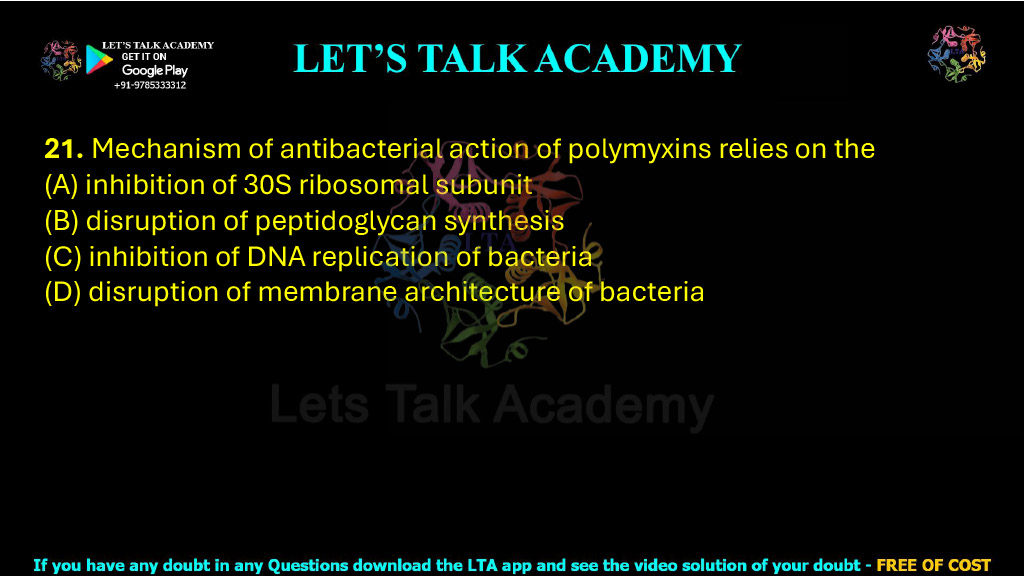
21. Mechanism of antibacterial action of polymyxins relies on the
(A) inhibition of 30S ribosomal subunit
(B) disruption of peptidoglycan synthesis
(C) inhibition of DNA replication of bacteria
(D) disruption of membrane architecture of bacteria
Mechanism of Action of Polymyxins: How Polymyxin Antibiotics Disrupt Bacterial Cell Membranes
Introduction
Antibiotics eliminate bacteria by targeting essential cellular structures or metabolic pathways that are either absent or significantly different in human cells. These targets include bacterial cell wall synthesis, protein synthesis, nucleic acid synthesis, folic acid metabolism, and the bacterial cell membrane. Among these mechanisms, disruption of the bacterial cell membrane is one of the fastest ways to kill bacterial cells because membrane integrity is essential for maintaining cellular homeostasis, ion gradients, and metabolic activity.
Polymyxins are a group of cyclic polypeptide antibiotics that act directly on the bacterial cell membrane. Unlike antibiotics such as penicillin, tetracycline, or ciprofloxacin, polymyxins do not interfere with cell wall synthesis, protein synthesis, or DNA replication. Instead, they bind to the outer membrane of Gram-negative bacteria, destabilize membrane architecture, increase membrane permeability, and ultimately cause leakage of intracellular contents leading to bacterial death. This unique mechanism makes polymyxins highly effective against multidrug-resistant Gram-negative pathogens and an important topic in microbiology and pharmacology.
Correct Answer
Correct Option: (D) Disruption of membrane architecture of bacteria
Detailed Explanation
Polymyxins, including Polymyxin B and Colistin (Polymyxin E), are bactericidal antibiotics that specifically target the membranes of Gram-negative bacteria. Their primary target is the lipopolysaccharide (LPS) present in the outer membrane. The positively charged polymyxin molecules bind electrostatically to the negatively charged lipid A component of LPS, displacing stabilizing calcium and magnesium ions that normally maintain membrane integrity.
Following this interaction, polymyxins insert their hydrophobic region into the bacterial membrane, disrupting its normal architecture. This increases membrane permeability, allowing essential ions, metabolites, and cytoplasmic components to leak out of the bacterial cell. As membrane integrity is lost, the bacterial cell rapidly undergoes lysis and death. Because this mechanism directly damages the membrane rather than inhibiting metabolic pathways, polymyxins are considered rapidly bactericidal antibiotics.
Human cell membranes contain cholesterol instead of lipopolysaccharide, making polymyxins relatively selective for bacteria. However, because mammalian cell membranes also contain phospholipids, high doses of polymyxins may produce nephrotoxicity and neurotoxicity, limiting their clinical use. Today, polymyxins are mainly reserved as last-line drugs against multidrug-resistant Gram-negative pathogens such as Pseudomonas aeruginosa, Acinetobacter baumannii, and carbapenem-resistant Enterobacterales.
Explanation of Each Option
Option (A): Inhibition of 30S Ribosomal Subunit
This option is incorrect. Inhibition of the 30S ribosomal subunit is the mechanism of antibiotics such as Tetracycline and Aminoglycosides. Polymyxins do not interfere with bacterial protein synthesis.
Option (B): Disruption of Peptidoglycan Synthesis
This option is incorrect. Peptidoglycan synthesis is inhibited by β-lactam antibiotics such as penicillin, cephalosporins, and carbapenems, as well as glycopeptides like vancomycin. Polymyxins do not target the bacterial cell wall.
Option (C): Inhibition of DNA Replication of Bacteria
This option is incorrect. DNA replication is inhibited by fluoroquinolones such as ciprofloxacin and levofloxacin through inhibition of DNA gyrase and topoisomerase IV. Polymyxins do not affect bacterial DNA synthesis.
Option (D): Disruption of Membrane Architecture of Bacteria
This option is correct. Polymyxins bind to lipopolysaccharides and phospholipids of Gram-negative bacterial membranes, disrupt membrane integrity, increase permeability, and cause leakage of intracellular components, resulting in rapid bacterial death.
Why Option (D) is Correct
The antibacterial effect of polymyxins depends entirely on their ability to disrupt the bacterial cell membrane. By damaging membrane architecture, polymyxins destroy the permeability barrier that is essential for bacterial survival.
Why the Other Options are Incorrect
Why Option (A) is Incorrect
Protein synthesis inhibitors such as tetracycline and streptomycin act on the 30S ribosomal subunit, whereas polymyxins do not interact with ribosomes.
Why Option (B) is Incorrect
Cell wall synthesis inhibitors target peptidoglycan biosynthesis, but polymyxins act after binding directly to the bacterial membrane.
Why Option (C) is Incorrect
DNA replication inhibitors interfere with bacterial DNA gyrase or topoisomerase. Polymyxins have no effect on DNA replication enzymes.
Comparison of All Options
| Option | Mechanism | Correct or Incorrect |
|---|---|---|
| A | Inhibits 30S ribosomal subunit | Incorrect |
| B | Disrupts peptidoglycan synthesis | Incorrect |
| C | Inhibits DNA replication | Incorrect |
| D | Disrupts bacterial membrane architecture | Correct |
Comparison of Major Antibiotic Mechanisms
| Antibiotic | Primary Target | Mechanism |
|---|---|---|
| Polymyxin B / Colistin | Cell membrane | Membrane disruption |
| Penicillin | Cell wall | Inhibits transpeptidase |
| Vancomycin | Cell wall | Binds D-Ala-D-Ala |
| Tetracycline | 30S ribosome | Blocks aminoacyl-tRNA binding |
| Chloramphenicol | 50S ribosome | Inhibits peptidyl transferase |
| Ciprofloxacin | DNA gyrase | Blocks DNA replication |
Clinical Uses of Polymyxins
| Drug | Major Clinical Use |
|---|---|
| Polymyxin B | Topical treatment of Gram-negative infections |
| Colistin (Polymyxin E) | Multidrug-resistant Gram-negative infections |
| Both Drugs | Pseudomonas aeruginosa, Acinetobacter baumannii, Carbapenem-resistant Enterobacterales |
Biological Significance
Polymyxins have regained tremendous clinical importance because of the worldwide emergence of multidrug-resistant Gram-negative bacteria. As last-resort antibiotics, they are often used when other antimicrobial agents fail. Their membrane-disrupting mechanism differs completely from most commonly used antibiotics, making them effective against pathogens resistant to β-lactams, aminoglycosides, and fluoroquinolones. Research on polymyxins has also contributed significantly to understanding bacterial membrane structure and antibiotic resistance mechanisms.
Final Answer
Correct Option: (D)
Polymyxins exert their antibacterial effect by disrupting the membrane architecture of Gram-negative bacteria. They bind to lipopolysaccharides in the outer membrane, increase membrane permeability, and cause leakage of essential intracellular contents, leading to rapid bacterial death.


