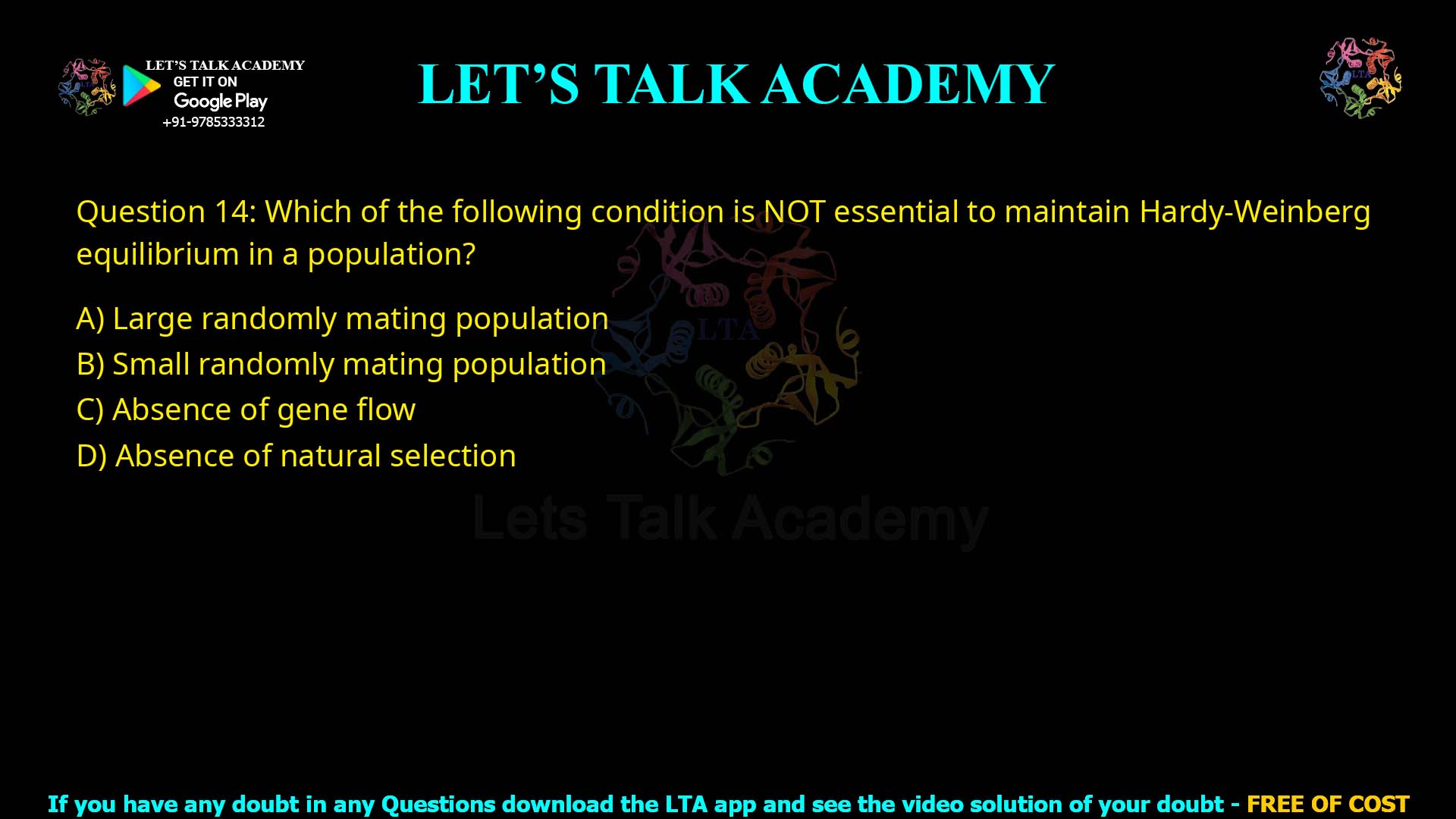
Q14.Which of the following condition is NOT essential to maintain Hardy-Weinberg equilibrium in a population?
(A) Large randomly mating population
(B) Small randomly mating population
(C) Absence of gene flow
(D) Absence of natural selection
Correct option: (B) Small randomly mating population
Introduction
The Hardy-Weinberg equilibrium describes a theoretical state where allele and genotype frequencies remain constant across generations in a population. Maintaining this equilibrium requires specific conditions like large population size, random mating, no gene flow, and no natural selection. Understanding which condition is NOT essential is crucial for competitive exams in population genetics.
Step-by-Step Analysis of Hardy-Weinberg Assumptions
The five essential conditions for Hardy-Weinberg equilibrium are:
-
Large population size (prevents genetic drift)
-
Random mating (no sexual selection or assortative mating)
-
No mutation (no new alleles introduced)
-
No gene flow (no migration in/out of population)
-
No natural selection (all genotypes equally fit)
Detailed Explanation of Each Option
(A) Large randomly mating population – Essential
Why required: Large population prevents genetic drift (random changes in allele frequencies due to chance). Small populations experience sampling error where alleles can be lost or fixed randomly.
Random mating ensures genotype frequencies follow expected p2+2pq+q2=1.
Example: In a population of 10,000 vs 10 individuals, drift effects are negligible in large populations.
(B) Small randomly mating population – NOT Essential (Correct Answer)
Why NOT required: Small populations violate Hardy-Weinberg assumptions due to genetic drift. In small populations:
-
Rare alleles have higher chance of being lost (bottleneck effect)
-
Allele frequencies fluctuate randomly between generations
-
Founder effect occurs when small groups establish new populations
Even with random mating, small population size alone disrupts equilibrium.
Conclusion: Small population is contrary to H-W requirements.
(C) Absence of gene flow – Essential
Why required: Gene flow (migration) introduces new alleles or changes existing frequencies.
Example: If immigrants bring allele A into population B, equilibrium is disrupted.
Migration either increases genetic diversity or homogenizes populations, preventing stable frequencies.
(D) Absence of natural selection – Essential
Why required: Natural selection changes allele frequencies by favoring certain genotypes.
Example: If AA genotype has higher fitness than aa, frequency of A increases over generations.
All genotypes must have equal reproductive success for equilibrium.
Quick Reference Table: H-W Assumptions
Exam Strategy: Why (B) is the Trap
Common student mistake: Thinking “randomly mating” makes small populations okay.
Correct reasoning: Size matters independently of mating pattern. Small populations always have drift, regardless of mating randomness.
Memory trick: H-W requires “LARGE randomly mating population” – option (B) says “SMALL” = automatically wrong.
Key Exam Takeaway
For MCQ “condition NOT essential to maintain Hardy-Weinberg equilibrium”:
Answer = Small population because H-W specifically requires large population size to eliminate genetic drift. All other options (A, C, D) represent actual required conditions.


