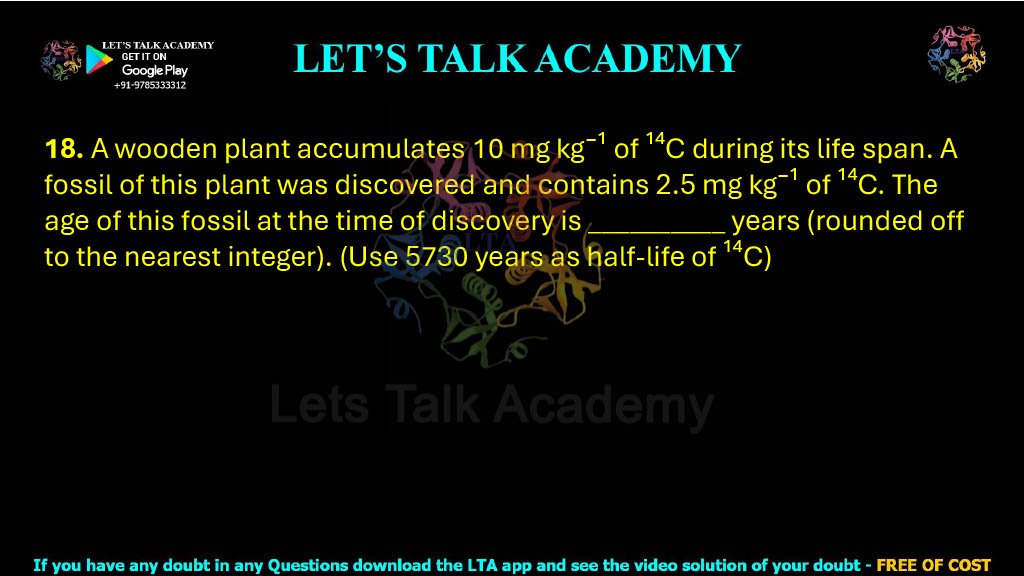
18. A wooden plant accumulates 10 mg kg⁻¹ of ¹⁴C during its life span. A fossil of this plant was discovered and contains 2.5 mg kg⁻¹ of ¹⁴C. The age of this fossil at the time of discovery is __________ years (rounded off to the nearest integer). (Use 5730 years as half-life of ¹⁴C)
How to Calculate Fossil Age Using Carbon-14 Half-Life: Complete Radiocarbon Dating Solution
Correct Answer: 11,460 years
The age of the fossil is 11,460 years. This answer can be calculated using the principle of radioactive decay and the half-life of Carbon-14. The original woody plant contained 10 mg kg⁻¹ of ¹⁴C during its lifetime, whereas the discovered fossil contains only 2.5 mg kg⁻¹. Since 2.5 mg kg⁻¹ is one-fourth of the original amount, exactly two half-lives have passed.
The half-life of ¹⁴C is given as 5730 years. Therefore, the age of the fossil is:
Age of fossil = 2 × 5730 = 11,460 years
Thus, the fossil was approximately 11,460 years old at the time of discovery.
Understanding the Given Information
To solve this Carbon-14 dating problem, we first need to identify the initial and remaining amounts of radioactive carbon.
The living woody plant accumulated:
Initial amount of ¹⁴C, N₀ = 10 mg kg⁻¹
The fossil contains:
Remaining amount of ¹⁴C, N = 2.5 mg kg⁻¹
The half-life of Carbon-14 is:
t₁/₂ = 5730 years
The objective is to determine how much time was required for the amount of ¹⁴C to decrease from 10 mg kg⁻¹ to 2.5 mg kg⁻¹.
What Is the Half-Life of Carbon-14?
The half-life of a radioactive isotope is the time required for half of the radioactive atoms present in a sample to decay.
For Carbon-14, the half-life is approximately 5730 years. This means that after every 5730 years, only half of the previous amount of ¹⁴C remains in the sample.
If a sample initially contains 10 mg kg⁻¹ of ¹⁴C, then after one half-life:
10 mg kg⁻¹ → 5 mg kg⁻¹
After another half-life:
5 mg kg⁻¹ → 2.5 mg kg⁻¹
The fossil contains exactly 2.5 mg kg⁻¹ of ¹⁴C. Therefore, the radioactive Carbon-14 has passed through exactly two half-lives.
Step-by-Step Calculation of Fossil Age
Step 1: Identify the Initial Amount of Carbon-14
The amount of ¹⁴C accumulated by the living plant was:
N₀ = 10 mg kg⁻¹
This represents the initial quantity of radioactive Carbon-14 before radioactive decay is considered.
Step 2: Calculate the Amount Remaining After One Half-Life
After one half-life, half of the original ¹⁴C remains.
Therefore:
10 ÷ 2 = 5 mg kg⁻¹
So, after 5730 years, the amount of Carbon-14 would decrease from:
10 mg kg⁻¹ → 5 mg kg⁻¹
However, the fossil contains only 2.5 mg kg⁻¹. Therefore, more than one half-life has passed.
Step 3: Calculate the Amount Remaining After Two Half-Lives
After another half-life, the remaining 5 mg kg⁻¹ is again reduced by half.
Therefore:
5 ÷ 2 = 2.5 mg kg⁻¹
Thus:
10 mg kg⁻¹ → 5 mg kg⁻¹ → 2.5 mg kg⁻¹
The first reduction represents one half-life, and the second reduction represents another half-life.
Therefore:
Number of half-lives elapsed = 2
Step 4: Calculate the Total Age of the Fossil
One half-life of Carbon-14 is 5730 years. Since two half-lives have passed:
Age of fossil = Number of half-lives × Half-life of ¹⁴C
Age of fossil = 2 × 5730
Age of fossil = 11,460 years
Therefore, the fossil is 11,460 years old.
Solving the Question Using the Radioactive Decay Formula
The same result can also be obtained using the standard radioactive decay relationship:
N = N₀(1/2)^(t/t₁/₂)
where N is the amount of radioactive isotope remaining, N₀ is the initial amount of radioactive isotope, t is the time elapsed, and t₁/₂ is the half-life.
Substituting the values given in the question:
2.5 = 10(1/2)^(t/5730)
Dividing both sides by 10:
2.5/10 = (1/2)^(t/5730)
Therefore:
0.25 = (1/2)^(t/5730)
Since:
0.25 = 1/4 = (1/2)²
we can write:
(1/2)² = (1/2)^(t/5730)
Since the bases are equal, their exponents must also be equal:
2 = t/5730
Therefore:
t = 2 × 5730
t = 11,460 years
This confirms the answer obtained using the direct half-life method.
Why Does One-Fourth of the Original Carbon-14 Mean Two Half-Lives?
The fossil contains 2.5 mg kg⁻¹ of ¹⁴C compared with the original 10 mg kg⁻¹. The fraction of Carbon-14 remaining is therefore:
Fraction remaining = 2.5/10 = 0.25
Since:
0.25 = 1/4
and:
1/4 = (1/2)²
the sample has undergone two successive half-life periods.
After one half-life, the remaining fraction is 1/2. After two half-lives, the remaining fraction is 1/4. After three half-lives, it would be 1/8.
Therefore, whenever exactly one-fourth of the original radioactive isotope remains, two half-lives have elapsed.
What Is Carbon-14 Dating?
Carbon-14 dating, also known as radiocarbon dating, is a method used to estimate the age of once-living materials. It is based on the radioactive decay of the isotope ¹⁴C.
While an organism is alive, carbon is continuously exchanged with the environment. As a result, the organism contains radioactive Carbon-14 along with stable forms of carbon. After the organism dies, this exchange stops, and the Carbon-14 already present in the tissues gradually decreases through radioactive decay.
Because the rate of decay is predictable and the half-life of ¹⁴C is known, scientists can estimate how much time has passed since the organism died by measuring the amount of Carbon-14 remaining.
Why Does Carbon-14 Decrease After the Death of a Plant?
A living plant continuously takes in carbon dioxide from the atmosphere during photosynthesis. This carbon includes a small amount of radioactive ¹⁴C. As long as the plant remains alive, it continues exchanging carbon with its environment.
After the plant dies, carbon uptake stops. No new Carbon-14 is incorporated into the tissues, but the existing radioactive ¹⁴C continues to decay.
As time passes, the amount of ¹⁴C decreases according to the laws of radioactive decay. Therefore, older biological remains generally contain less Carbon-14 than younger remains, provided the system has remained suitable for radiocarbon dating.
In this question, the decrease from 10 mg kg⁻¹ to 2.5 mg kg⁻¹ indicates that the original Carbon-14 content has been reduced to one-fourth.
Radioactive Decay of Carbon-14 Over Time
The decay sequence in this question can be represented as:
At the beginning: 10 mg kg⁻¹
After 5730 years: 5 mg kg⁻¹
After 11,460 years: 2.5 mg kg⁻¹
The measured amount in the fossil is 2.5 mg kg⁻¹. Therefore, the fossil corresponds to the second stage of the decay sequence, representing two complete half-lives.
This direct relationship makes the numerical calculation simple because the remaining amount is an exact fraction of the original amount.
Direct Half-Life Method vs Radioactive Decay Formula
For this particular question, the direct half-life method is the fastest approach because the Carbon-14 concentration decreases by exact halves:
10 → 5 → 2.5
The number of reductions is two, so the number of half-lives is also two.
However, the radioactive decay formula is more useful when the remaining amount is not an exact fraction such as one-half, one-fourth, or one-eighth of the original amount. In such cases, logarithms may be required to calculate the exact age.
Both methods are based on the same radioactive decay principle and produce the same answer.
Final Answer
The plant initially contained 10 mg kg⁻¹ of ¹⁴C, while the fossil contains 2.5 mg kg⁻¹.
The Carbon-14 concentration decreased as follows:
10 mg kg⁻¹ → 5 mg kg⁻¹ → 2.5 mg kg⁻¹
Therefore, exactly two half-lives have passed.
Since the half-life of ¹⁴C is 5730 years:
Age of fossil = 2 × 5730 = 11,460 years
Correct Answer: 11,460 years


