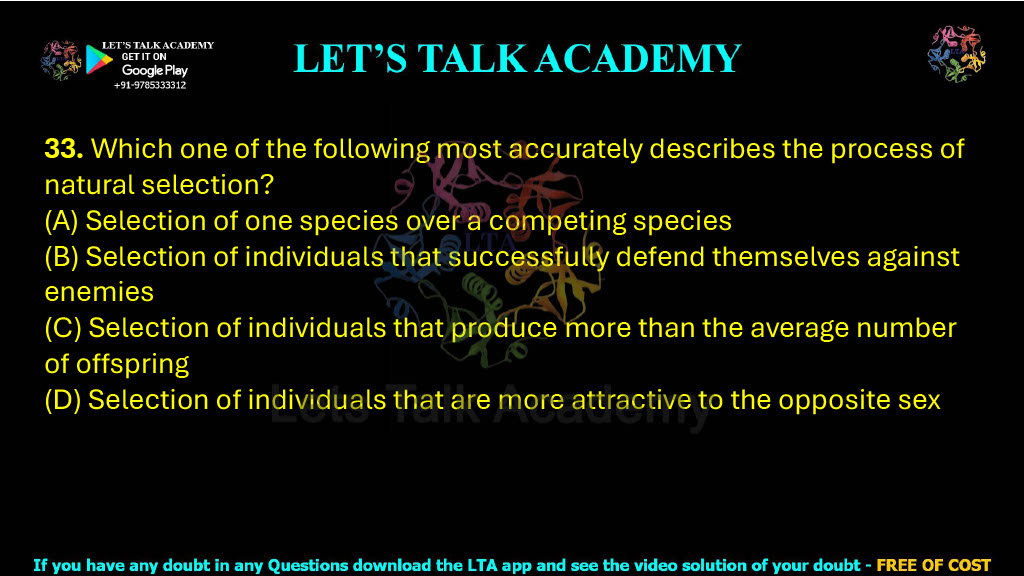
33. Which one of the following most accurately describes the process of natural selection?
(A) Selection of one species over a competing species
(B) Selection of individuals that successfully defend themselves against enemies
(C) Selection of individuals that produce more than the average number of offspring
(D) Selection of individuals that are more attractive to the opposite sex
Natural Selection Is the Selection of Individuals That Produce More Than the Average Number of Offspring
Detailed Explanation of the Correct Answer
The process of natural selection is most accurately described as the selection of individuals that produce more than the average number of offspring. Therefore, option (C) is the correct answer.
Natural selection is a fundamental mechanism of evolution. It occurs when individuals within a population differ in their heritable characteristics and these differences influence their reproductive success. Individuals possessing traits that increase their ability to survive and reproduce in a particular environment tend to contribute more offspring to the next generation.
The central point is that evolutionary success is measured by relative reproductive success. An individual does not contribute to evolution merely because it survives for a long time, defeats competitors, escapes predators, or attracts mates. These characteristics matter only when they ultimately result in the production of more surviving, reproducing offspring than other individuals in the population.
Therefore, natural selection favors individuals whose heritable traits allow them to leave a greater genetic contribution to future generations. Over many generations, the alleles associated with greater reproductive success may increase in frequency within the population.
What Is Natural Selection?
Natural selection is the process by which heritable characteristics that improve reproductive success become more common in a population over generations.
Individuals within a population are not identical. They differ in characteristics such as body size, physiology, behavior, disease resistance, ability to obtain food, tolerance to environmental stress, and reproductive performance. Some of these differences have a genetic basis and can be transmitted from parents to offspring.
If a heritable characteristic enables an individual to produce more surviving offspring than other members of the population, that characteristic is likely to become more common in future generations.
Thus, natural selection can be understood as differential reproductive success among individuals with different heritable traits.
The process acts on individuals, but the evolutionary outcome is observed as a change in the genetic composition of a population across generations.
Why Reproductive Success Is Central to Natural Selection
Natural Selection Depends on Differences in Reproduction
For natural selection to occur, individuals must differ in their contribution to the next generation. If every individual produced exactly the same number of surviving and reproducing offspring, no individual would have a selective advantage over another.
Suppose some individuals possess a heritable trait that allows them to produce more offspring than the population average. If their offspring inherit that beneficial trait, the associated genetic variants may become more common in subsequent generations.
Therefore, the most direct measure of success under natural selection is not simply survival but the number of genes successfully transmitted to future generations through offspring.
Survival Matters Because It Can Increase Reproduction
The phrase “survival of the fittest” is often associated with natural selection, but survival alone is not the complete explanation.
An individual may survive for many years but produce no offspring. From an evolutionary perspective, such an individual makes little or no direct genetic contribution to the next generation.
In contrast, another individual may have a shorter lifespan but produce many offspring that survive and reproduce. This individual can make a much larger contribution to future generations.
Therefore, survival is important mainly because it often provides opportunities for reproduction.
Offspring Must Contribute to Future Generations
The biological consequences of reproduction extend beyond simply producing a large number of young. The offspring must survive sufficiently well to continue the transmission of genes through the population.
For this reason, evolutionary fitness is associated with an individual’s contribution to future generations relative to other individuals.
A trait that increases the number of surviving and reproducing descendants can be favored by natural selection, even if that trait has certain costs.
What Is Biological Fitness?
In evolutionary biology, fitness refers to the relative reproductive success of an individual or genotype.
A biologically fit organism is not necessarily the strongest, fastest, largest, or longest-living organism. Fitness depends on how effectively an individual contributes its genes to subsequent generations compared with others in the same population.
For example, an individual that produces six surviving offspring may have greater fitness than another individual that produces only two, provided the difference is associated with heritable characteristics.
Fitness is therefore strongly connected with reproductive output and the successful transmission of genetic information.
This concept directly supports option (C), which focuses on individuals that produce more than the average number of offspring.
Conditions Required for Natural Selection
Variation Among Individuals
Individuals within a population must differ from one another. Without variation, natural selection has nothing on which to act.
Variation may occur in morphology, physiology, behavior, development, resistance to disease, or many other characteristics.
Heritability of Traits
At least some of the variation must be heritable. This means that differences among individuals must have a genetic component that can be transmitted from parents to offspring.
A characteristic produced entirely by environmental conditions and not inherited cannot directly cause evolutionary change through natural selection.
Differential Reproductive Success
Individuals with different heritable characteristics must differ in their reproductive contribution to the next generation.
Some individuals produce more surviving offspring than others. When this difference is associated with heritable traits, natural selection can occur.
Change Across Generations
If individuals with certain heritable traits consistently leave more offspring, the genetic variants associated with those traits may increase in frequency over generations.
This population-level change represents evolution by natural selection.
Option (A): Selection of One Species Over a Competing Species
Option (A), selection of one species over a competing species, is incorrect because it does not accurately describe the fundamental process of natural selection.
Competition between species can influence evolution and community structure. One species may outcompete another for food, space, light, or other limited resources. However, natural selection primarily operates through differences in reproductive success among individuals with different heritable characteristics.
The phrase “selection of one species over another” incorrectly suggests that nature directly chooses entire species as winners and losers.
Natural selection is not a conscious process and does not intentionally select one species over another. It results from consistent differences in survival and reproduction among individuals.
Therefore, option (A) is incorrect.
Option (B): Selection of Individuals That Successfully Defend Themselves Against Enemies
Option (B), selection of individuals that successfully defend themselves against enemies, describes only one possible factor that may influence natural selection.
Successful defense against predators, parasites, pathogens, or competitors can improve an individual’s chances of survival. Defensive adaptations such as camouflage, toxins, armor, warning coloration, and escape behavior may therefore be favored under certain environmental conditions.
However, successful defense is not the complete definition of natural selection.
An individual that survives every predator attack but produces no offspring does not make a direct genetic contribution to the next generation. Defensive ability becomes evolutionarily important only when it leads to greater reproductive success.
Therefore, option (B) is too narrow to describe the entire process of natural selection.
Hence, option (B) is incorrect.
Option (C): Selection of Individuals That Produce More Than the Average Number of Offspring
Option (C), selection of individuals that produce more than the average number of offspring, is the correct answer.
This statement directly describes the central principle of natural selection: differential reproductive success.
Individuals with heritable characteristics that enable them to contribute more offspring to the next generation have greater relative fitness. Their genetic variants are therefore more likely to increase in frequency over time.
The advantage may arise from better survival, improved ability to obtain food, resistance to disease, greater mating success, increased fertility, better parental care, or any other characteristic that ultimately increases reproductive contribution.
All these different pathways lead to the same evolutionary result: some individuals leave more descendants than others.
Therefore, option (C) most accurately describes natural selection.
Option (D): Selection of Individuals That Are More Attractive to the Opposite Sex
Option (D), selection of individuals that are more attractive to the opposite sex, describes a specific form of natural selection known as sexual selection.
Sexual selection occurs when individuals differ in their ability to obtain mates or achieve successful fertilization. Traits such as elaborate ornaments, courtship displays, songs, weapons, and competitive behaviors may evolve because they improve mating success.
For example, an individual that is more attractive to potential mates may obtain more mating opportunities and consequently produce more offspring.
However, attraction to the opposite sex represents only one possible pathway to greater reproductive success. Natural selection is a broader process that includes differences in survival, fertility, disease resistance, resource acquisition, parental care, and many other factors.
Therefore, option (D) describes only a special component of selection rather than the most complete definition of natural selection.
Hence, option (D) is incorrect.
Difference Between Natural Selection and Sexual Selection
Natural selection is the broad process through which heritable differences in reproductive success cause evolutionary change. Any characteristic that consistently increases an individual’s genetic contribution to future generations may be favored.
Sexual selection is a more specific process involving differences in mating success. It may occur through competition among individuals for access to mates or through mate choice.
Therefore, sexual selection can contribute to differential reproductive success, but it does not represent the entire process of natural selection.
This is why option (D) is less accurate than option (C).
Natural Selection Acts on Individuals but Populations Evolve
Natural selection acts through differences among individuals. Some individuals possess heritable traits that enable them to leave more offspring than others.
However, individual organisms do not genetically evolve during their lifetimes. Evolution is observed when allele frequencies or heritable characteristics change within a population over generations.
For example, if individuals carrying a particular heritable trait repeatedly produce more offspring, the genetic variants associated with that trait may become increasingly common in the population.
Thus, natural selection operates through individual differences, while evolutionary change occurs at the population level.
Natural Selection Is Not a Conscious Process
The word “selection” can sometimes create the incorrect impression that nature deliberately chooses particular organisms. Natural selection has no goal, intention, or conscious decision-making process.
Instead, it is the automatic consequence of interactions among heritable variation, environmental conditions, and differences in reproductive success.
Individuals with certain traits may leave more descendants under one set of environmental conditions, while different traits may be favored if the environment changes.
Therefore, natural selection is an ongoing ecological and evolutionary process rather than a deliberate choice.
Why Option (C) Is the Most Accurate Statement
Options (B) and (D) describe particular ways in which individuals might gain a reproductive advantage. Successful defense may increase survival, while attractiveness may increase mating success.
However, both mechanisms matter evolutionarily only if they ultimately increase the individual’s contribution of offspring to future generations.
Option (C) directly identifies this final evolutionary outcome: some individuals produce more offspring than the population average.
For this reason, option (C) is broader and more accurate than the other choices.
Final Answer
Natural selection is most accurately described as the selection of individuals that produce more than the average number of offspring because evolutionary fitness is determined by relative reproductive success.
Therefore, the correct answer is:
(C) Selection of individuals that produce more than the average number of offspring


