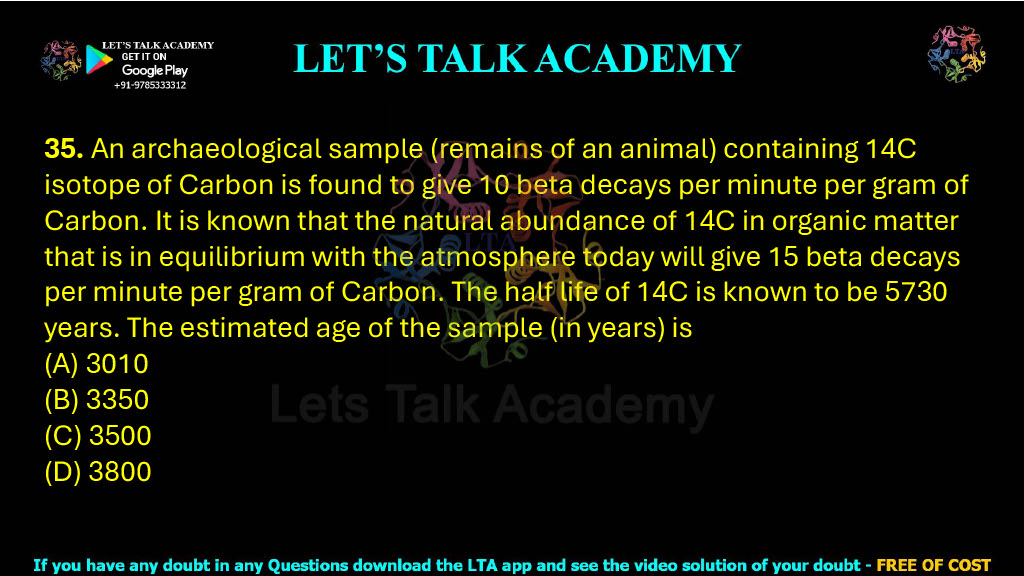
35. An archaeological sample (remains of an animal) containing 14C isotope of Carbon is found to give 10 beta decays per minute per gram of Carbon. It is known that the natural abundance of 14C in organic matter that is in equilibrium with the atmosphere today will give 15 beta decays per minute per gram of Carbon. The half life of 14C is known to be 5730 years. The estimated age of the sample (in years) is
(A) 3010
(B) 3350
(C) 3500
(D) 3800
Carbon-14 Dating Numerical: Calculate the Age of an Archaeological Sample
Understanding the Carbon-14 Dating Principle
Carbon-14 dating, also known as radiocarbon dating, is a widely used method for determining the age of archaeological remains and once-living materials. It is particularly useful for dating materials such as bones, wood, charcoal, plant remains, and other organic samples.
While an organism is alive, it continuously exchanges carbon with the environment. Because of this continuous exchange, the proportion of radioactive Carbon-14 (¹⁴C) in the organism remains approximately equal to the proportion present in the atmosphere. Therefore, living organic matter remains in equilibrium with atmospheric Carbon-14.
When the organism dies, this exchange of carbon stops. The Carbon-14 already present in the organism begins to decay radioactively. Since no new Carbon-14 is added after death, the amount of ¹⁴C gradually decreases with time. By comparing the present radioactive activity of the archaeological sample with the activity of modern living organic matter, the time elapsed since the organism died can be calculated.
In this question, modern organic matter gives 15 beta decays per minute per gram of Carbon, whereas the archaeological animal remains give only 10 beta decays per minute per gram of Carbon. The lower activity of the ancient sample indicates that some of its original Carbon-14 has decayed.
Data Given in the Question
The radioactive activity of modern organic matter is:
N₀ = 15 beta decays per minute per gram of Carbon
The present radioactive activity of the archaeological sample is:
N = 10 beta decays per minute per gram of Carbon
The half-life of Carbon-14 is:
t₁/₂ = 5730 years
The age of the archaeological sample is represented by t.
Radioactive Decay Formula Used in Carbon-14 Dating
Radioactive decay follows first-order kinetics. The relationship between the initial radioactive activity and the remaining radioactive activity after time t is:
N = N₀e⁻ˡᵃᵐᵇᵈᵃᵗ
where N₀ is the initial radioactive activity, N is the radioactive activity remaining after time t, λ is the radioactive decay constant, and t is the age of the sample.
The decay constant is related to the half-life by the equation:
λ = 0.693 / t₁/₂
Substituting the half-life of Carbon-14:
λ = 0.693 / 5730
Therefore:
λ ≈ 1.209 × 10⁻⁴ year⁻¹
Step-by-Step Calculation of the Age of the Archaeological Sample
The integrated form of the radioactive decay equation can be written as:
t = (1 / λ) ln(N₀ / N)
Substituting the given values:
t = (5730 / 0.693) ln(15 / 10)
The activity ratio is:
15 / 10 = 1.5
Therefore:
t = (5730 / 0.693) ln(1.5)
Since:
ln(1.5) ≈ 0.4055
we get:
t = (5730 / 0.693) × 0.4055
Now:
5730 / 0.693 ≈ 8268.4
Therefore:
t ≈ 8268.4 × 0.4055
t ≈ 3352.8 years
Thus, the estimated age of the archaeological sample is approximately:
t ≈ 3350 years
Therefore, the correct answer is Option (B) 3350 years.
Why Radioactive Activity Can Be Used to Calculate Age
The number of beta decays per minute is directly proportional to the number of radioactive Carbon-14 atoms present in the sample. A sample containing more ¹⁴C atoms shows greater radioactive activity, whereas an older sample containing fewer ¹⁴C atoms shows lower activity.
Therefore, the ratio of radioactive activities can be treated in the same way as the ratio of the numbers of radioactive atoms:
N / N₀ = Activity of ancient sample / Activity of modern sample
For this question:
N / N₀ = 10 / 15 = 2 / 3
This means that approximately two-thirds of the original Carbon-14 activity remains in the archaeological sample. Because this is more than one-half of the original activity, the sample must be younger than one half-life of Carbon-14, which is 5730 years. The calculated age of approximately 3350 years is therefore scientifically reasonable.
Detailed Explanation of Each Option
Option (A) 3010 Years
Option (A), 3010 years, is incorrect. If the age were 3010 years, the predicted remaining Carbon-14 activity would be higher than the observed value of 10 beta decays per minute per gram of Carbon.
Using the radioactive decay relationship, a sample of this age would retain more than two-thirds of its original Carbon-14 activity. However, the archaeological sample has decreased from 15 beta decays per minute per gram to 10 beta decays per minute per gram, corresponding exactly to an activity ratio of 2/3. Therefore, 3010 years does not satisfy the given radioactive decay data.
Option (B) 3350 Years
Option (B), 3350 years, is correct. Substituting the initial activity of 15 beta decays per minute per gram, the present activity of 10 beta decays per minute per gram, and the Carbon-14 half-life of 5730 years into the radioactive decay equation gives an age of approximately 3353 years.
Since the answer choices are given as approximate values, this calculated result corresponds most closely to 3350 years. Therefore, Option (B) is the correct answer.
Option (C) 3500 Years
Option (C), 3500 years, is incorrect. Although this value is relatively close to the calculated age, the radioactive decay equation gives approximately 3353 years, not 3500 years.
In numerical questions involving Carbon-14 dating, the answer should be selected according to the closest value obtained from the decay equation. Since 3350 years differs from the calculated value by only about 3 years, while 3500 years differs by nearly 147 years, Option (B) is clearly the more accurate answer.
Option (D) 3800 Years
Option (D), 3800 years, is incorrect because a sample of this age would have undergone more radioactive decay than the sample described in the question. Its remaining Carbon-14 activity would therefore be lower than 10 beta decays per minute per gram of Carbon.
The observed activity ratio of 10/15 = 2/3 corresponds to an age of approximately 3350 years. Therefore, an estimated age of 3800 years is too high for the measured radioactive activity.
Why Carbon-14 Is Useful for Dating Archaeological Samples
Carbon-14 is especially useful for dating once-living materials because it is naturally incorporated into organisms while they are alive. After death, the intake of Carbon-14 stops, but the radioactive isotope already present continues to decay at a predictable rate.
The half-life of Carbon-14 is approximately 5730 years, meaning that after 5730 years, only half of the original Carbon-14 remains. After another 5730 years, one-quarter remains, and this progressive decrease continues according to the exponential radioactive decay law.
Because the archaeological sample in this question retains two-thirds of its original radioactive activity, it has not yet completed one full half-life. The calculated age of approximately 3350 years is consistent with this observation.
Final Answer
Using the Carbon-14 radioactive decay equation:
t = (t₁/₂ / 0.693) ln(N₀ / N)
Substituting the values:
t = (5730 / 0.693) ln(15 / 10)
t ≈ 3353 years
Therefore, the estimated age of the archaeological sample is approximately 3350 years.
Correct Option: (B) 3350 years


