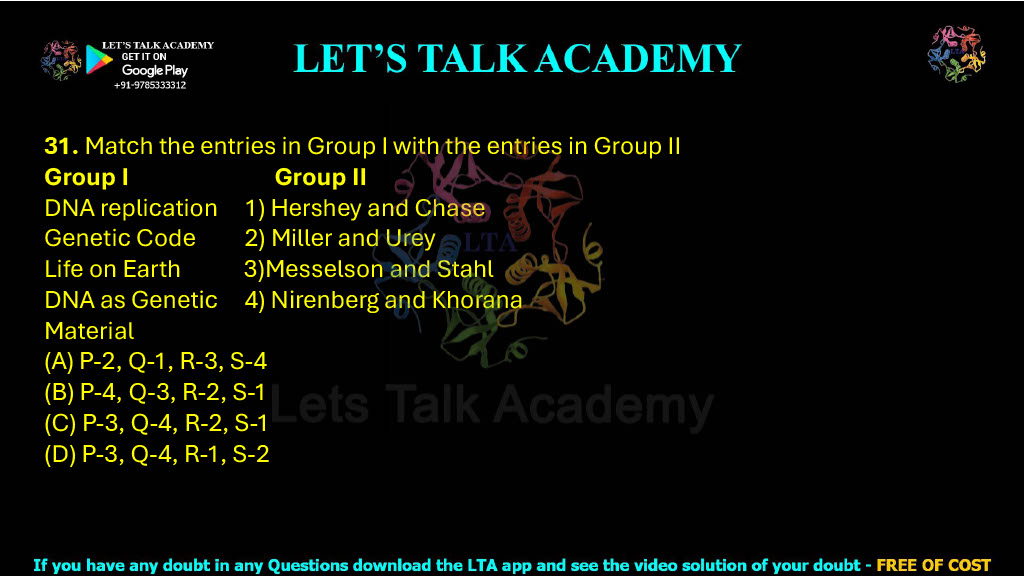
31. Match the entries in Group I with the entries in Group II
Group I Group II
DNA replication 1) Hershey and Chase
Genetic Code 2) Miller and Urey
Life on Earth 3)Messelson and Stahl
DNA as Genetic 4) Nirenberg and Khorana
Material
(A) P-2, Q-1, R-3, S-4
(B) P-4, Q-3, R-2, S-1
(C) P-3, Q-4, R-2, S-1
(D) P-3, Q-4, R-1, S-2
Match DNA Replication, Genetic Code, Life on Earth and DNA as Genetic Material with the Correct Scientists
Explanation of the Correct Answer
The correct answer is (C) P-3, Q-4, R-2, S-1. Each entry in Group I is associated with a landmark experiment or major scientific contribution made by the scientists listed in Group II.
DNA replication is matched with Meselson and Stahl, who experimentally demonstrated that DNA replication is semiconservative. The genetic code is matched with Nirenberg and Khorana, whose experiments were central to deciphering the relationship between nucleotide codons and amino acids. Life on Earth is matched with Miller and Urey, whose classic experiment demonstrated that organic molecules could form under simulated early Earth conditions. DNA as genetic material is matched with Hershey and Chase, whose bacteriophage experiment provided strong evidence that DNA, rather than protein, carries genetic information.
The complete matching is therefore:
P. DNA replication → 3. Meselson and Stahl
Q. Genetic Code → 4. Nirenberg and Khorana
R. Life on Earth → 2. Miller and Urey
S. DNA as Genetic Material → 1. Hershey and Chase
Therefore, the correct sequence is P-3, Q-4, R-2, S-1, which corresponds to option (C).
P. DNA Replication and the Meselson-Stahl Experiment
DNA replication is correctly matched with Meselson and Stahl. Their experiment provided convincing experimental evidence that DNA replication follows the semiconservative model.
Before their experiment, scientists proposed three major models to explain how a DNA molecule might be copied: conservative replication, semiconservative replication, and dispersive replication.
According to the conservative model, the original parental DNA molecule would remain completely intact, while an entirely new DNA molecule would be synthesized. According to the semiconservative model, each daughter DNA molecule would contain one parental strand and one newly synthesized strand. According to the dispersive model, parental and newly synthesized DNA would be mixed in segments throughout both strands.
Meselson and Stahl designed an elegant experiment that distinguished among these three possibilities and demonstrated that DNA replication is semiconservative.
How the Meselson-Stahl Experiment Was Performed
Meselson and Stahl grew Escherichia coli bacteria in a medium containing the heavy nitrogen isotope 15N. As the bacteria grew and replicated their DNA, the heavy nitrogen became incorporated into nitrogen-containing DNA bases.
After many generations, the bacterial DNA became uniformly labelled with 15N and was therefore denser than ordinary DNA containing the lighter isotope 14N.
The bacteria were then transferred to a medium containing 14N and allowed to divide. DNA samples were collected after successive generations and analysed by density-gradient centrifugation.
Result After One Generation
After one generation in the 14N medium, the DNA formed a single band of intermediate density. This result ruled out the conservative model.
If replication had been conservative, one heavy parental DNA band and one light newly synthesized DNA band would have appeared. Instead, all DNA molecules showed intermediate density.
The intermediate band was consistent with each DNA molecule containing one old heavy strand and one newly synthesized light strand.
Result After Two Generations
After two generations, two DNA bands were observed. One band had intermediate density, while the other had light density.
This result ruled out the dispersive model and supported semiconservative replication. The experiment therefore demonstrated that each daughter DNA molecule receives one parental strand and one newly synthesized strand.
Thus, DNA replication matches with Meselson and Stahl, giving P-3.
Q. Genetic Code and Nirenberg-Khorana
The genetic code is correctly matched with Nirenberg and Khorana. Their experimental work played a central role in determining how nucleotide sequences in messenger RNA specify amino acids during protein synthesis.
The genetic code is based on groups of three nucleotides called codons. Each codon specifies a particular amino acid or a translation signal.
Scientists needed to determine which codons corresponded to which amino acids. Experimental studies using synthetic RNA molecules and cell-free protein synthesis systems made this possible.
Nirenberg and the First Deciphered Codon
Marshall Nirenberg and his collaborators used a cell-free translation system containing the cellular components required for protein synthesis.
They added a synthetic RNA molecule composed entirely of uracil nucleotides, known as poly-U RNA. This RNA contained repeated UUU codons.
The system produced a polypeptide composed entirely of the amino acid phenylalanine. From this result, scientists concluded that:
UUU codes for phenylalanine.
This experiment represented a major breakthrough in deciphering the genetic code.
Khorana’s Contribution to Deciphering the Genetic Code
Har Gobind Khorana made major contributions by developing methods for synthesizing RNA molecules with known and repeating nucleotide sequences.
By analysing the polypeptides produced from these synthetic RNA templates, researchers could determine the amino acids specified by additional codons.
The combined work of Nirenberg, Khorana, and other researchers eventually led to the complete interpretation of the genetic code.
Thus, Genetic Code matches with Nirenberg and Khorana, giving Q-4.
R. Life on Earth and the Miller-Urey Experiment
Life on Earth is correctly matched with Miller and Urey. Their famous experiment investigated whether organic molecules important for life could form naturally under conditions proposed for the early Earth.
The origin of life is one of the major questions in biology. Scientists proposed that simple inorganic molecules present on early Earth could have reacted under suitable environmental conditions to produce organic compounds.
Stanley Miller, working with Harold Urey, experimentally tested this idea by constructing an apparatus that simulated certain proposed conditions of the primitive Earth.
Design of the Miller-Urey Experiment
The experimental apparatus contained water and a mixture of gases intended to represent a proposed early atmosphere. Water was heated to produce water vapour, and electrical sparks were used as an energy source analogous to lightning.
The gases and water vapour circulated through the closed system. A condenser cooled the vapour, allowing liquid containing reaction products to collect.
After the experiment had operated for a period of time, the collected material was analysed.
Importance of the Miller-Urey Experiment
The experiment produced organic compounds, including amino acids. Amino acids are the building blocks of proteins and are essential molecules in living organisms.
The experiment did not create life itself. Instead, it demonstrated that biologically important organic molecules could form from simpler substances under certain simulated prebiotic conditions.
This result provided experimental support for the concept of chemical evolution, in which increasingly complex organic molecules could arise before the origin of the first living systems.
Thus, Life on Earth matches with Miller and Urey, giving R-2.
S. DNA as Genetic Material and the Hershey-Chase Experiment
DNA as genetic material is correctly matched with Hershey and Chase. Their bacteriophage experiment provided strong evidence that DNA, rather than protein, carries the hereditary information required to produce new viruses.
At the time, scientists knew that chromosomes contained both DNA and proteins. Although earlier experiments had provided evidence for DNA as the genetic material, some researchers still considered proteins strong candidates because of their structural complexity.
Alfred Hershey and Martha Chase used bacteriophages to distinguish between the roles of viral DNA and viral protein during infection.
Why Bacteriophages Were Used
A bacteriophage is a virus that infects bacteria. The phages used in the experiment consisted primarily of DNA surrounded by a protein coat.
This simple structure made it possible to ask a direct question: which component enters the bacterial cell and directs the formation of new phages?
Radioactive Labelling of DNA and Protein
Hershey and Chase labelled phage DNA with radioactive phosphorus, 32P, because DNA contains phosphorus in its phosphate backbone.
They labelled phage protein with radioactive sulfur, 35S, because proteins can contain sulfur in amino acids such as cysteine and methionine, while DNA does not contain sulfur.
This differential labelling allowed the movement of DNA and protein to be followed separately during infection.
Results of the Hershey-Chase Experiment
After the labelled phages infected bacterial cells, the samples were agitated to remove viral coats from the cell surfaces and then centrifuged.
Most of the radioactive phosphorus associated with DNA was found with the bacterial cells, while most of the radioactive sulfur associated with protein remained outside the cells.
The DNA that entered the bacteria directed the production of new phage particles. This provided strong evidence that DNA is the genetic material.
Thus, DNA as Genetic Material matches with Hershey and Chase, giving S-1.
Complete Matching of Group I with Group II
The correct associations are:
P. DNA replication → 3. Meselson and Stahl
Q. Genetic Code → 4. Nirenberg and Khorana
R. Life on Earth → 2. Miller and Urey
S. DNA as Genetic Material → 1. Hershey and Chase
Therefore:
P-3, Q-4, R-2, S-1
This matching corresponds to option (C).
Detailed Explanation of Every Option
Option (A): P-2, Q-1, R-3, S-4 — Incorrect
This option incorrectly matches all four scientific contributions.
DNA replication is not associated with Miller and Urey. Their experiment concerned the prebiotic formation of organic molecules under simulated early Earth conditions.
The genetic code is not associated with Hershey and Chase. Their experiment investigated whether DNA or protein serves as genetic material in bacteriophages.
Life on Earth is not matched with Meselson and Stahl because their experiment demonstrated semiconservative DNA replication.
DNA as genetic material is not matched with Nirenberg and Khorana because their work focused on deciphering the genetic code.
Therefore, option (A) is incorrect.
Option (B): P-4, Q-3, R-2, S-1 — Incorrect
This option correctly matches Life on Earth with Miller and Urey and DNA as genetic material with Hershey and Chase. However, the first two associations are reversed.
DNA replication should be matched with Meselson and Stahl, not Nirenberg and Khorana. The Meselson-Stahl experiment demonstrated the semiconservative nature of DNA replication.
The genetic code should be matched with Nirenberg and Khorana, not Meselson and Stahl. Nirenberg and Khorana made fundamental contributions to determining the relationship between codons and amino acids.
Therefore, option (B) is incorrect.
Option (C): P-3, Q-4, R-2, S-1 — Correct
This option correctly matches every entry.
Meselson and Stahl demonstrated semiconservative DNA replication. Nirenberg and Khorana contributed to deciphering the genetic code. Miller and Urey studied the formation of organic molecules under simulated early Earth conditions. Hershey and Chase provided strong evidence that DNA is the genetic material.
Therefore, option (C) is correct.
Option (D): P-3, Q-4, R-1, S-2 — Incorrect
This option correctly matches DNA replication with Meselson and Stahl and the genetic code with Nirenberg and Khorana. However, the final two associations are incorrect.
Life on Earth should be matched with Miller and Urey, not Hershey and Chase. The Miller-Urey experiment investigated the abiotic formation of organic molecules relevant to the origin of life.
DNA as genetic material should be matched with Hershey and Chase, not Miller and Urey. The Hershey-Chase experiment used radioactive labelling of bacteriophage DNA and protein to identify DNA as the hereditary material.
Therefore, option (D) is incorrect.
Comparison of the Four Landmark Biological Experiments
Meselson and Stahl: Semiconservative DNA Replication
Meselson and Stahl used heavy and light nitrogen isotopes to track DNA molecules across generations. Their results demonstrated that each daughter DNA molecule contains one parental strand and one newly synthesized strand.
Nirenberg and Khorana: Deciphering the Genetic Code
Nirenberg and Khorana used synthetic RNA molecules and experimental translation systems to determine how nucleotide codons specify amino acids.
Miller and Urey: Chemical Evolution and Early Earth
Miller and Urey demonstrated that organic molecules could form from simpler substances under certain simulated early Earth conditions, supporting the possibility of prebiotic chemical evolution.
Hershey and Chase: DNA as Genetic Material
Hershey and Chase used radioactively labelled bacteriophages to show that viral DNA enters bacterial cells and directs the formation of new viruses, providing strong evidence that DNA carries genetic information.
Why These Experiments Are Important in Modern Biology
These four scientific contributions address fundamental questions about life and heredity.
The Meselson-Stahl experiment explained how genetic information is copied before cell division. The work of Nirenberg and Khorana revealed how the nucleotide language of nucleic acids is translated into the amino acid language of proteins.
The Miller-Urey experiment showed that organic molecules important for life can arise through non-biological chemical processes under suitable conditions. The Hershey-Chase experiment helped establish DNA as the molecule that carries hereditary information.
Together, these studies contributed to the modern understanding of molecular biology, genetics, evolution, and the origin of life.
Final Answer
DNA replication is associated with Meselson and Stahl, who demonstrated semiconservative replication. The genetic code is associated with Nirenberg and Khorana, whose experiments helped decipher codon assignments.
Life on Earth is associated with Miller and Urey, who demonstrated the abiotic formation of organic compounds under simulated early Earth conditions. DNA as genetic material is associated with Hershey and Chase, whose bacteriophage experiment showed that DNA enters bacterial cells and directs viral reproduction.
The correct matching is:
P-3, Q-4, R-2, S-1
Therefore, the correct answer is (C) P-3, Q-4, R-2, S-1.


