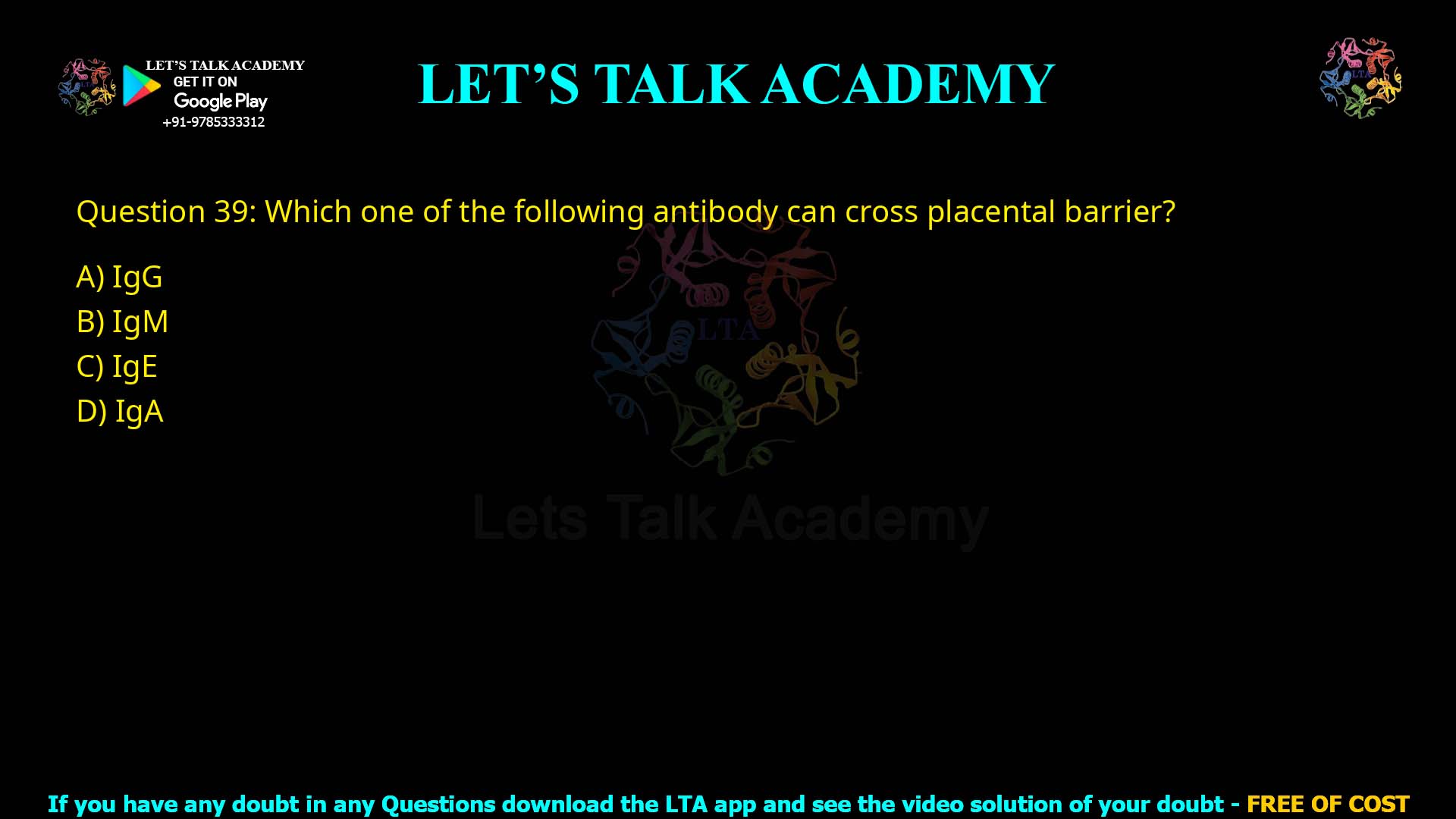
Q39.Which one of the following antibody can cross placental barrier?
(A) IgG
(B) IgM
(C) IgE
(D) IgA
The correct answer is (A) IgG.
IgG is the only antibody class that crosses the placental barrier via active transport mediated by the neonatal Fc receptor (FcRn) on syncytiotrophoblast cells, providing passive immunity to the fetus primarily in the third trimester.
Option Analysis
IgG (A)
IgG, the smallest and most abundant immunoglobulin (70-80% of serum antibodies), efficiently crosses the placenta. Its Fc region binds FcRn receptors, enabling receptor-mediated transcytosis from maternal to fetal circulation, protecting newborns against infections.
IgM (B)
IgM, the largest antibody (pentameric structure), cannot cross the placenta due to its high molecular weight (~900 kDa) and lack of FcRn binding affinity. It appears first in primary immune responses but stays maternal.
IgE (C)
IgE mediates allergic responses and parasite defense but does not cross the placenta effectively. Its structure prevents transport across the placental barrier.
IgA (D)
IgA, predominant in mucosal secretions (secretory IgA), does not cross the placenta. It protects external body surfaces but remains confined to maternal circulation.
Introduction to Placental Antibody Transfer
Which one of the following antibody can cross placental barrier? Only IgG transfers across placenta to deliver maternal antibodies to the fetus, crucial for neonatal immunity during early months when infant’s own response matures.
Mechanism of IgG Transport
IgG crosses via FcRn on syncytiotrophoblast, undergoing endocytosis, sorting in endosomes, and exocytosis into fetal blood. Transfer peaks in third trimester, with subclasses IgG1 and IgG3 most efficient.
Role in Passive Immunity
Maternal IgG protects against pathogens like tetanus, measles via placental transfer. Levels in newborns often exceed maternal, amplifying defense until 6 months.
Other Antibodies Limited
IgM’s size blocks passage; IgE focuses on allergies; IgA guards mucosae—none utilize FcRn for placental crossing.
| Antibody | Crosses Placenta? | Function | Size |
|---|---|---|---|
| IgG | Yes | Systemic immunity | 150 kDa |
| IgM | No | Primary response | 900 kDa |
| IgE | No | Allergies/parasites | 190 kDa |
| IgA | No | Mucosal defense | 160 kDa (dimer) |
Exam Relevance
This MCQ assesses immunology basics for NEET, CSIR—emphasizing IgG’s unique transport for fetal protection versus other isotypes’ confinement.


