
1. Introduction
RNA synthesis in eukaryotic cells is not complete when RNA polymerase II simply produces an RNA molecule. The newly synthesized RNA undergoes several processing events before it becomes a mature and functional RNA.
One of the earliest and most important processing events is 5′ capping.
5′ capping is the process by which a specialized modified guanine nucleotide is added to the 5′ end of a newly synthesized RNA molecule.
The resulting structure is known as the 5′ cap or RNA cap.
The cap is added very early during transcription, while the RNA molecule is still being synthesized by RNA polymerase II.
A simplified representation is:
DNA → RNA Polymerase II → Nascent RNA → 5′ Capping → Processed RNA
The 5′ cap is important for:
- protection of RNA from degradation,
- RNA processing,
- nuclear export,
- efficient translation,
- recognition by cellular proteins,
- regulation of RNA stability.
2. Definition of 5′ Capping
2.1 Basic Definition
5′ capping is a co-transcriptional RNA-processing reaction in which a modified guanosine nucleotide is attached to the 5′ end of a newly synthesized RNA transcript.
The most common cap in higher eukaryotic cells is called the 7-methylguanosine cap, abbreviated as m⁷G cap.
2.2 Nature of the Cap
The cap contains a guanosine nucleotide that is connected to the first nucleotide of the RNA through an unusual:
5′–5′ triphosphate linkage
This linkage is different from the normal:
3′–5′ phosphodiester linkage
found within the RNA chain.
3. Structure of the 5′ Cap

3.1 Basic Cap Structure
The simplest and most common cap is:
m⁷GpppN
where:
- m⁷G = 7-methylguanosine,
- ppp = triphosphate bridge,
- N = first nucleotide of the RNA.
The structure can be represented as:
m⁷G — 5′ppp— 5′N
The unusual 5′–5′ linkage is one of the defining features of the RNA cap.
3.2 7-Methylguanosine
The guanine nucleotide added to the RNA is methylated at the N7 position.
This produces:
7-methylguanosine (m⁷G)
The methyl group is essential for recognition of the cap by several cap-binding proteins.
4. Types of 5′ RNA Caps

Different eukaryotic RNA molecules can contain different cap structures.
4.1 Cap 0
The basic cap structure is called Cap 0.
Its general structure is:
m⁷GpppN
The ribose of the first transcribed nucleotide is not additionally methylated at its 2′-O position.
4.2 Cap 1
In Cap 1, the ribose of the first nucleotide is methylated at the 2′-O position.
The general arrangement can be represented as:
m⁷GpppNm
where the first nucleotide contains a 2′-O-methyl group.
4.3 Cap 2
In Cap 2, the first two nucleotides contain 2′-O methylation.
The general arrangement is:
m⁷GpppNmNm
Cap structures can therefore differ according to the extent of ribose methylation.
5. Timing of 5′ Capping

5.1 Co-Transcriptional Process
5′ capping occurs co-transcriptionally.
This means that capping begins while RNA polymerase II is still synthesizing the RNA.
It does not normally wait until the complete RNA molecule has been produced.
5.2 Requirement for Nascent RNA
Capping occurs when the nascent RNA reaches a sufficient length, typically when the 5′ end emerges from the RNA polymerase II transcription complex.
This allows the capping machinery to access the newly synthesized RNA.
6. Role of RNA Polymerase II CTD

The C-terminal domain (CTD) of RNA polymerase II plays an important role in coordinating transcription with RNA processing.
The CTD becomes phosphorylated during transcription.
These phosphorylation changes help recruit processing factors, including factors involved in 5′ capping.
Therefore:
RNA Polymerase II transcription
↓
CTD phosphorylation
↓
Recruitment of capping machinery
↓
5′ cap formation
This provides an important connection between transcription and RNA processing.
7. Enzymes Involved in 5′ Capping
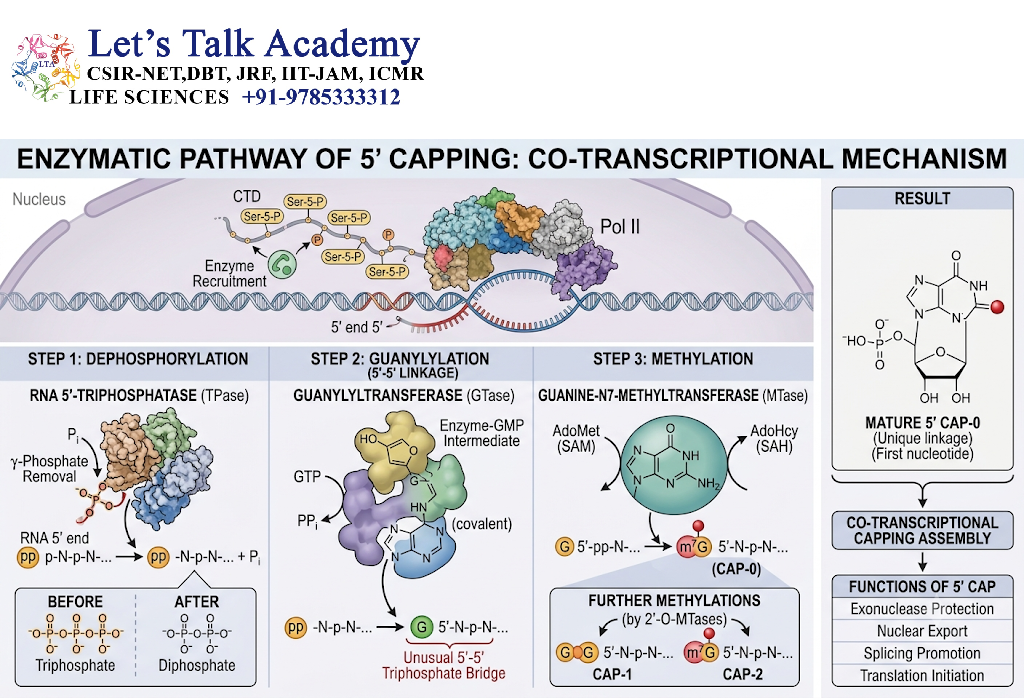
Three major enzymatic activities are involved in formation of the basic cap:
- RNA 5′-triphosphatase
- Guanylyltransferase
- Guanine-N7 methyltransferase
Additional enzymes can catalyze ribose 2′-O methylation to generate Cap 1 and Cap 2 structures.
8. RNA 5′-Triphosphatase

8.1 Function
The newly synthesized RNA initially contains a 5′ triphosphate end.
The RNA 5′-triphosphatase removes the terminal phosphate.
The reaction can be represented as:
pppN → ppN
Thus, the 5′ end changes from a triphosphate to a diphosphate state.
8.2 Importance
This reaction prepares the RNA end for attachment of the guanosine nucleotide.
9. Guanylyltransferase

9.1 Function
Guanylyltransferase adds a guanosine monophosphate to the 5′ end of the RNA.
The guanosine is attached through a:
5′–5′ triphosphate linkage
The reaction produces the basic cap structure:
GpppN
9.2 Importance
This unusual linkage protects the RNA and creates the structural foundation required for recognition by cap-binding proteins.
10. Guanine-N7 Methyltransferase

10.1 Function
The guanosine residue of the cap is methylated at its N7 position.
This converts:
GpppN
into:
m⁷GpppN
10.2 Methyl Donor
The methyl group is generally donated by:
S-adenosylmethionine (SAM)
SAM acts as an important methyl-group donor in many cellular methylation reactions.
11. Formation of Cap 1 and Cap 2

Additional methyltransferases can modify the ribose of the first and second transcribed nucleotides.
11.1 Cap 1 Formation
The ribose 2′-O position of the first nucleotide is methylated.
This produces a Cap 1 structure.
11.2 Cap 2 Formation
The ribose 2′-O position of the second nucleotide can also be methylated.
This produces a Cap 2 structure.
These additional modifications can influence RNA recognition and cellular function.
12. Complete Mechanism of 5′ Capping

The basic capping mechanism can be divided into several steps.
12.1 Step 1: RNA Synthesis Begins
RNA polymerase II initiates transcription.
The newly synthesized RNA initially has a:
5′-triphosphate end
represented as:
pppN
12.2 Step 2: Removal of Terminal Phosphate
RNA 5′-triphosphatase removes the terminal phosphate.
The end becomes:
ppN
12.3 Step 3: Addition of Guanosine
Guanylyltransferase adds GMP to the 5′ end.
A:
5′–5′ triphosphate linkage
is formed.
The intermediate becomes:
GpppN
12.4 Step 4: Methylation
Guanine-N7 methyltransferase transfers a methyl group to the N7 position of guanine.
The structure becomes:
m⁷GpppN
This is the basic Cap 0 structure.
12.5 Step 5: Additional Ribose Methylation
Further enzymes may methylate the 2′-O position of the first and second nucleotides.
This produces:
Cap 1
and
Cap 2
structures.
13. Overall Capping Pathway

The process can be summarized as:
Nascent RNA
↓
5′-pppN
↓
RNA 5′-triphosphatase
↓
5′-ppN
↓
Guanylyltransferase
↓
GpppN
↓
Guanine-N7 methyltransferase
↓
m⁷GpppN
↓
2′-O methylation
↓
Cap 1 / Cap 2
14. Importance of the 5′ Cap
The 5′ cap performs multiple functions.
Major functions include:
- Protection from degradation
- Promotion of RNA processing
- Nuclear export
- Translation initiation
- RNA stability
- Recognition by RNA-binding proteins
- Regulation of gene expression
- Coordination with transcription and splicing
15. Protection from RNA Degradation

15.1 Exonuclease Protection
The 5′ end of RNA is vulnerable to degradation by enzymes that degrade RNA from the end.
The cap provides structural protection against many forms of 5′-end degradation.
15.2 Increased RNA Stability
Capped RNA is generally more stable than an otherwise similar uncapped transcript.
Thus:
5′ cap → protection → increased RNA stability
16. Role of Cap-Binding Proteins
The cap is recognized by specialized proteins.
One major cap-binding complex in the nucleus is:
Cap-Binding Complex (CBC)
It recognizes the capped 5′ end of RNA and contributes to RNA processing and export.
In the cytoplasm, the cap is recognized by translation-initiation factors, especially:
eIF4E
17. Role in Translation Initiation
The 5′ cap is particularly important for efficient translation of eukaryotic mRNA.
17.1 Cap Recognition
The cap-binding protein eIF4E recognizes the m⁷G cap.
eIF4E is a component of the eukaryotic initiation factor 4F complex.
17.2 eIF4F Complex
The eIF4F complex includes:
- eIF4E,
- eIF4G,
- eIF4A.
eIF4E binds the cap, while eIF4G acts as a scaffold and eIF4A functions as an RNA helicase.
17.3 Ribosome Recruitment
Through interactions involving initiation factors, the capped mRNA is recruited into the translation-initiation machinery.
Therefore:
5′ cap → eIF4E recognition → initiation-factor recruitment → ribosome recruitment → translation
18. Cap and Poly(A) Tail Cooperation
The 5′ cap and 3′ poly(A) tail can work together to promote efficient translation.
Proteins associated with the poly(A) tail interact with translation-initiation factors.
This can help bring the 5′ and 3′ ends of the mRNA into functional proximity.
The resulting organization is often described as a closed-loop configuration.
This arrangement can promote:
- translation initiation,
- mRNA stability,
- efficient ribosome recycling.
19. Role in Nuclear RNA Processing
The 5′ cap is involved in several nuclear RNA-processing events.
It can influence:
- RNA splicing,
- RNA export,
- RNA surveillance,
- transcript maturation.
Cap-binding proteins help connect the newly synthesized RNA with these processing pathways.
20. Role in Splicing
The presence of a proper 5′ cap can enhance efficient processing of some introns, particularly early events in transcript maturation.
The cap-binding complex interacts with factors associated with the spliceosome and can influence recruitment or organization of splicing machinery.
Therefore, transcription and splicing are functionally coordinated.
21. Role in Nuclear Export
Mature RNA must be transported from the nucleus to the cytoplasm before it can be translated.
Cap-binding proteins contribute to recognition and processing of properly capped RNA.
The cap therefore forms part of the quality-control pathway that helps distinguish appropriately processed transcripts.
22. RNA Quality Control
Cells have surveillance mechanisms that identify improperly processed RNA.
A defective or improperly capped transcript may be:
- retained in the nucleus,
- degraded,
- prevented from efficient translation.
Thus, capping contributes to RNA quality control.
23. Capping and RNA Stability
The cap influences RNA stability through interactions with cap-binding proteins and RNA degradation pathways.
When the cap is removed, the RNA becomes more susceptible to degradation by 5′-to-3′ exonucleases.
A simplified pathway is:
Capped mRNA → relatively protected
Decapped mRNA → degradation
24. Decapping
24.1 Definition
Decapping is the enzymatic removal of the 5′ cap from an RNA molecule.
24.2 Consequence
Once the cap is removed, the RNA becomes susceptible to degradation.
The general pathway is:
mRNA
↓
Decapping
↓
5′ end exposed
↓
5′ → 3′ exonuclease activity
↓
RNA degradation
Decapping is therefore an important component of controlled mRNA turnover.
25. Regulation of mRNA Lifespan
The cap contributes to determining how long an mRNA remains available for translation.
An mRNA can undergo:
Translation → storage → decapping → degradation
The balance between cap protection and decapping helps regulate gene expression at the post-transcriptional level.
26. Cap-Dependent and Cap-Independent Translation
26.1 Cap-Dependent Translation
Most cellular eukaryotic mRNAs are efficiently translated through cap-dependent initiation.
The cap is recognized by initiation factors, especially eIF4E.
26.2 Cap-Independent Translation
Some RNAs can initiate translation through mechanisms that do not require conventional cap recognition.
A well-known mechanism involves:
Internal Ribosome Entry Sites (IRESs)
These allow translation initiation through internal RNA elements under particular conditions.
27. Capping and Viral RNA
Many viruses that replicate in eukaryotic cells produce RNAs that interact with host translation machinery.
Some viruses:
- synthesize their own cap structures,
- modify host RNA,
- use cap-independent translation,
- manipulate host capping or decapping pathways.
This illustrates the importance of RNA caps in cellular translation and host-pathogen interactions.
28. Capping and Innate Immune Recognition
RNA cap structures can influence how cellular RNA is distinguished from certain foreign RNA molecules.
Properly capped cellular RNA is generally handled differently by innate immune surveillance systems than many abnormal or uncapped RNA species.
Cap structure and 2′-O methylation can therefore contribute to self versus non-self RNA discrimination.
29. Capping and Gene Expression
Capping contributes to gene expression at multiple levels.
It influences:
- RNA stability,
- RNA processing,
- nuclear export,
- translation,
- RNA degradation.
Thus, capping is not simply a protective modification; it is an important regulatory component of gene expression.
30. Capping and Transcription
Capping is closely connected with RNA polymerase II transcription.
As transcription proceeds, the phosphorylation state of the RNA polymerase II CTD changes.
These changes help recruit RNA-processing machinery.
Therefore:
Transcription → CTD modification → capping machinery recruitment → RNA capping
This coordination ensures that RNA processing begins at the appropriate stage of transcript synthesis.
31. Capping and Alternative Splicing
The 5′ cap and associated proteins can influence spliceosome recruitment and RNA-processing pathways.
Because transcription, capping, and splicing occur in a coordinated nuclear environment, changes in transcriptional kinetics and RNA-processing factor recruitment can influence the final RNA product.
32. Enzymatic Activities Involved in Capping
| Enzymatic activity | Major function |
|---|---|
| RNA 5′-triphosphatase | Removes terminal phosphate |
| Guanylyltransferase | Adds GMP to RNA |
| Guanine-N7 methyltransferase | Methylates guanine at N7 |
| 2′-O-methyltransferase | Methylates ribose of early nucleotides |
33. Cap 0, Cap 1 and Cap 2 Comparison
| Feature | Cap 0 | Cap 1 | Cap 2 |
|---|---|---|---|
| m⁷G cap | Present | Present | Present |
| 1st nucleotide 2′-O methylation | Absent | Present | Present |
| 2nd nucleotide 2′-O methylation | Absent | Absent | Present |
| Basic function | Protection and recognition | Additional processing/recognition functions | Additional modification and recognition functions |
34. Difference Between 5′ Capping and Polyadenylation
| Feature | 5′ Capping | Polyadenylation |
|---|---|---|
| Location | 5′ end | 3′ end |
| Major modification | m⁷G cap | Poly(A) tail |
| Timing | Early and co-transcriptional | Usually near transcription termination |
| Major role | Stability, processing, translation initiation | Stability, export, translation regulation |
| Major recognition factors | CBC, eIF4E | Poly(A)-binding proteins |
| Main substrate | Nascent RNA | Processed 3′ end |
35. Difference Between Capping and Splicing
| Feature | Capping | Splicing |
|---|---|---|
| Main event | Addition of 5′ cap | Removal of introns |
| Location | 5′ RNA end | Internal RNA regions |
| Major machinery | Capping enzymes | Spliceosome |
| Timing | Very early during transcription | Often co-transcriptional and/or post-transcriptional |
| Main function | Protection and RNA maturation | Formation of mature RNA sequence |
36. Molecular Significance of the 5′–5′ Linkage
The 5′–5′ triphosphate linkage is unusual because normal RNA nucleotides within the chain are connected through 3′–5′ phosphodiester bonds.
The unusual cap linkage:
- contributes to protection,
- creates a recognizable molecular structure,
- allows specific cap-binding proteins to recognize the RNA.
This unique chemical structure is central to cap function.
37. Capping as a Quality-Control Signal
A correctly capped RNA is more likely to be recognized as a properly processed transcript.
Cap-binding proteins can participate in pathways that monitor RNA maturation.
Therefore, the cap can function as both:
a protective structure
and
a molecular processing signal.
38. Capping and RNA Export
Before an mRNA can reach the cytoplasm, it must pass through nuclear quality-control and export pathways.
The cap-binding complex interacts with proteins involved in these pathways.
This helps ensure that appropriately processed RNA is efficiently exported.
39. Capping and mRNA Degradation Pathways
mRNA degradation is carefully regulated.
One major route involves:
Deadenylation
↓
Decapping
↓
5′ → 3′ RNA degradation
Thus, decapping often represents an important commitment step toward rapid RNA degradation.
40. Biological Importance
5′ capping is essential for efficient expression of many eukaryotic protein-coding genes.
Its major biological functions include:
40.1 RNA Protection
Protects the 5′ end against degradation.
40.2 RNA Processing
Supports efficient maturation of newly synthesized transcripts.
40.3 Nuclear Export
Contributes to recognition and export of mature RNA.
40.4 Translation
Promotes efficient translation initiation.
40.5 RNA Stability
Helps determine the lifespan of mRNA.
40.6 RNA Quality Control
Contributes to recognition of properly processed transcripts.
40.7 Gene Regulation
Influences post-transcriptional control of gene expression.


