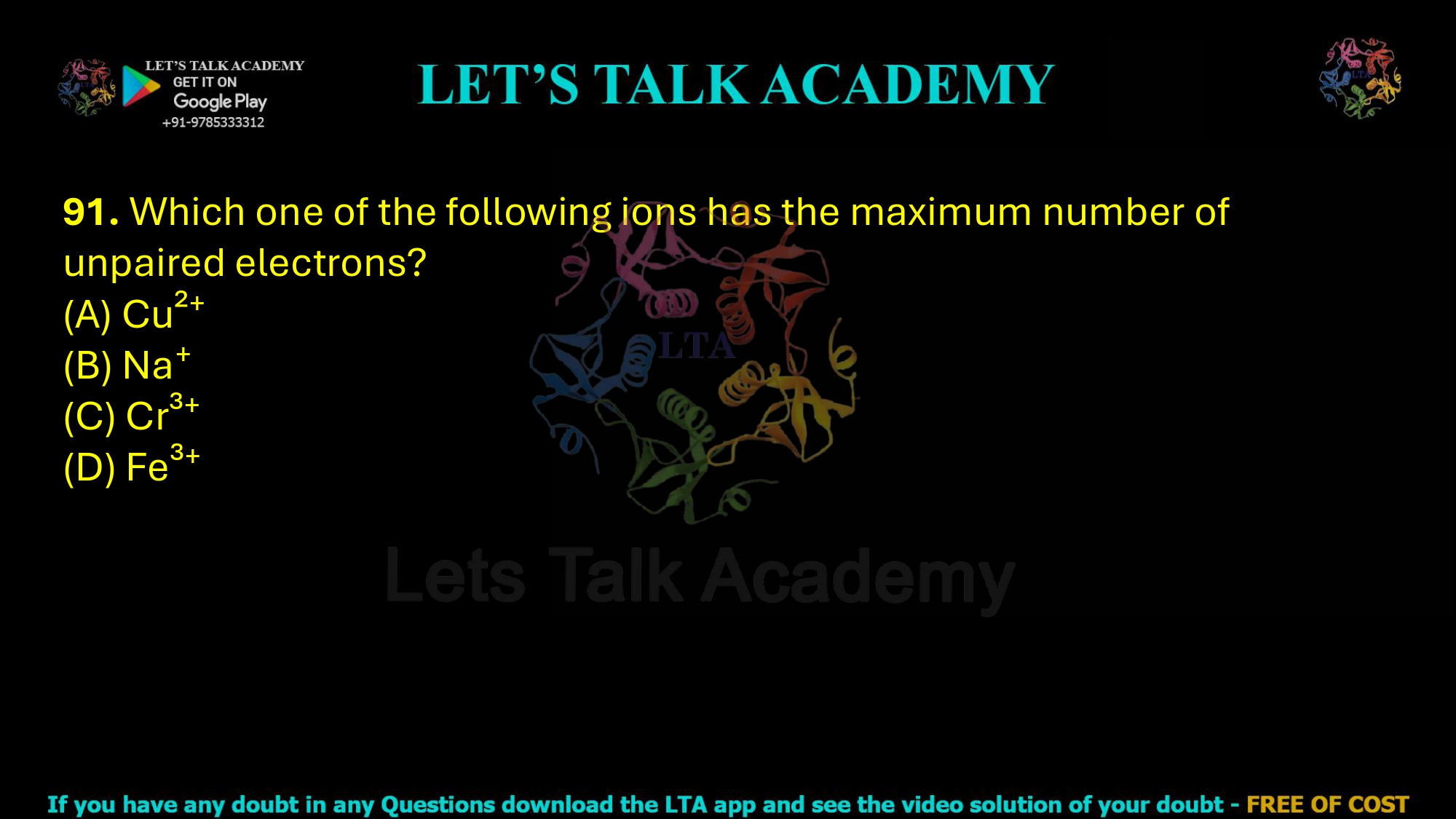
91. Which one of the following ions has the maximum number of unpaired electrons?
(A) Cu²⁺
(B) Na⁺
(C) Cr³⁺
(D) Fe³⁺
Which Ion Has the Maximum Number of Unpaired Electrons? Complete Electronic Configuration
Although identifying the number of unpaired electrons may appear straightforward, many students make mistakes while writing the electronic configuration of transition metal ions. The most common error is removing electrons from the 3d orbital before the 4s orbital. In reality, during ion formation, electrons are removed first from the 4s orbital and only then from the 3d orbitals. A proper understanding of this principle allows students to solve such questions quickly and accurately.
In this question, four different ions are given. Our objective is to determine which ion contains the maximum number of unpaired electrons.
Concept Required to Solve the Question
To determine the number of unpaired electrons, we must first write the electronic configuration of the neutral atom. Next, electrons are removed according to the ionic charge. Finally, Hund’s rule is applied to determine how many electrons remain unpaired.
Hund’s rule states that electrons occupy degenerate orbitals singly before pairing begins. Therefore, the arrangement of electrons in the d orbitals directly determines the magnetic behavior of the ion.
Step-by-Step Analysis of Every Ion
Option (A): Cu2+
The atomic number of copper is 29.
The electronic configuration of neutral copper is
Cu = [Ar] 3d10 4s1
While forming Cu2+, electrons are removed first from the 4s orbital and then from the 3d orbital.
Therefore,
Cu2+ = [Ar] 3d9
A d9 configuration contains only one unpaired electron.
Hence, Cu2+ has 1 unpaired electron.
Option (B): Na+
The atomic number of sodium is 11.
The electronic configuration of sodium is
Na = 1s2 2s2 2p6 3s1
After losing one electron,
Na+ = 1s2 2s2 2p6
This is the electronic configuration of neon, in which every orbital is completely filled.
Therefore, Na+ has 0 unpaired electrons.
Option (C): Cr3+
The atomic number of chromium is 24.
The ground-state electronic configuration is
Cr = [Ar] 3d5 4s1
Formation of Cr3+ involves removal of one electron from the 4s orbital and two electrons from the 3d orbitals.
Therefore,
Cr3+ = [Ar] 3d3
A d3 configuration has three electrons occupying three different d orbitals.
Hence, Cr3+ contains 3 unpaired electrons.
Option (D): Fe3+
The atomic number of iron is 26.
The electronic configuration of neutral iron is
Fe = [Ar] 3d6 4s2
When Fe forms Fe3+, two electrons are removed from the 4s orbital and one electron from the 3d orbital.
Thus,
Fe3+ = [Ar] 3d5
A d5 configuration is one of the most stable electronic arrangements because each of the five d orbitals contains exactly one electron.
According to Hund’s rule, all five electrons remain unpaired.
Therefore, Fe3+ possesses 5 unpaired electrons.
Comparison of the Number of Unpaired Electrons
| Ion | Electronic Configuration | Number of Unpaired Electrons |
|---|---|---|
| Cu2+ | 3d9 | 1 |
| Na+ | Ne configuration | 0 |
| Cr3+ | 3d3 | 3 |
| Fe3+ | 3d5 | 5 |
Clearly, Fe3+ contains the greatest number of unpaired electrons.
Explanation of Every Option
Option (A): Cu2+
This option is incorrect because the d9 configuration contains only one unpaired electron. Most of the d orbitals already contain paired electrons.
Option (B): Na+
This option is incorrect because sodium ion has the completely filled noble gas configuration of neon. Every electron is paired, making the ion diamagnetic.
Option (C): Cr3+
This option is incorrect because although Cr3+ possesses three unpaired electrons, this number is smaller than that of Fe3+.
Option (D): Fe3+
This is the correct answer. The d5 electronic configuration places one electron in each of the five d orbitals according to Hund’s rule, producing five unpaired electrons and maximum spin multiplicity.
Why the d5 Configuration is Especially Stable
The half-filled d5 configuration possesses exceptional stability because the electrons occupy all five d orbitals individually with parallel spins. This arrangement minimizes electron-electron repulsion and provides maximum exchange energy. As a result, Fe3+, Mn2+, and similar d5 ions exhibit remarkable stability and strong paramagnetic behavior.
Relationship Between Unpaired Electrons and Magnetism
The magnetic behavior of an ion depends directly on the number of unpaired electrons present. Species with no unpaired electrons are diamagnetic, whereas species containing one or more unpaired electrons are paramagnetic.
Because Fe3+ contains five unpaired electrons, it exhibits strong paramagnetism and has one of the highest spin-only magnetic moments among the first-row transition metal ions.
Final Answer
Correct Option: (D)
Fe3+ has the maximum number of unpaired electrons (5).


