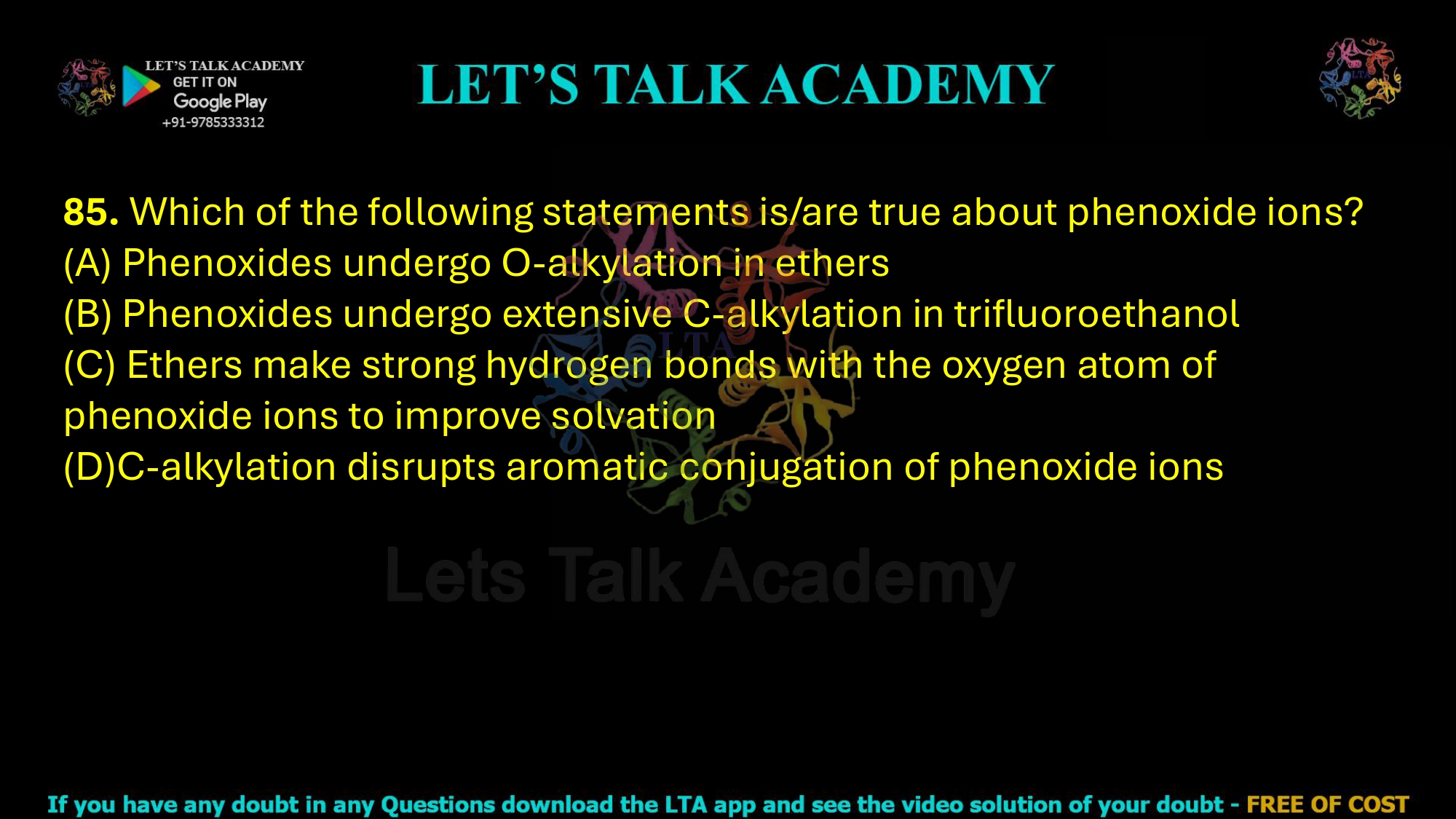
85. Which of the following statements is/are true about phenoxide ions?
(A) Phenoxides undergo O-alkylation in ethers
(B) Phenoxides undergo extensive C-alkylation in trifluoroethanol
(C) Ethers make strong hydrogen bonds with the oxygen atom of phenoxide ions to improve solvation
(D)C-alkylation disrupts aromatic conjugation of phenoxide ions
True Statements About Phenoxide Ions
Correct Answer
Answer: (A) and (B)
Understanding the Chemistry of Phenoxide Ions
The phenoxide ion (C₆H₅O⁻) is an ambident nucleophile because the negative charge is delocalized over the oxygen atom and the ortho and para carbon atoms of the aromatic ring through resonance. As a result, it can react through either the oxygen atom to give O-alkylation products or through the aromatic carbon atoms to give C-alkylation products.
The product distribution depends strongly on the reaction medium. Solvent polarity, hydrogen-bonding ability, and the degree of solvation of the oxygen atom determine whether oxygen or carbon behaves as the more reactive nucleophilic site.
Role of Solvent in O- and C-Alkylation
In aprotic solvents such as ethers, the oxygen atom of the phenoxide ion is only weakly solvated. Because the oxygen remains highly nucleophilic, alkylation occurs predominantly at oxygen, producing aryl ethers through the Williamson ether synthesis pathway.
In contrast, trifluoroethanol is a highly hydrogen-bond donating solvent. It strongly solvates the negatively charged oxygen atom of the phenoxide ion, reducing its nucleophilicity. As the oxygen becomes less reactive, the resonance-related carbon centers become relatively more competitive, leading to extensive C-alkylation.
Option-wise Explanation
Option (A): Phenoxides undergo O-alkylation in ethers
This statement is correct. Ether solvents are aprotic and do not strongly hydrogen bond with the phenoxide oxygen. Consequently, the oxygen atom retains high nucleophilicity and preferentially attacks alkyl halides to form ethers. This is the basis of the Williamson ether synthesis.
Option (B): Phenoxides undergo extensive C-alkylation in trifluoroethanol
This statement is correct. Trifluoroethanol is a strongly hydrogen-bond donating solvent. It preferentially solvates the oxygen atom, decreasing its nucleophilicity and making carbon attack comparatively more favorable. Therefore, C-alkylation becomes much more significant in this solvent.
Option (C): Ethers make strong hydrogen bonds with the oxygen atom of phenoxide ions to improve solvation
This statement is incorrect. Ether molecules are poor hydrogen-bond donors because they do not possess an O–H bond. Although ethers can accept hydrogen bonds, they cannot strongly hydrogen bond to the negatively charged oxygen atom of phenoxide. Therefore, they do not provide strong solvation through hydrogen bonding.
Option (D): C-alkylation disrupts aromatic conjugation of phenoxide ions
This statement is incorrect. During C-alkylation, the aromatic benzene ring remains aromatic. Although the resonance distribution of the phenoxide ion changes after substitution, aromatic conjugation is not destroyed. The benzene ring continues to satisfy aromaticity with six π electrons.
Why the Correct Answer Is (A) and (B)
The selectivity between O-alkylation and C-alkylation depends mainly on solvent effects. Weakly solvating aprotic solvents such as ethers favor oxygen attack because the oxygen atom remains highly nucleophilic. Strong hydrogen-bond donating solvents such as trifluoroethanol selectively solvate the oxygen atom, reducing its nucleophilicity and promoting carbon alkylation. Statements (C) and (D) are inconsistent with the properties of ether solvents and the concept of aromaticity.
Final Answer
The true statements are:
(A) and (B)


