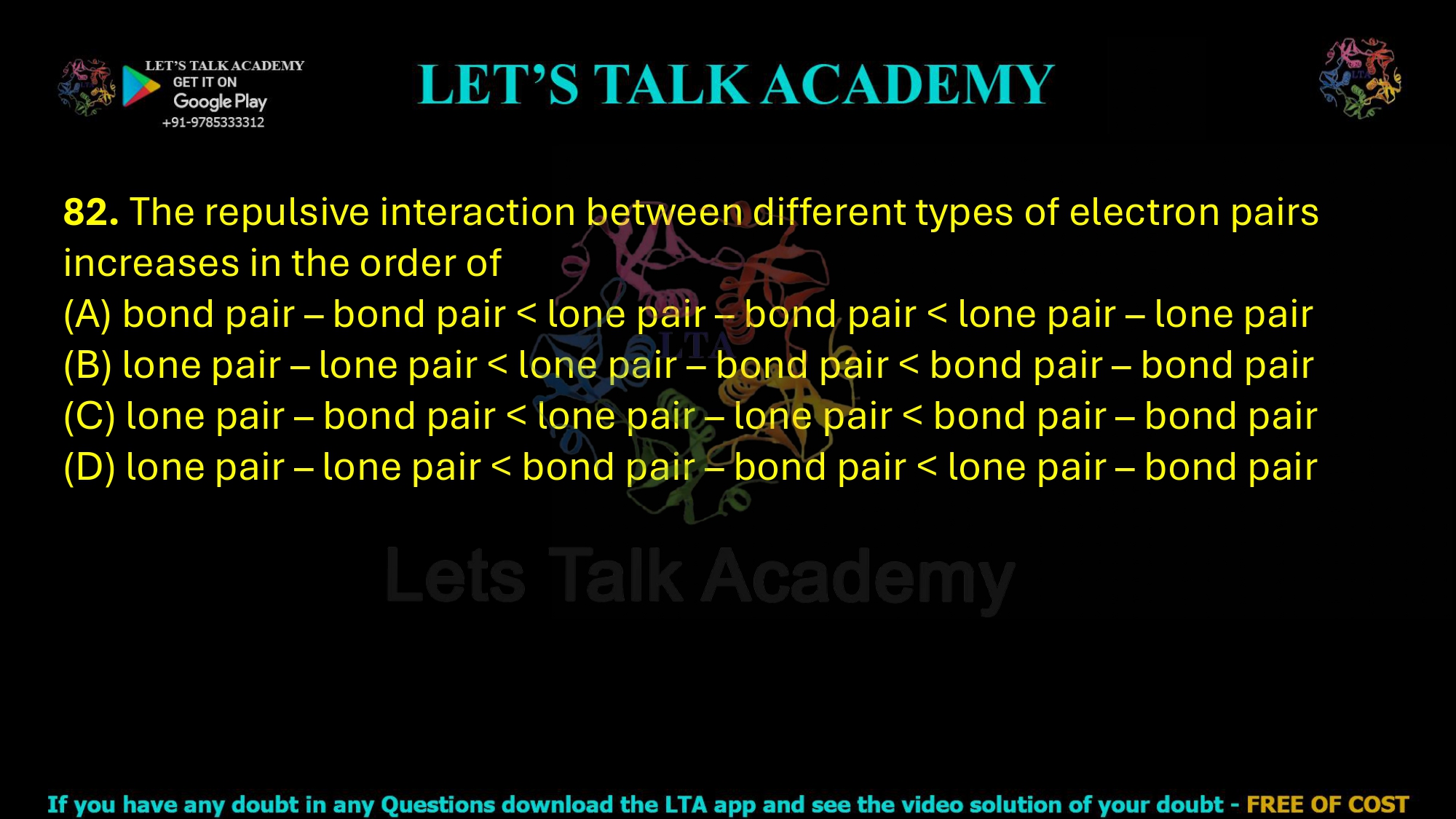
82. The repulsive interaction between different types of electron pairs increases in the order of
(A) bond pair – bond pair < lone pair – bond pair < lone pair – lone pair
(B) lone pair – lone pair < lone pair – bond pair < bond pair – bond pair
(C) lone pair – bond pair < lone pair – lone pair < bond pair – bond pair
(D) lone pair – lone pair < bond pair – bond pair < lone pair – bond pair
Order of Repulsive Interactions Between Electron Pairs According to VSEPR Theory
Correct Answer
✅ Correct Option: (A)
Understanding VSEPR Theory
According to the Valence Shell Electron Pair Repulsion (VSEPR) Theory, electron pairs surrounding a central atom repel one another because they possess negative charge. The arrangement of these electron pairs in space is such that the overall repulsive forces are minimized, resulting in the most stable molecular geometry.
Electron pairs can exist as either bond pairs, which are shared between two atoms, or lone pairs, which are localized entirely on the central atom. Since lone pairs occupy more space around the central atom than bonding pairs, they exert stronger repulsive forces.
Why Lone Pairs Repel More Strongly
A bonding pair of electrons is attracted simultaneously by two nuclei. As a result, its electron density is confined between the bonded atoms, reducing the space it occupies around the central atom.
In contrast, a lone pair is influenced by only one nucleus. Because it is not shared with another atom, its electron cloud spreads over a larger region of space. This greater spatial distribution causes lone pairs to exert stronger repulsive forces than bonding pairs.
Therefore, whenever a lone pair is involved in an interaction, the repulsion increases.
Order of Electron Pair Repulsions
The increasing order of repulsive interactions is:
Bond Pair–Bond Pair < Lone Pair–Bond Pair < Lone Pair–Lone Pair
This order is universally applicable in VSEPR theory and explains why molecules containing lone pairs often exhibit bond angles smaller than the ideal values predicted for perfect geometries.
Effect on Molecular Geometry
The stronger repulsion exerted by lone pairs compresses the bond angles between bonding pairs. For example, methane (CH₄), which contains only bonding pairs, has the ideal tetrahedral bond angle of 109.5°. Ammonia (NH₃), containing one lone pair, has a bond angle of approximately 107°. Water (H₂O), with two lone pairs, has an even smaller bond angle of about 104.5°. These observations provide direct experimental evidence that lone pair repulsions are stronger than bond pair repulsions.
Explanation of Each Option
Option (A): Bond Pair–Bond Pair < Lone Pair–Bond Pair < Lone Pair–Lone Pair
This option is correct. Bonding electron pairs occupy the least space and therefore repel each other the least. Interactions involving one lone pair are stronger because the lone pair occupies more space. The strongest repulsion occurs between two lone pairs since both electron clouds are highly diffuse and localized around the same atom.
Option (B): Lone Pair–Lone Pair < Lone Pair–Bond Pair < Bond Pair–Bond Pair
This option is incorrect because it reverses the actual order of repulsion. Lone pair–lone pair interactions are the strongest, not the weakest.
Option (C): Lone Pair–Bond Pair < Lone Pair–Lone Pair < Bond Pair–Bond Pair
This option is incorrect because bond pair–bond pair interactions are the weakest among all electron pair repulsions, not the strongest.
Option (D): Lone Pair–Lone Pair < Bond Pair–Bond Pair < Lone Pair–Bond Pair
This option is also incorrect because it incorrectly places lone pair–lone pair interactions as the weakest. According to VSEPR theory, these interactions are actually the strongest.
Concept Behind the Question
This question evaluates the understanding of electron pair repulsion and its influence on molecular shape. Students should remember that the extent of repulsion depends on how much space the electron pairs occupy around the central atom. Lone pairs are more diffuse because they are localized on a single atom, whereas bonding pairs are shared between two atoms and occupy less space. As a result, lone pairs exert greater repulsive forces than bonding pairs.
Final Answer
According to VSEPR theory, the strength of electron pair repulsions increases in the following order:
Bond Pair–Bond Pair < Lone Pair–Bond Pair < Lone Pair–Lone Pair
✅ Correct Answer: Option (A)


