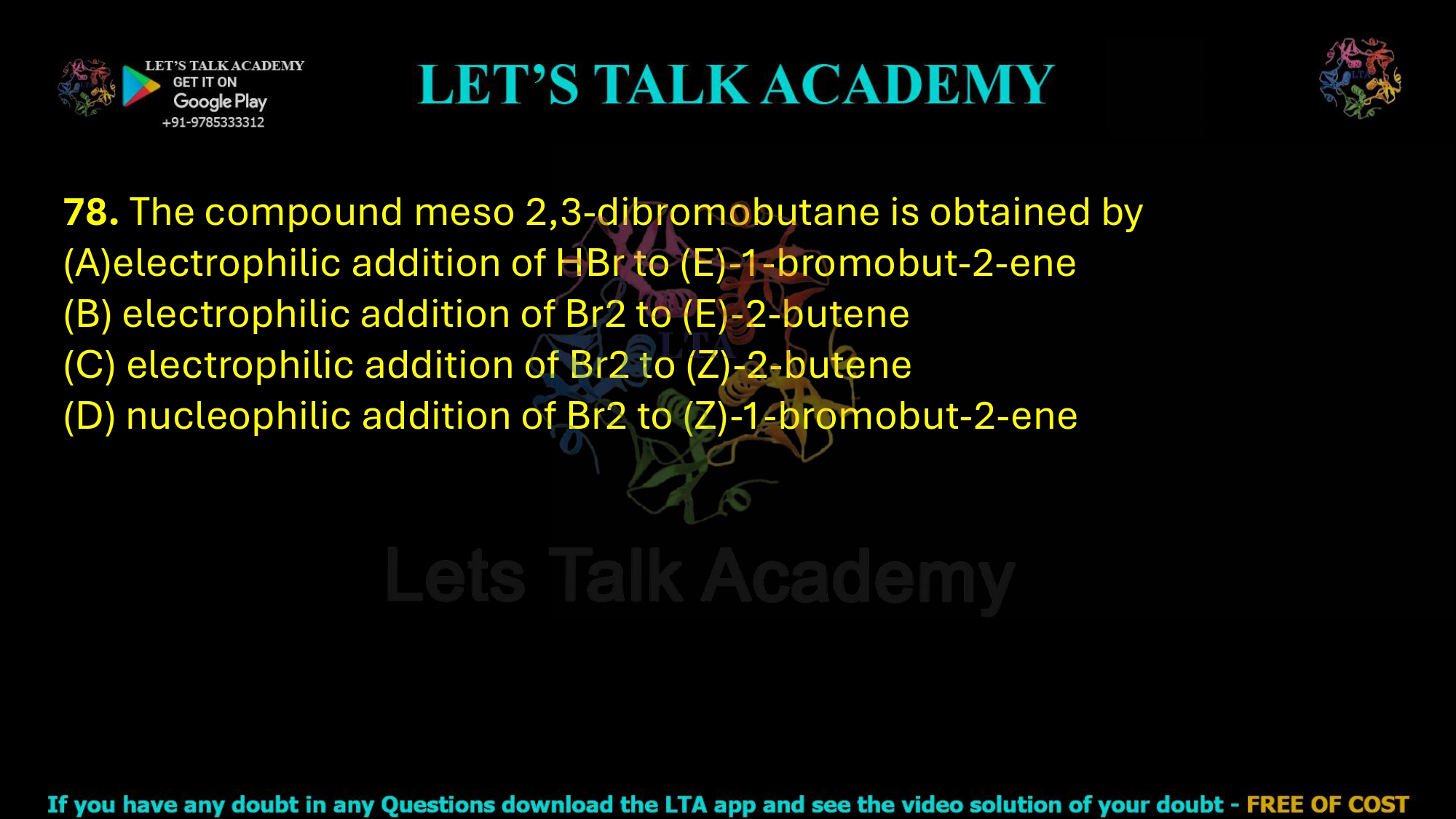
78. The compound meso 2,3-dibromobutane is obtained by
(A)electrophilic addition of HBr to (E)-1-bromobut-2-ene
(B) electrophilic addition of Br2 to (E)-2-butene
(C) electrophilic addition of Br2 to (Z)-2-butene
(D) nucleophilic addition of Br2 to (Z)-1-bromobut-2-ene
Formation of meso-2,3-Dibromobutane by Bromination of Butene Isomers
Correct Answer
✅ Correct Option: (B)
Understanding Bromination of Alkenes
When bromine (Br₂) reacts with an alkene, the reaction proceeds through an electrophilic addition mechanism. The π electrons of the double bond attack one bromine atom, forming a cyclic bromonium ion intermediate. This intermediate is highly reactive and is subsequently attacked by a bromide ion from the opposite side of the ring.
Because the nucleophilic attack occurs from the side opposite to the bromonium ion, the overall reaction proceeds through anti addition. The stereochemistry of the starting alkene therefore determines whether the final product is a meso compound or a pair of enantiomers.
Formation of meso-2,3-Dibromobutane
(E)-2-butene is the trans isomer of 2-butene. During bromination, bromine atoms are added to opposite faces of the double bond because of the anti addition mechanism.
The trans arrangement of the methyl groups in the starting alkene combined with anti addition produces a molecule possessing an internal plane of symmetry. The resulting product is meso-2,3-dibromobutane, which is optically inactive despite containing two stereogenic carbon atoms.
This reaction is one of the classic examples used to explain the relationship between alkene geometry and stereochemical outcome.
Why (E)-2-Butene Gives a meso Compound
In trans-2-butene, the two methyl groups lie on opposite sides of the double bond. Anti addition of bromine places the bromine atoms on opposite faces of the molecule, generating the (2R,3S) configuration. Since this structure possesses a plane of symmetry, it is a meso compound and therefore optically inactive.
Thus, electrophilic addition of bromine to (E)-2-butene produces meso-2,3-dibromobutane.
Explanation of Each Option
Option (A): Electrophilic Addition of HBr to (E)-1-Bromobut-2-ene
This option is incorrect. Addition of hydrogen bromide follows a different electrophilic addition mechanism and does not produce vicinal dibromides. Therefore, meso-2,3-dibromobutane cannot be formed through this reaction.
Option (B): Electrophilic Addition of Br₂ to (E)-2-Butene
This option is correct. Bromination proceeds through a bromonium ion intermediate followed by anti addition. Because the starting alkene is the trans (E) isomer, the product obtained is the meso form of 2,3-dibromobutane.
Option (C): Electrophilic Addition of Br₂ to (Z)-2-Butene
This option is incorrect. The cis (Z) isomer also undergoes anti addition, but the stereochemical outcome is different. Instead of a meso compound, bromination of (Z)-2-butene produces a pair of enantiomers, namely (2R,3R)- and (2S,3S)-2,3-dibromobutane. Therefore, the product is racemic rather than meso.
Option (D): Nucleophilic Addition of Br₂ to (Z)-1-Bromobut-2-ene
This option is incorrect. Bromine reacts with alkenes through an electrophilic addition mechanism, not a nucleophilic addition mechanism. Furthermore, the substrate differs from 2-butene and cannot produce meso-2,3-dibromobutane.
Comparison of Bromination Products
| Starting Alkene | Addition Type | Major Product |
|---|---|---|
| (E)-2-Butene (Trans) | Anti Addition | meso-2,3-Dibromobutane |
| (Z)-2-Butene (Cis) | Anti Addition | Racemic mixture of enantiomers |
Concept Behind the Question
This question tests the relationship between alkene geometry and stereochemical outcome during electrophilic addition reactions. Students must recognize that bromination proceeds through a bromonium ion intermediate, leading exclusively to anti addition. The stereochemistry of the alkene determines whether the product possesses an internal plane of symmetry or exists as a pair of enantiomers.
Final Answer
Electrophilic addition of bromine to (E)-2-butene proceeds through anti addition and produces meso-2,3-dibromobutane.
✅ Correct Answer: Option (B)


