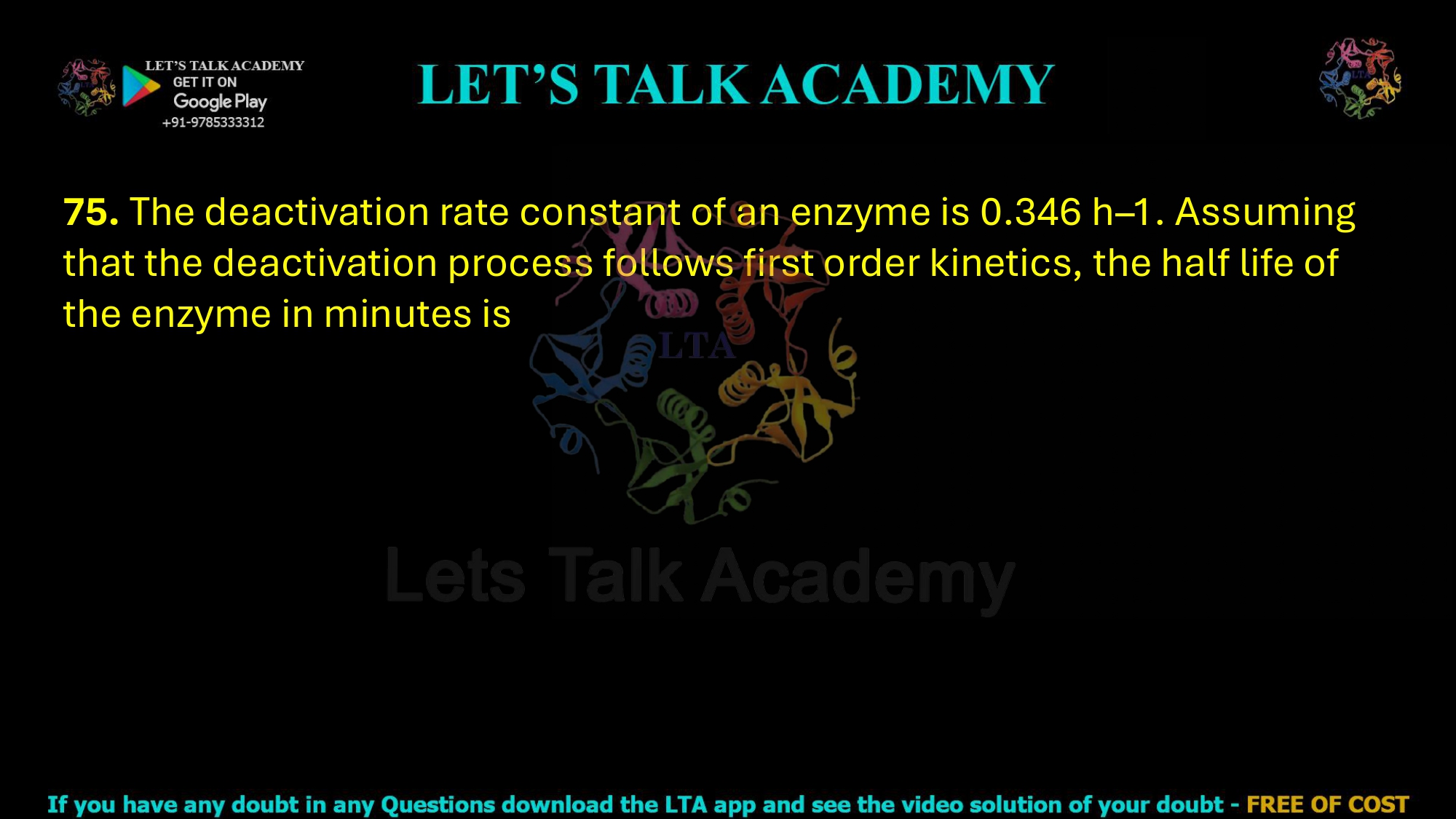
75. The deactivation rate constant of an enzyme is 0.346 h–1. Assuming that the deactivation process follows first order kinetics, the half life of the enzyme in minutes is
Half-Life of an Enzyme Following First-Order Deactivation Kinetics
Correct Answer
✅ Correct Answer: 120 minutes (2 hours)
Understanding First-Order Deactivation Kinetics
In a first-order deactivation process, the rate of loss of enzyme activity is directly proportional to the amount of active enzyme remaining. This means that the enzyme loses the same fraction of its activity during equal intervals of time. One important characteristic of first-order kinetics is that the half-life remains constant and is independent of the initial enzyme concentration.
The half-life is defined as the time required for the enzyme activity to decrease to one-half of its original value. Because first-order reactions follow exponential decay, the half-life can be calculated directly from the rate constant using a standard kinetic equation.
Formula for Half-Life of a First-Order Reaction
The half-life for a first-order process is given by:
t1/2 = 0.693 / k
where:
t1/2 = Half-life of the enzyme
k = First-order deactivation rate constant
For this question,
k = 0.346 h−1
Step-by-Step Calculation
Substituting the given value into the first-order half-life equation:
t1/2 = 0.693 / 0.346
t1/2 ≈ 2.00 hours
Since the answer is required in minutes, convert hours into minutes.
2 hours × 60 = 120 minutes
Therefore, the half-life of the enzyme is:
120 minutes
Why This Formula is Used
The equation t1/2 = 0.693/k is derived from the integrated rate law for first-order reactions. Because the logarithmic relationship between concentration and time is constant, every first-order reaction has a fixed half-life regardless of the starting concentration. This property distinguishes first-order reactions from zero-order and second-order reactions, whose half-lives depend on the initial concentration.
Concept Behind the Question
This question tests the application of first-order reaction kinetics to enzyme deactivation. Enzyme molecules gradually lose their catalytic activity because of denaturation, structural changes, oxidation, or other irreversible processes. When this loss follows first-order kinetics, the rate constant completely determines how long the enzyme remains active. Such calculations are commonly used in enzyme engineering, pharmaceutical biotechnology, industrial bioprocesses, and protein stability studies.
Final Answer
The enzyme follows first-order deactivation kinetics, so its half-life is calculated using the equation:
t1/2 = 0.693 / k
Substituting the given rate constant of 0.346 h−1 gives a half-life of 2 hours, which is equivalent to 120 minutes.
✅ Correct Answer: 120 minutes


