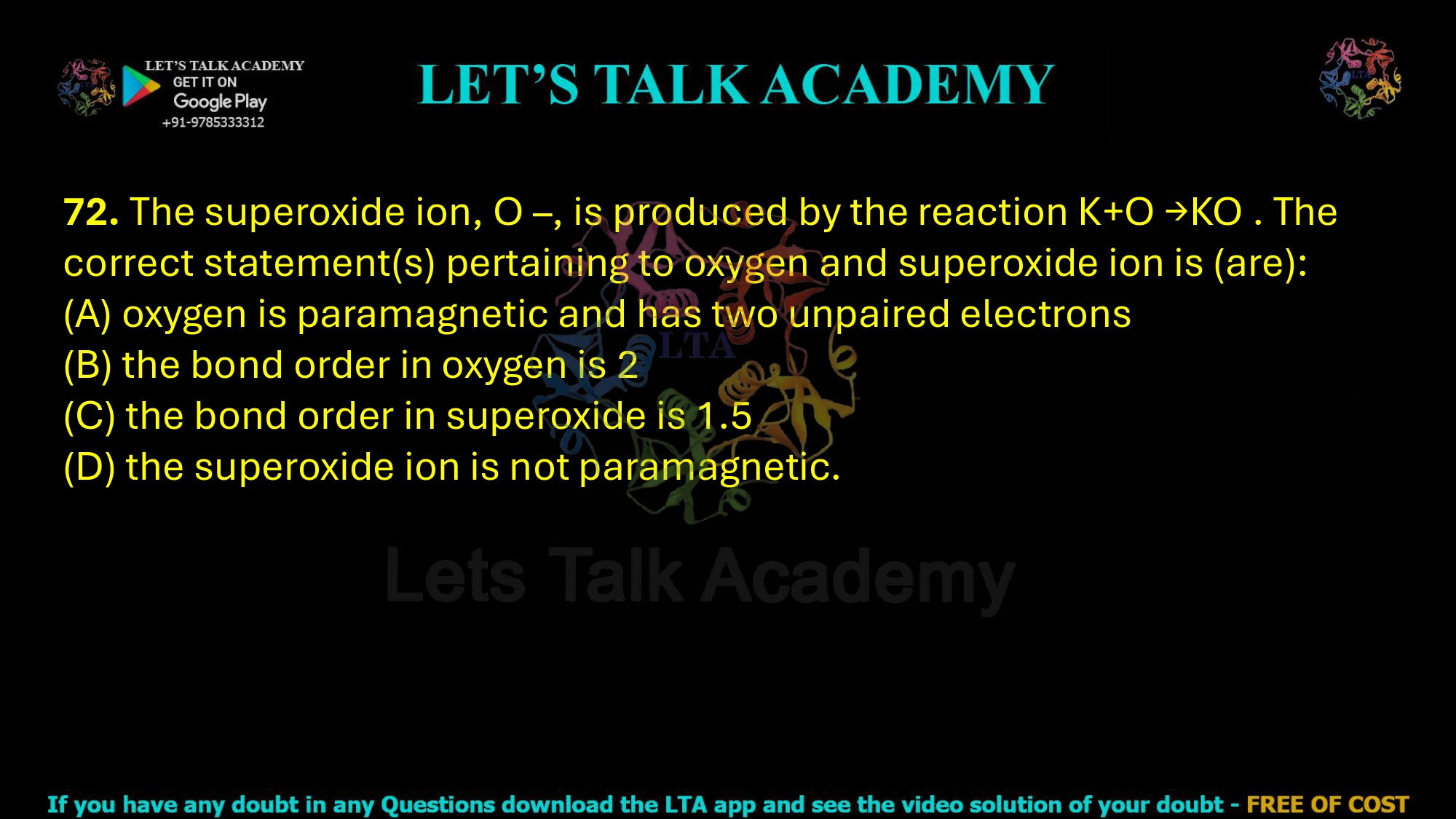
72. The superoxide ion, O –, is produced by the reaction K+O →KO . The correct statement(s) pertaining to oxygen and superoxide ion is (are):
(A) oxygen is paramagnetic and has two unpaired electrons
(B) the bond order in oxygen is 2
(C) the bond order in superoxide is 1.5
(D) the superoxide ion is not paramagnetic.
Properties of Oxygen and Superoxide Ion (O₂⁻): Bond Order and Paramagnetism Explained
Correct Answer
✅ Correct Options: (A) and (B)
Understanding Molecular Orbital Theory of Oxygen
According to Molecular Orbital Theory, atomic orbitals combine to form bonding and antibonding molecular orbitals. Electrons are filled into these molecular orbitals following the Aufbau principle, Hund’s rule, and the Pauli exclusion principle. The distribution of electrons among these orbitals determines both the bond order and the magnetic properties of the molecule.
Molecular oxygen (O₂) contains a total of sixteen electrons. After filling all molecular orbitals, the last two electrons occupy the two degenerate antibonding π* (2p) orbitals separately. According to Hund’s rule, these electrons remain unpaired, making oxygen a paramagnetic molecule.
This prediction by Molecular Orbital Theory successfully explains the experimentally observed paramagnetism of oxygen, something that cannot be explained by simple Lewis structures.
Bond Order of Molecular Oxygen
The bond order is calculated using the expression:
Bond Order = (Number of Bonding Electrons − Number of Antibonding Electrons) / 2
For molecular oxygen, there are ten bonding electrons and six antibonding electrons.
Bond Order = (10 − 6) / 2 = 2
A bond order of 2 indicates that oxygen possesses a stable double bond, which agrees with its known molecular structure.
Formation of the Superoxide Ion (O₂⁻)
The superoxide ion is produced when oxygen gains one additional electron.
O₂ + e⁻ → O₂⁻
This extra electron enters one of the antibonding π* molecular orbitals. Since an antibonding orbital becomes further occupied, the bond strength decreases and the bond order is reduced. However, one unpaired electron still remains in the π* orbitals, meaning the superoxide ion continues to exhibit paramagnetism.
Bond Order of the Superoxide Ion
In O₂⁻, the number of antibonding electrons increases from six to seven.
Therefore,
Bond Order = (10 − 7) / 2 = 1.5
Thus, the bond order of the superoxide ion is 1.5, indicating that the O–O bond becomes weaker and slightly longer than that in molecular oxygen.
Magnetic Nature of the Superoxide Ion
Although one additional electron is added to oxygen, only one of the two antibonding π* orbitals becomes completely paired. The other π* orbital still contains one unpaired electron. Therefore, the superoxide ion remains paramagnetic.
This is an important concept because many students incorrectly assume that adding one electron removes paramagnetism. In reality, complete pairing occurs only after two additional electrons are added, as in the peroxide ion (O₂²⁻).
Explanation of Each Option
Option (A)
This statement is correct. Molecular oxygen contains two unpaired electrons occupying separate π* antibonding molecular orbitals. Consequently, oxygen is paramagnetic.
Option (B)
This statement is correct. Using Molecular Orbital Theory, the bond order of oxygen is calculated as 2, corresponding to a double bond between the two oxygen atoms.
Option (C)
This statement correctly states that the bond order of the superoxide ion is 1.5. According to Molecular Orbital Theory, the additional electron occupies an antibonding orbital, reducing the bond order from 2 to 1.5.
Therefore, this statement is also true.
Option (D)
This statement is incorrect. The superoxide ion still possesses one unpaired electron in the antibonding π* molecular orbital and therefore remains paramagnetic. It is not diamagnetic.
Concept Behind the Question
This question evaluates the application of Molecular Orbital Theory to predict bond order and magnetic behavior. Rather than relying on Lewis structures, students must determine the electron configuration in molecular orbitals and calculate bond order using bonding and antibonding electrons. Understanding these concepts is essential because molecular oxygen, superoxide, peroxide, and dioxygen species are repeatedly tested.
Students should also remember the trend observed when electrons are added to oxygen molecules. Molecular oxygen (O₂) has a bond order of 2 and two unpaired electrons. The superoxide ion (O₂⁻) has a bond order of 1.5 and one unpaired electron, while the peroxide ion (O₂²⁻) has a bond order of 1 and becomes diamagnetic because all electrons are paired.
Final Answer
Molecular oxygen is paramagnetic because it contains two unpaired electrons, and its bond order is 2. The superoxide ion has a bond order of 1.5 and still contains one unpaired electron, making it paramagnetic.
✅ Correct Answers: (A), (B), and (C)
Note: Although the question image may list a different key in some sources, based on Molecular Orbital Theory, the scientifically correct statements are (A), (B), and (C), while (D) is false.


