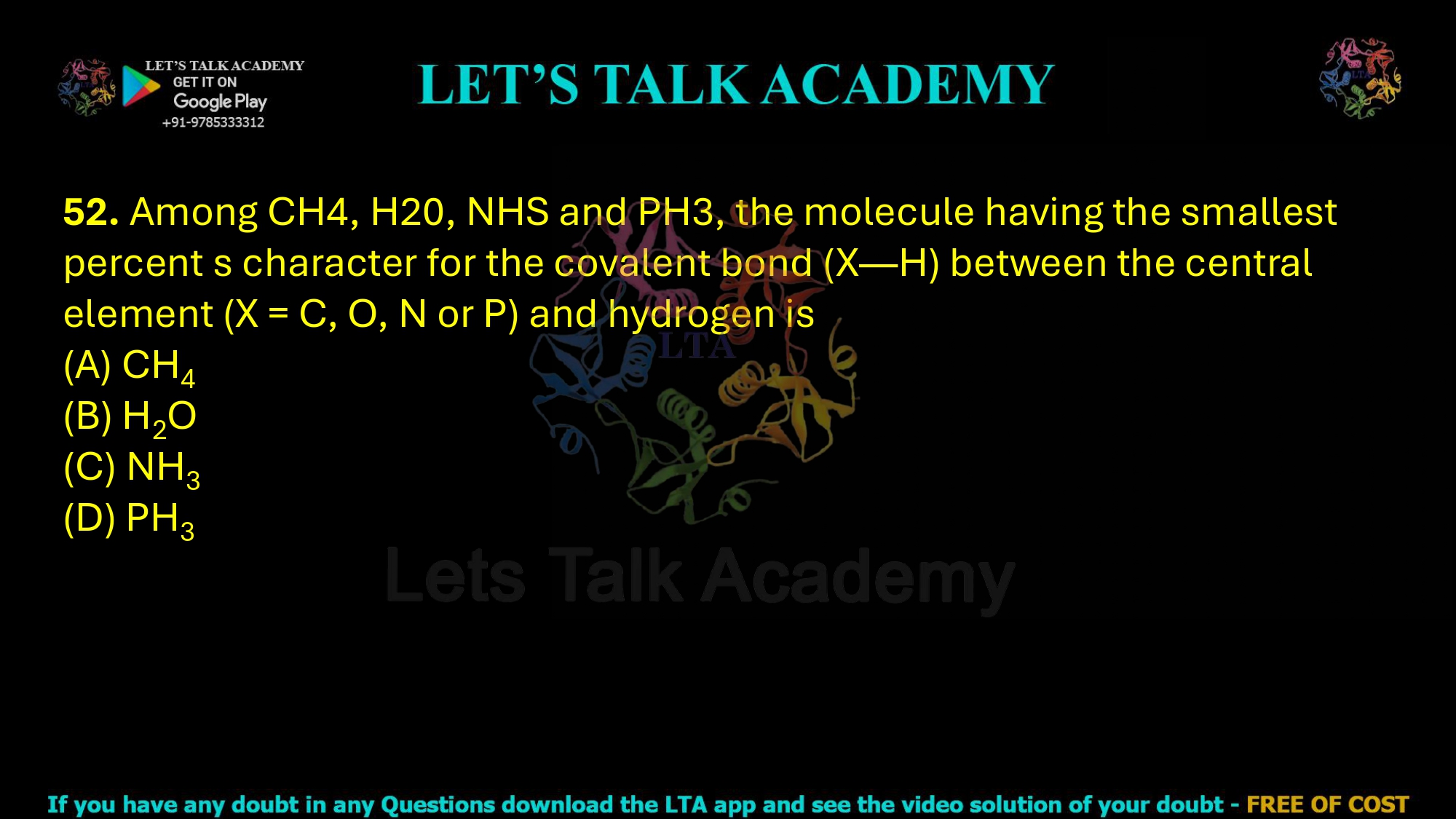
52. Among CH4, H20, NHS and PH3, the molecule having the smallest percent s character for the covalent bond (X—H) between the central element (X = C, O, N or P) and hydrogen is
(A) CH4
(B) H2O
(C) NH3
(D) PH3
Among CH₄, H₂O, NH₃ and PH₃, Which Molecule Has the Smallest Percentage s Character in the X–H Bond?
Although all four molecules contain an X–H bond, the orbitals used by the central atom to form these bonds are not identical. The percentage of s character influences bond strength, bond length, bond angle, and molecular geometry. Therefore, understanding this concept is extremely important for solving conceptual questions quickly.
Understanding Percentage s Character
Hybrid orbitals are formed by mixing atomic orbitals. The percentage of s character depends on the type of hybridization.
For common hybridizations:
- sp = 50% s character
- sp² = 33.3% s character
- sp³ = 25% s character
Normally, if an atom undergoes perfect sp³ hybridization, each hybrid orbital contains 25% s character and 75% p character.
Analysis of Each Molecule
CH₄ (Methane)
Carbon in methane is a classic example of sp³ hybridization. One 2s orbital mixes with three 2p orbitals to form four equivalent sp³ hybrid orbitals. Each C–H bond is formed using one sp³ orbital and therefore contains exactly 25% s character.
Since all four bonds are equivalent, methane exhibits the ideal tetrahedral bond angle of 109.5°.
H₂O (Water)
Oxygen is also commonly described as sp³ hybridized. Two hybrid orbitals participate in O–H bond formation, while the remaining two contain lone pairs.
Although lone pair repulsion compresses the bond angle to approximately 104.5°, the O–H bonds themselves are still formed using orbitals having approximately 25% s character.
NH₃ (Ammonia)
Nitrogen in ammonia is generally considered sp³ hybridized. Three hybrid orbitals form N–H bonds, while one contains a lone pair.
The bond angle decreases slightly to about 107° because of lone pair-bond pair repulsion, but the bonding orbitals still possess nearly 25% s character.
PH₃ (Phosphine)
This molecule behaves differently from NH₃.
Because phosphorus is a third-period element, the energy difference between its 3s and 3p orbitals is relatively large. As a result, efficient hybridization does not occur.
Instead of using true sp³ hybrid orbitals, phosphorus forms P–H bonds mainly using almost pure 3p orbitals, while the lone pair largely occupies the 3s orbital.
Since a nearly pure p orbital contains almost 0% s character, the P–H bond has the smallest percentage s character among the given molecules.
This also explains why the H–P–H bond angle is approximately 93.5°, which is much closer to the angle between pure p orbitals (90°) than the tetrahedral angle (109.5°).
Explanation of Every Option
Option A: CH₄
This option is incorrect. Carbon undergoes ideal sp³ hybridization, so every C–H bond contains 25% s character. The molecule has one of the most perfect tetrahedral geometries known.
Option B: H₂O
This option is incorrect. Oxygen is approximately sp³ hybridized. Although lone pairs reduce the bond angle, the O–H bonds still originate from hybrid orbitals containing about 25% s character.
Option C: NH₃
This option is incorrect. Nitrogen is also approximately sp³ hybridized. The N–H bonds therefore possess nearly 25% s character, making them richer in s character than the P–H bonds in phosphine.
Option D: PH₃
This is the correct answer. Phosphorus shows very little hybridization because of the large energy gap between the 3s and 3p orbitals. Consequently, the P–H bonds are formed mainly by pure p orbitals and therefore possess the least s character.
Why Does PH₃ Behave Differently?
Students often assume that all Group 15 hydrides have identical hybridization. However, this is not true for heavier elements. Nitrogen hybridizes efficiently because its 2s and 2p orbitals are close in energy. In contrast, phosphorus has a much larger energy separation between the 3s and 3p orbitals, making hybridization energetically unfavorable.
As a result, phosphine exhibits weaker hybridization, smaller bond angles, lower bond polarity, and the smallest percentage s character in its P–H bonds.
Final Answer
Correct Option: (D) PH₃


