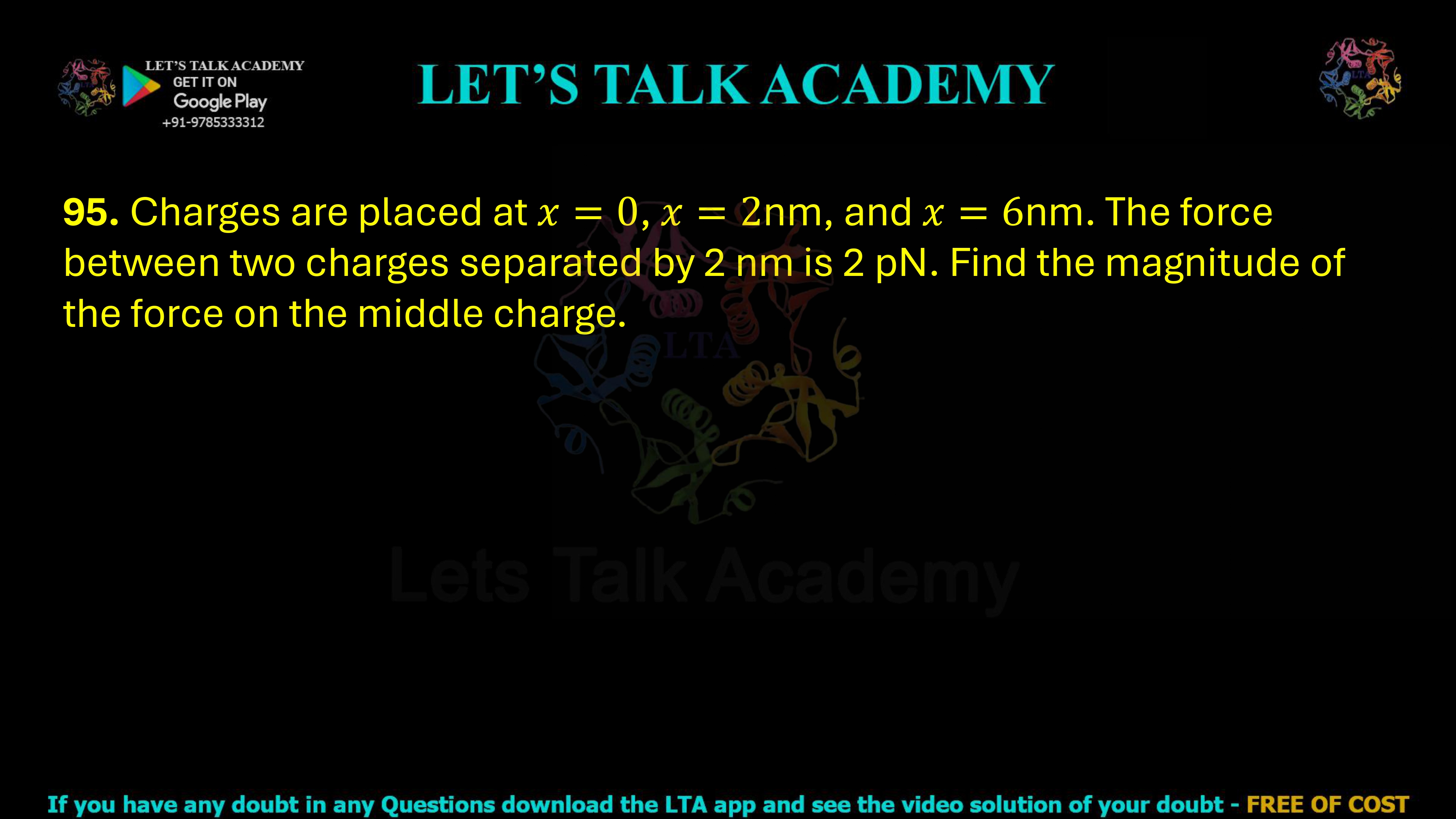
95. Charges are placed at , nm, and nm. The force between two charges separated by 2 nm is 2 pN. Find the magnitude of the force on the middle charge.
Force on the Middle Charge Using Coulomb’s Law – Complete Step-by-Step Explanation
Given Data
Position of first charge = 0 nm
Position of second (middle) charge = 2 nm
Position of third charge = 6 nm
Force between charges separated by 2 nm = 2 pN
Concept Used
Coulomb’s Law states that the electrostatic force between two point charges is directly proportional to the product of their charges and inversely proportional to the square of the distance between them.
::contentReference[oaicite:0]{index=0}
Since all three charges are assumed to have the same magnitude, only the distance changes. Therefore, the force varies according to the inverse square law:
F ∝ 1/r²
Step 1: Force Due to the Charge at x = 0 nm
The distance between the first charge and the middle charge is
2 nm
The problem states that the force at this separation is
F₁ = 2 pN
Step 2: Force Due to the Charge at x = 6 nm
The distance between the middle charge and the third charge is
6 − 2 = 4 nm
Since Coulomb’s force varies inversely as the square of the distance,
F₂ = 2 × (2/4)²
F₂ = 2 × (1/2)²
F₂ = 2 × 1/4
F₂ = 0.5 pN
Step 3: Determine the Direction of Forces
Assuming all the charges are of the same sign, the force due to the charge at x = 0 nm pushes the middle charge towards the right, while the force due to the charge at x = 6 nm pushes it towards the left. Thus, the two forces act in opposite directions.
Since the forces are opposite, the net force is obtained by taking their difference.
Fnet = F₁ − F₂
Fnet = 2 − 0.5
Fnet = 1.5 pN
Why the Forces Are Not Added
Many students mistakenly add the two forces and obtain 2.5 pN. This is incorrect because electrostatic force is a vector quantity. The direction of each force must always be considered before performing the calculation.
For like charges, both outer charges repel the middle charge. Since they are located on opposite sides, one force acts towards the right while the other acts towards the left. Opposite forces subtract from one another, producing the resultant force of 1.5 pN.
If the charges had opposite signs, the directions would change accordingly, and the net force would have to be calculated using the appropriate vector directions.
Detailed Explanation
This problem demonstrates two important concepts simultaneously. The first is Coulomb’s inverse square law, which states that doubling the distance reduces the electrostatic force to one-fourth of its original value. The second is the principle of superposition, according to which the total force acting on a charge is the vector sum of the individual forces due to all other charges.
By combining these two ideas, multi-charge electrostatic problems become much easier to solve without repeatedly applying the complete Coulomb’s Law equation.
Final Answer
Magnitude of the force on the middle charge = 1.5 pN


