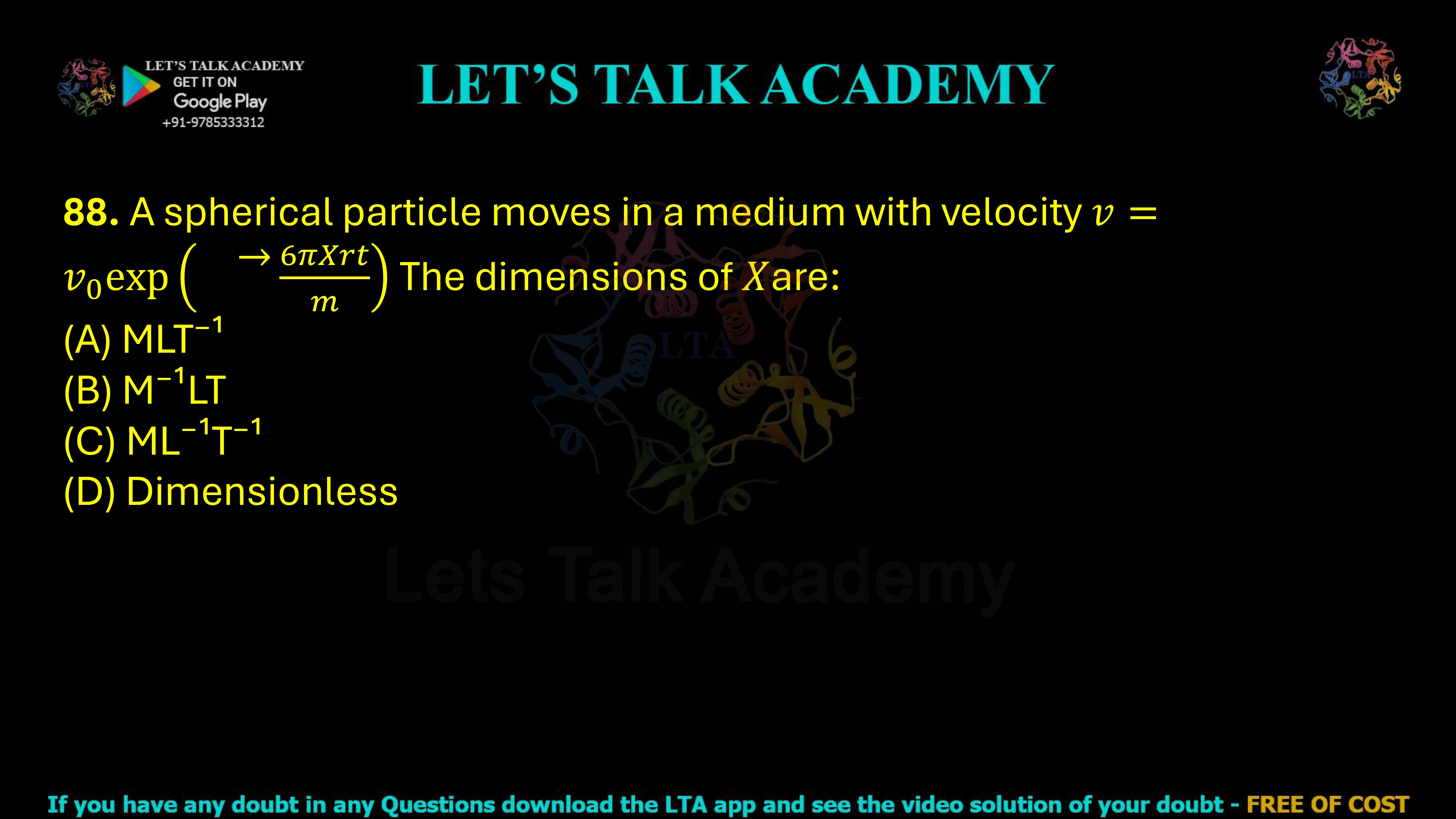
88. A spherical particle moves in a medium with velocity v = v0 exp (−6πXrt / m) The dimensions of X are:
(A) MLT⁻¹
(B) M⁻¹LT
(C) ML⁻¹T⁻¹
(D) Dimensionless
Dimensions of X in an Exponential Velocity Equation
Correct Answer
(C) ML−1T−1
Concept Used in This Question
The given equation contains an exponential function.
exp (−6πXrt/m)
One of the most fundamental rules of mathematics and physics is that the quantity inside an exponential function must not possess any physical dimensions.
In other words,
The exponent must always be dimensionless.
This rule is equally applicable to exponential functions, logarithmic functions, sine, cosine, tangent, and other trigonometric functions.
Why Must the Exponent Be Dimensionless?
The exponential function is represented by the infinite series
ex = 1 + x + x²/2! + x³/3! + …
Since every term in this expansion is added together, each term must have the same dimensions. The constant “1” has no dimensions, therefore every other term must also be dimensionless. Consequently, the exponent itself cannot have any physical dimensions.
This principle forms the basis of solving such dimensional analysis questions.
Step-by-Step Solution
The exponent is
6πXrt / m
The constants 6 and π are pure numbers and therefore dimensionless.
Hence,
[Xrt/m] = 1
or
[X][r][t] = [m]
Step 1: Write the Dimensions of Known Quantities
Mass
[m] = M
Radius
[r] = L
Time
[t] = T
Step 2: Substitute the Dimensions
[X] × L × T = M
Step 3: Solve for X
[X] = M / (LT)
Therefore,
[X] = ML−1T−1
Verification of the Answer
Substitute the obtained dimensions back into the exponent.
(ML−1T−1) × L × T / M
The mass, length, and time dimensions cancel completely.
= M × L−1 × T−1 × L × T / M
= 1
Thus, the exponent becomes dimensionless, confirming that the answer is correct.
Option-Wise Analysis
Option (A): MLT−1
If these dimensions are substituted into the exponent, the remaining dimensions become L² instead of unity. Therefore, the exponent is not dimensionless.
Incorrect.
Option (B): M−1LT
Substituting this option leaves dimensions of M−2L²T² inside the exponent, which is physically impossible.
Incorrect.
Option (C): ML−1T−1
All dimensions cancel exactly, making the exponent dimensionless.
This satisfies the basic requirement of an exponential function.
Correct.
Physical Significance
The given equation resembles the velocity equation for a small spherical particle moving through a viscous medium, where the velocity decreases exponentially with time because of resistive forces. In such equations, the exponent represents the ratio of physical quantities and must always be a pure number. This ensures that the exponential function is mathematically and physically meaningful.
Important Rules for Dimensional Analysis
Students should always remember the following rules:
- The arguments of exponential, logarithmic, sine, cosine, and tangent functions are always dimensionless.
- Only quantities having identical dimensions can be added or subtracted.
- Physical equations must be dimensionally homogeneous.
- Dimensionless constants such as π, e, 2, and 6 never affect dimensional calculations.
Exam-Oriented Key Concepts
Questions involving exponential functions are among the easiest dimensional analysis problems in competitive examinations. As soon as an exponential expression is observed, immediately equate the exponent to a dimensionless quantity. This approach allows the dimensions of unknown variables to be obtained in just a few algebraic steps.
Final Answer
The dimensions of X are
ML−1T−1
Correct Option: (C)


