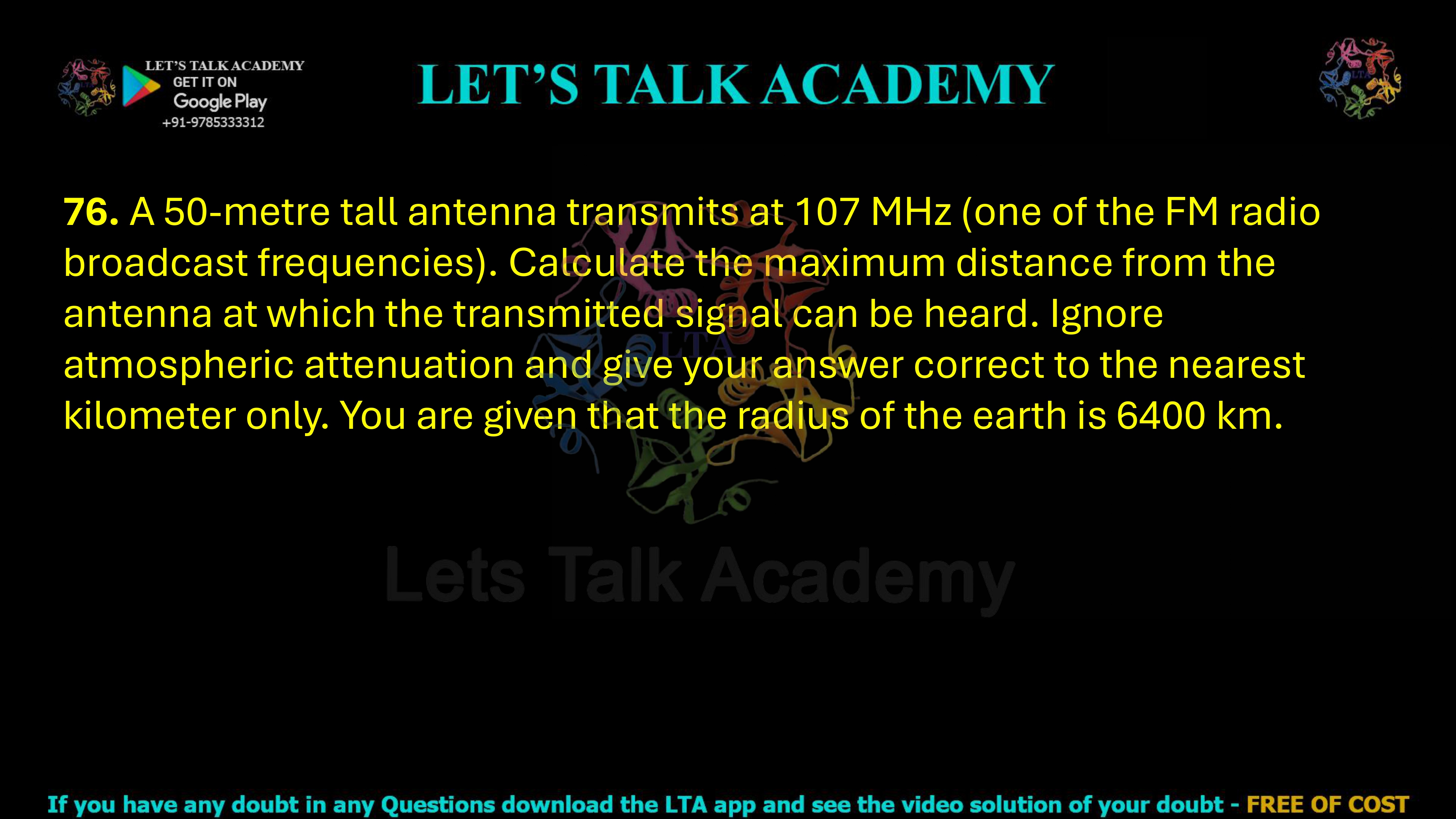
76. A 50-metre tall antenna transmits at 107 MHz (one of the FM radio broadcast frequencies). Calculate the maximum distance from the antenna at which the transmitted signal can be heard. Ignore atmospheric attenuation and give your answer correct to the nearest kilometer only. You are given that the radius of the earth is 6400 km.
Maximum Distance of an FM Radio Signal from a Transmitting Antenna
Concept Used
Since FM waves travel by line-of-sight propagation, the maximum communication distance is determined by the radio horizon.
The distance to the horizon from an antenna of height h is given by
d = √(2Rh)
where
- R = Radius of Earth
- h = Height of antenna
When the height is expressed in metres and the answer is required in kilometres, the formula becomes
d = √(2Rh) (using SI units), or equivalently
d ≈ 3.57√h (with h in metres and d in kilometres).
Step 1: Use the Simplified Formula
Given,
h = 50 m
Therefore,
d = 3.57√50
√50 ≈ 7.07
d = 3.57 × 7.07
d ≈ 25.25 km
Step 2: Round to the Nearest Kilometre
Therefore,
d ≈ 25 km
Derivation Using the Radius of the Earth
Convert the Earth’s radius into metres:
R = 6400 km = 6.4 × 10⁶ m
Using
d = √(2Rh)
d = √[2 × (6.4 × 106) × 50]
d = √(6.4 × 10⁸)
d ≈ 2.53 × 10⁴ m
d ≈ 25.3 km
This agrees with the simplified formula.
Why Is the Frequency Given?
The frequency of 107 MHz identifies the transmission as an FM radio signal, which belongs to the VHF region of the electromagnetic spectrum. These waves propagate primarily by line of sight and are not significantly reflected by the ionosphere. Therefore, the communication range depends on the height of the antenna rather than on the frequency itself.
For this calculation, the frequency does not appear explicitly in the formula. It simply confirms that the line-of-sight model should be used.
Understanding Line-of-Sight Communication
Electromagnetic waves of very high frequency travel almost in straight lines. Because the Earth is curved, the signal cannot reach beyond the geometric horizon unless repeaters or taller antennas are used. Increasing the antenna height increases the distance to the horizon and therefore extends the communication range.
This principle is used in FM broadcasting, television transmission towers, microwave communication, radar systems, and mobile communication networks.
Applications
- FM radio broadcasting
- Television transmission
- Microwave communication
- Radar systems
- Mobile communication towers
- Satellite ground stations
Important Formulae
Distance to the Horizon
d = √(2Rh)
Simplified Formula
d = 3.57√h
where
- d is in kilometres.
- h is in metres.
Maximum Communication Range Between Two Antennas
D = 3.57(√h₁ + √h₂)
Key Points to Remember
FM radio waves travel by line-of-sight propagation. The communication range depends on the height of the transmitting and receiving antennas, not directly on the frequency. A taller antenna provides a larger radio horizon, increasing the maximum distance over which signals can be received.
Final Answer
The maximum distance from the antenna at which the transmitted FM signal can be heard is
25 km


