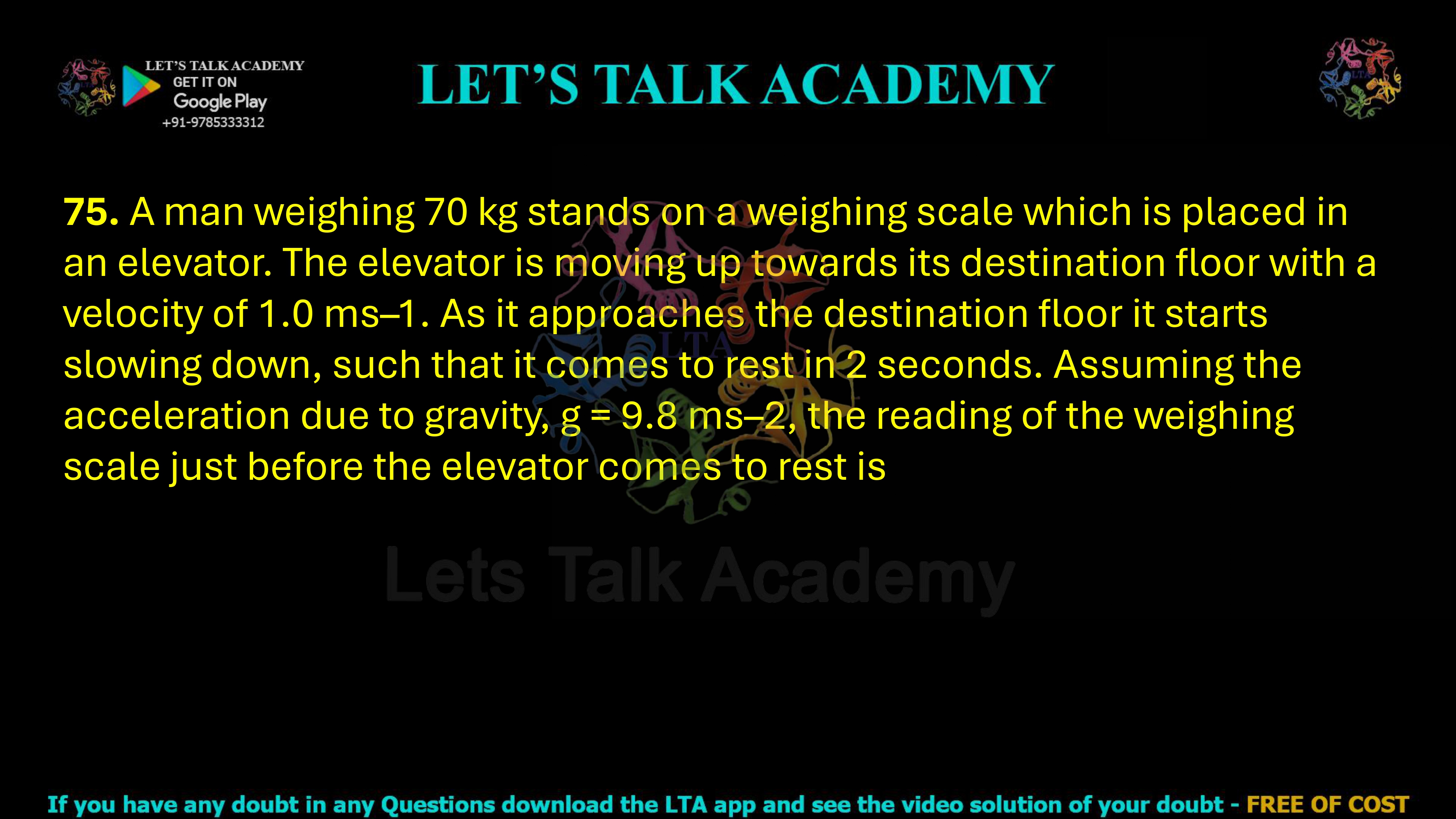
75. A man weighing 70 kg stands on a weighing scale which is placed in an elevator. The elevator is moving up towards its destination floor with a velocity of 1.0 ms–1. As it approaches the destination floor it starts slowing down, such that it comes to rest in 2 seconds. Assuming the acceleration due to gravity, g = 9.8 ms–2, the reading of the weighing scale just before the elevator comes to rest is
Weighing Scale Reading in a Decelerating Elevator
Concept Used
The weighing scale measures the normal reaction force, not the true weight. This normal reaction is called the apparent weight.
Since the elevator is moving upward but slowing down, its acceleration is downward.
First, calculate the acceleration of the elevator.
Step 1: Calculate the Acceleration
Using the first equation of motion,
v = u + at
Substituting the given values,
0 = 1 + a × 2
2a = −1
a = −0.5 m/s²
The negative sign indicates that the acceleration is downward.
Step 2: Determine the Apparent Weight
When the elevator accelerates downward, the normal reaction is given by
N = m(g − a)
where a is the magnitude of the downward acceleration.
Substituting the values,
N = 70(9.8 − 0.5)
N = 70 × 9.3
N = 651 N
Therefore, the weighing scale reads 651 N.
Alternative Method Using Newton’s Second Law
Two forces act on the man:
- The normal reaction N acting upward.
- The gravitational force mg acting downward.
Since the acceleration is downward,
mg − N = ma
Rearranging,
N = m(g − a)
Substituting the values again gives
N = 651 N.
Why Does the Reading Decrease?
Although the elevator is moving upward, it is slowing down. A body that slows down while moving upward must have a downward acceleration. Because of this downward acceleration, the floor of the elevator exerts a smaller normal reaction on the man than when the elevator is at rest. Since the weighing scale measures the normal reaction, the reading decreases below the true weight.
The true weight of the man is
W = mg = 70 × 9.8 = 686 N
During deceleration, the apparent weight becomes
651 N, which is less than the true weight.
Special Cases of Elevator Motion
Elevator at Rest or Moving with Constant Velocity
N = mg
The weighing scale shows the true weight.
Elevator Accelerating Upward
N = m(g + a)
The apparent weight is greater than the true weight.
Elevator Accelerating Downward
N = m(g − a)
The apparent weight is less than the true weight.
Free Fall
N = 0
The person experiences weightlessness.
Detailed Explanation of Common Mistakes
A common mistake is to think that because the elevator is moving upward, the apparent weight should increase. However, the weighing scale depends on acceleration, not on the direction of motion. In this problem, the elevator is moving upward but accelerating downward because it is slowing down. Therefore, the apparent weight decreases.
Important Formulae
True Weight
W = mg
Apparent Weight (Upward Acceleration)
N = m(g + a)
Apparent Weight (Downward Acceleration)
N = m(g − a)
Equation of Motion
v = u + at
Key Points to Remember
The weighing scale always measures the normal reaction force. The direction of acceleration determines whether the apparent weight increases or decreases. Upward acceleration increases the reading, while downward acceleration decreases it. The direction of motion alone has no effect on the scale reading.
Final Answer
The reading of the weighing scale just before the elevator comes to rest is
651 N


