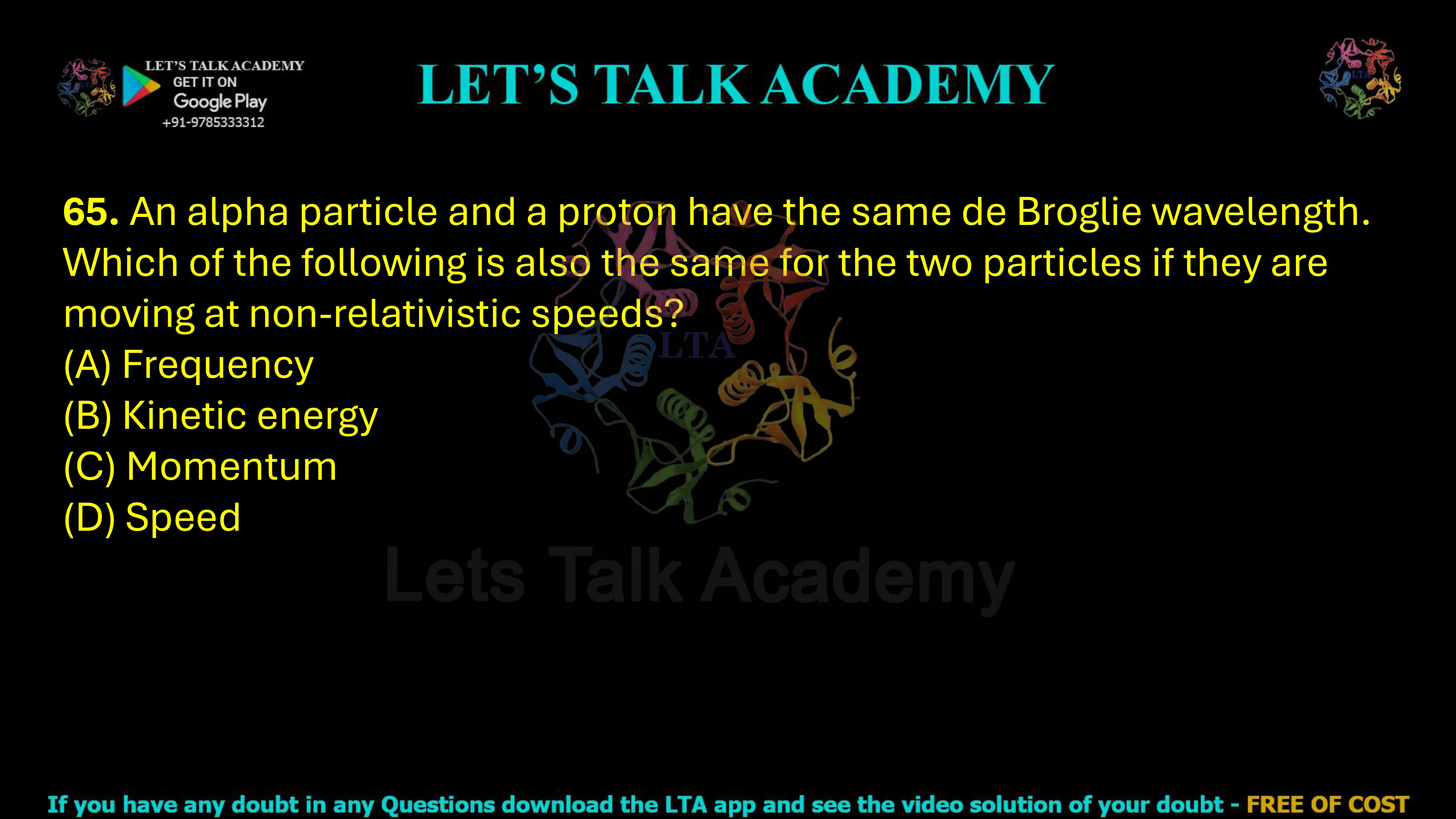
65. An alpha particle and a proton have the same de Broglie wavelength. Which of the following is also the same for the two particles if they are moving at non-relativistic speeds?
(A) Frequency
(B) Kinetic energy
(C) Momentum
(D) Speed
Alpha Particle and Proton Having the Same de Broglie Wavelength – Complete Theory, Derivation
Correct Answer
(C) Momentum
Understanding the de Broglie Hypothesis
According to Louis de Broglie, every moving particle behaves like a wave. The wavelength associated with a moving particle is known as its de Broglie wavelength. This wavelength depends on the particle’s momentum rather than its mass or speed individually.
The de Broglie wavelength is given by
λ = h / p
where
- λ = de Broglie wavelength
- h = Planck’s constant
- p = momentum of the particle
This equation immediately tells us that wavelength is inversely proportional to momentum.
Key Concept Used in This Question
The question states that an alpha particle and a proton have the same de Broglie wavelength.
Since Planck’s constant is universal and remains the same for every particle, equal wavelengths imply
λ₁ = λ₂
Therefore,
h / p₁ = h / p₂
which gives
p₁ = p₂
Thus, both particles have exactly the same momentum.
This conclusion is true regardless of their masses.
Comparison Between an Alpha Particle and a Proton
An alpha particle consists of two protons and two neutrons. Therefore, its mass is approximately four times the mass of a proton.
Although both particles have the same momentum in this question, their masses are very different. Because many physical quantities depend on mass, those quantities cannot remain equal.
Option-Wise Explanation
Option (A): Frequency
The frequency associated with a matter wave is related to the total energy of the particle. Since the alpha particle and proton have different masses, their total energies are different even when their momenta are the same.
Therefore, their frequencies are not equal.
Option (A) is Incorrect.
Option (B): Kinetic Energy
For non-relativistic particles, kinetic energy is given by
K = p² / 2m
Although both particles have the same momentum, the alpha particle has approximately four times the mass of the proton.
Since mass appears in the denominator, the alpha particle has a smaller kinetic energy.
Therefore, the kinetic energies are different.
Option (B) is Incorrect.
Option (C): Momentum
The de Broglie wavelength depends only on momentum.
Since
λ = h / p
equal wavelengths automatically mean equal momentum.
This conclusion follows directly from the de Broglie equation and does not depend on particle mass.
Option (C) is Correct.
Option (D): Speed
Momentum is given by
p = mv
The alpha particle has approximately four times the mass of a proton.
If momentum is the same, then
v = p / m
Since the alpha particle has a much larger mass, its speed must be much smaller than the proton’s speed.
Therefore, the speeds cannot be equal.
Option (D) is Incorrect.
Mathematical Verification
Let the common momentum of both particles be p.
For the proton,
p = mpvp
For the alpha particle,
p = 4mpvα
Therefore,
vα = vp/4
This proves that the alpha particle moves four times slower than the proton.
Similarly,
Kα = p² / 8mp
Kp = p² / 2mp
Hence,
Kα = Kp/4
Thus, both speed and kinetic energy are different.
Physical Interpretation
The de Broglie wavelength measures the wave nature of a moving particle. Since wavelength depends only on momentum, particles of completely different masses can have identical matter wavelengths if their momenta are equal.
However, quantities such as speed and kinetic energy depend on both momentum and mass. Therefore, heavier particles must move more slowly and possess lower kinetic energy when their momentum is the same.
This principle is frequently used in electron diffraction, neutron diffraction, and other quantum mechanical experiments.
Exam-Oriented Key Concepts
Students should remember that equal de Broglie wavelengths always imply equal momentum because Planck’s constant is universal. Equal momentum does not imply equal speed, equal kinetic energy, or equal frequency when the masses of the particles are different. For non-relativistic motion, heavier particles always move more slowly than lighter particles if both possess the same momentum.
Final Answer
Since the de Broglie wavelength is inversely proportional to momentum, an alpha particle and a proton having the same wavelength must have identical momentum.
Correct Option: (C) Momentum


