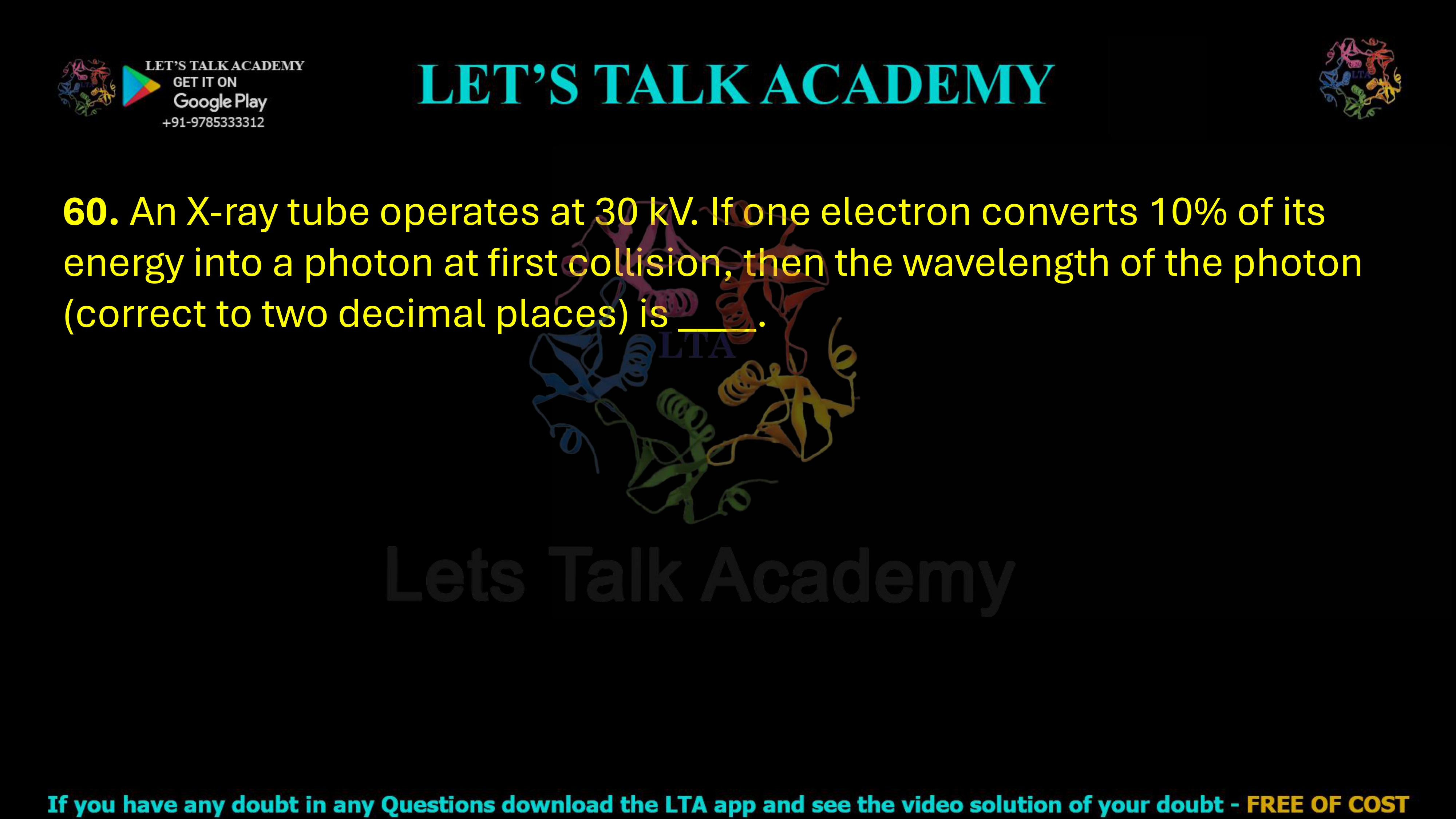
60. An X-ray tube operates at 30 kV. If one electron converts 10% of its energy into a photon at first collision, then the wavelength of the photon (correct to two decimal places) is ____.
X-ray Tube Operates at 30 kV – Photon Wavelength Calculation with Complete Theory and Detailed Solution
Correct Answer
4.13 × 10⁻¹⁰ m
or
0.413 nm
or
4.13 Å
Understanding How an X-ray Tube Works
An X-ray tube consists of a heated cathode and a heavy metal target known as the anode. When the cathode is heated, electrons are emitted through thermionic emission. These electrons are accelerated towards the positively charged anode by applying a high potential difference.
The accelerating voltage determines the kinetic energy gained by each electron. As the high-speed electrons strike the target metal, they undergo sudden deceleration. During this deceleration, a part of their kinetic energy is converted into electromagnetic radiation in the form of X-rays. This process is known as Bremsstrahlung radiation, meaning “braking radiation.”
Not all of the electron’s kinetic energy is converted into X-rays. In practice, most of the energy is converted into heat, while only a small fraction appears as X-ray photons.
Concept Behind the Numerical
The kinetic energy gained by an electron accelerated through a potential difference V is given by:
Electron Energy = eV
where
- e = electronic charge
- V = accelerating voltage
In this question, only 10% of the electron’s energy is converted into a single photon.
Therefore,
Photon Energy = 0.10 × eV
The energy of a photon is also given by Planck’s equation:
E = hc / λ
where
- h = Planck’s constant
- c = speed of light
- λ = wavelength
By equating the photon energy to the converted electron energy, we can determine the wavelength.
Given Data
Accelerating voltage
V = 30 kV = 30,000 V
Energy converted into photon
10% = 0.10
Planck’s constant
h = 6.626 × 10⁻³⁴ J s
Speed of light
c = 3 × 10⁸ m/s
Electronic charge
e = 1.6 × 10⁻¹⁹ C
Step-by-Step Solution
Step 1: Calculate the kinetic energy of one electron.
Electron energy
E = eV
= (1.6 × 10−19) × (30,000)
= 4.8 × 10⁻¹⁵ J
Step 2: Calculate the energy converted into the photon.
Only 10% becomes X-ray energy.
Photon Energy
= 0.10 × 4.8 × 10−15
= 4.8 × 10⁻¹⁶ J
Step 3: Use Planck’s equation.
E = hc / λ
Therefore,
λ = hc / E
= (6.626 × 10−34 × 3 × 108) / (4.8 × 10⁻¹⁶)
= (1.9878 × 10⁻²⁵) / (4.8 × 10⁻¹⁶)
= 4.14 × 10⁻¹⁰ m
Correct to two decimal places,
λ = 4.13 × 10⁻¹⁰ m
Answer in Different Units
Since different examinations may ask for different units, it is useful to convert the wavelength.
- 4.13 × 10⁻¹⁰ m
- 0.413 nm
- 4.13 Å
All three values represent the same wavelength.
Why is the Wavelength Larger Than the Minimum Wavelength?
The minimum possible wavelength of an X-ray is produced only when an electron converts 100% of its kinetic energy into a single photon. This condition gives rise to the well-known Duane–Hunt law.
However, in this problem only 10% of the electron’s kinetic energy is converted into the photon. Since photon energy is much smaller, the wavelength becomes correspondingly larger because wavelength and energy are inversely proportional.
Thus, the emitted photon has a wavelength ten times larger than the minimum wavelength that could be produced by a 30 kV X-ray tube.
Physical Interpretation
In practical X-ray tubes, electrons rarely convert all their kinetic energy into a single photon. Most collisions produce heat, while only a small fraction of the energy appears as X-rays. Consequently, the emitted X-ray spectrum contains photons of many different wavelengths, forming a continuous spectrum known as Bremsstrahlung radiation. Characteristic X-rays are produced only when inner-shell electrons of the target atoms are ejected and higher-energy electrons fill the vacancies.
Final Answer
The wavelength of the emitted X-ray photon is
λ = 4.13 × 10⁻¹⁰ m
Equivalent values:
- 0.413 nm
- 4.13 Å
Final Answer: 4.13 × 10⁻¹⁰ m


