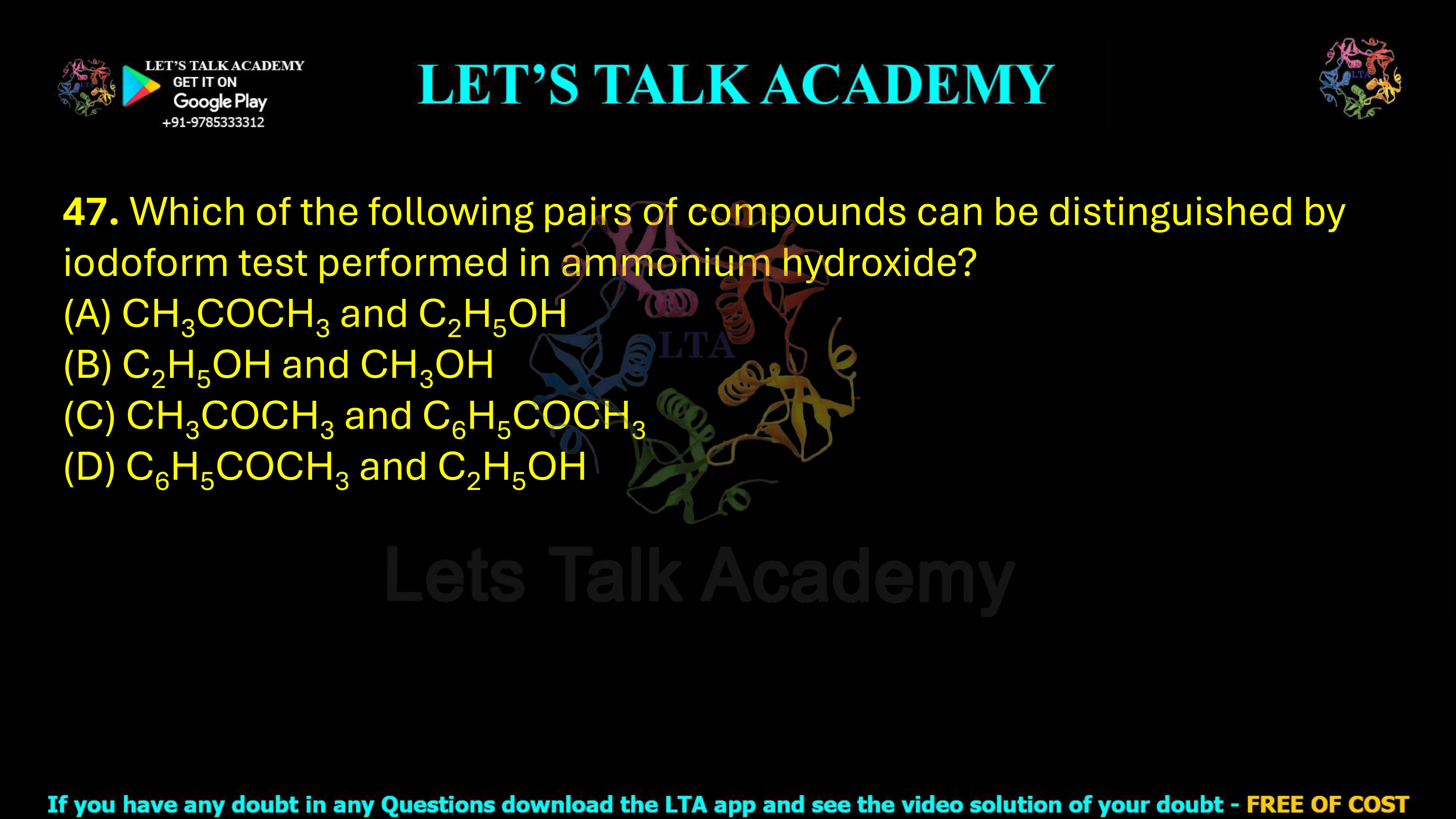
(A) CH3COCH3 and C2H5OH
(B) C2H5OH and CH3OH
(C) CH3COCH3 and C6H5COCH3
(D) C6H5COCH3 and C2H5OH
Iodoform Test in Ammonium Hydroxide: Which Pair of Compounds Can Be Distinguished?
Correct Answer: (D) C6H5COCH3 and C2H5OH
Understanding the Iodoform Test in Ammonium Hydroxide
The iodoform test in ammonium hydroxide is an important qualitative test in organic chemistry used to identify compounds capable of producing iodoform (CHI3). A positive iodoform test is indicated by the formation of a characteristic yellow precipitate of iodoform. Compounds containing a methyl ketone group, –COCH3, and certain alcohols that can be oxidized to suitable carbonyl compounds may give this reaction.
However, this question specifically mentions that the test is performed in ammonium hydroxide (NH4OH). This condition is important because ammonium hydroxide provides a weaker basic medium than sodium hydroxide or potassium hydroxide. Therefore, the behaviour of certain organic compounds may differ from their behaviour in the conventional strongly alkaline iodoform test.
Why Is Ammonium Hydroxide Important in the Iodoform Test?
In the usual iodoform reaction, a sufficiently alkaline medium helps the repeated iodination of the methyl group adjacent to the carbonyl group. After complete iodination, cleavage occurs and yellow iodoform, CHI3, is formed. When ammonium hydroxide is used instead of a strong alkali, the reaction medium is comparatively mild.
Under the specified conditions, ethanol gives a positive iodoform test because it can be oxidized to acetaldehyde, CH3CHO, which subsequently undergoes the iodoform reaction. In contrast, acetophenone, C6H5COCH3, does not readily give the same positive result under these weaker ammonium hydroxide conditions. This difference allows acetophenone and ethanol to be distinguished.
Detailed Analysis of Each Option
Option (A): CH3COCH3 and C2H5OH
CH3COCH3, commonly known as acetone, is a methyl ketone. It contains the characteristic CH3CO– group required for the iodoform reaction. Therefore, acetone produces the characteristic yellow precipitate of CHI3.
C2H5OH, or ethanol, also gives a positive iodoform test. Ethanol is first oxidized to acetaldehyde, CH3CHO, which then undergoes further iodination and cleavage to produce iodoform.
Since both compounds give a positive result, they cannot be effectively distinguished from each other by observing only the iodoform test result. Therefore, option (A) is incorrect.
Option (B): C2H5OH and CH3OH
Ethanol, C2H5OH, gives a positive iodoform test because it is oxidized to acetaldehyde. Acetaldehyde contains the necessary structural arrangement required for the formation of CHI3.
Methanol, CH3OH, does not give the iodoform test because its oxidation produces formaldehyde, HCHO. Formaldehyde does not contain the required structural arrangement and therefore cannot undergo the haloform reaction to form iodoform.
Although these compounds show different behaviour in the general iodoform test, the specific chemistry emphasized in this question concerns the selective behaviour under the stated ammonium hydroxide conditions. Therefore, option (B) is not the intended correct answer.
Option (C): CH3COCH3 and C6H5COCH3
Acetone, CH3COCH3, is an aliphatic methyl ketone and readily undergoes the iodoform reaction. It forms the characteristic yellow precipitate of CHI3.
Acetophenone, C6H5COCH3, is an aromatic methyl ketone. In the conventional iodoform test using a strong alkali such as NaOH or KOH, acetophenone is structurally capable of giving the iodoform reaction because it contains the CH3CO– group. However, the use of weak ammonium hydroxide changes the reaction conditions and affects the readiness of acetophenone to undergo the complete reaction.
The intended distinguishing pair under the specified conditions is acetophenone and ethanol. Therefore, option (C) is incorrect.
Option (D): C6H5COCH3 and C2H5OH
Acetophenone, C6H5COCH3, is an aromatic methyl ketone. Although it can respond to the conventional iodoform test in a strongly alkaline medium, its reaction does not readily proceed in the same way when the test is carried out using weak ammonium hydroxide.
Ethanol, C2H5OH, behaves differently. It is oxidized to acetaldehyde, CH3CHO, and subsequently produces the characteristic yellow precipitate of iodoform, CHI3. Therefore, ethanol gives a positive result, whereas acetophenone does not readily give the same result under the specified conditions.
This clear difference in observation makes it possible to distinguish the two compounds. Hence, option (D) is the correct answer.
Chemical Basis of the Positive Iodoform Test
A compound gives a positive iodoform test when it contains a methyl ketone group or can be converted into a compound containing the required structural arrangement. The general methyl ketone structure can be represented as:
R–CO–CH3
During the reaction, the three hydrogen atoms of the methyl group adjacent to the carbonyl group are successively replaced by iodine atoms. The resulting triiodomethyl carbonyl compound then undergoes cleavage in the basic medium to produce a carboxylate ion and iodoform.
RCOCH3 + 3I2 + 4OH− → RCOO− + CHI3↓ + 3I− + 3H2O
The formation of the pale-yellow to yellow precipitate of CHI3 confirms a positive iodoform test.
Why Does Ethanol Give the Iodoform Test?
Ethanol is a special primary alcohol because it gives a positive iodoform test. The reason is that ethanol can be oxidized to acetaldehyde:
CH3CH2OH → CH3CHO
The acetaldehyde formed then undergoes the required iodination and cleavage reactions to produce yellow iodoform. Methanol cannot follow this pathway because it is oxidized to formaldehyde, HCHO, which lacks the required structural arrangement for the formation of iodoform.
Final Answer
The pair that can be distinguished by the iodoform test performed in ammonium hydroxide is C6H5COCH3 and C2H5OH. Under the specified mild basic conditions, ethanol gives a positive iodoform test with the formation of a yellow CHI3 precipitate, whereas acetophenone does not readily give the same reaction.
Therefore, the correct answer is Option (D): C6H5COCH3 and C2H5OH.


