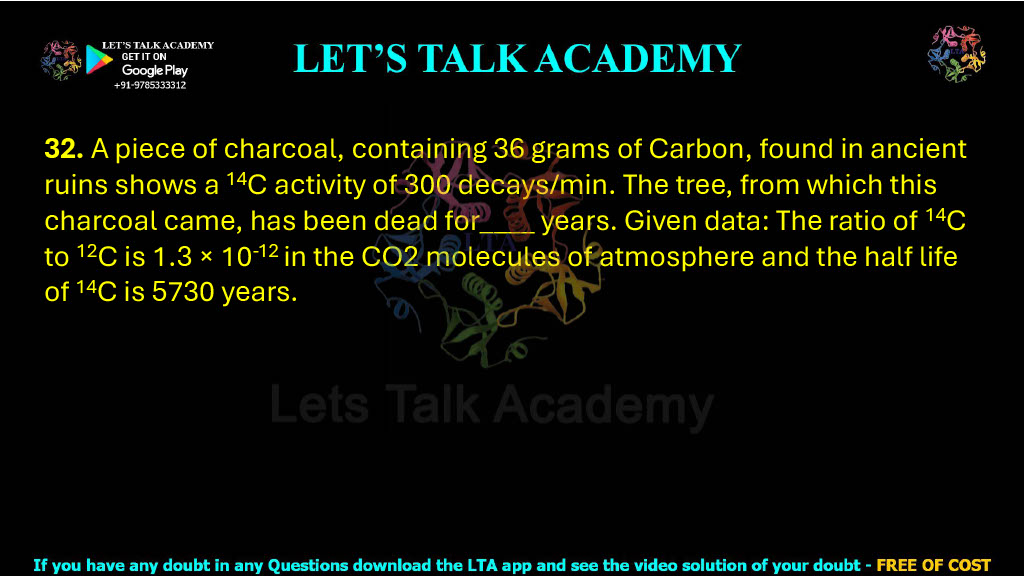
32. A piece of charcoal, containing 36 grams of Carbon, found in ancient ruins shows a 14C activity of 300 decays/min. The tree, from which this charcoal came, has been dead for____ years. Given data: The ratio of 14C to 12C is 1.3 × 10⁻¹² in the CO2 molecules of atmosphere and the half life of 14C is 5730 years.
Carbon-14 Dating Numerical: Calculate the Age of Charcoal from Its Radioactive Activity
Given data:
Ratio of ¹⁴C to ¹²C in atmospheric CO₂ = 1.3 × 10⁻¹²
Half-life of ¹⁴C = 5730 years
Observed activity of the charcoal = 300 decays/min
Correct Answer: Approximately 4867 years
The tree from which the charcoal originated has been dead for approximately 4867 years. To solve this radiocarbon dating problem, we first calculate the original number of ¹⁴C atoms present when the tree was alive. From this value, we determine the initial radioactive activity of the carbon sample. Finally, the decrease in activity from the initial value to the observed value of 300 decays per minute is used to calculate the time elapsed since the death of the tree.
This problem is slightly more advanced than a standard Carbon-14 half-life question because the initial activity is not directly provided. It must first be calculated using the mass of carbon, the atmospheric ¹⁴C/¹²C ratio, and the radioactive decay constant.
Understanding the Given Information
The charcoal sample contains 36 g of carbon and currently produces 300 radioactive decays per minute. While the tree was alive, its carbon isotope ratio was assumed to be in equilibrium with atmospheric carbon. The given atmospheric ratio is:
¹⁴C/¹²C = 1.3 × 10⁻¹²
The half-life of Carbon-14 is:
t₁/₂ = 5730 years
The calculation requires three major steps. First, we determine the number of ¹²C atoms in 36 g of carbon. Second, we use the given isotope ratio to calculate the initial number of ¹⁴C atoms. Third, we calculate the initial activity and compare it with the present activity to determine the age of the charcoal.
Step-by-Step Calculation of the Age of the Charcoal
Step 1: Calculate the Number of Moles of Carbon
The charcoal contains 36 g of carbon. Taking the molar mass of ¹²C as 12 g mol⁻¹:
Number of moles = Mass/Molar mass
Therefore:
Number of moles = 36/12 = 3 mol
Thus, the charcoal sample contains approximately 3 moles of carbon atoms.
Step 2: Calculate the Number of ¹²C Atoms
One mole contains Avogadro’s number of particles:
Nₐ = 6.022 × 10²³ atoms mol⁻¹
Therefore, the number of ¹²C atoms in 3 moles is:
Number of ¹²C atoms = 3 × 6.022 × 10²³
Number of ¹²C atoms = 1.8066 × 10²⁴ atoms
Thus, the sample originally contained approximately:
N(¹²C) = 1.8066 × 10²⁴ atoms
Because ¹⁴C is present only in a tiny proportion, treating the 36 g sample as essentially ¹²C is an excellent approximation.
Step 3: Calculate the Initial Number of ¹⁴C Atoms
The atmospheric isotope ratio is given as:
¹⁴C/¹²C = 1.3 × 10⁻¹²
Therefore:
N₀(¹⁴C) = 1.3 × 10⁻¹² × N(¹²C)
Substituting the number of ¹²C atoms:
N₀(¹⁴C) = 1.3 × 10⁻¹² × 1.8066 × 10²⁴
Therefore:
N₀(¹⁴C) = 2.34858 × 10¹² atoms
Thus, when the tree was alive, the carbon corresponding to the present charcoal sample contained approximately:
2.35 × 10¹² atoms of ¹⁴C
Calculating the Decay Constant of Carbon-14
The radioactive decay constant is related to the half-life by the equation:
λ = 0.693/t₁/₂
Since the observed activity is given in decays per minute, it is convenient to express the half-life in minutes.
The half-life is:
5730 years
Using:
1 year = 365 days
1 day = 24 hours
1 hour = 60 minutes
the half-life in minutes is:
t₁/₂ = 5730 × 365 × 24 × 60
t₁/₂ = 3.011688 × 10⁹ minutes
Therefore:
λ = 0.693/(3.011688 × 10⁹)
λ ≈ 2.301 × 10⁻¹⁰ min⁻¹
This value represents the probability of decay per unit time for a ¹⁴C nucleus.
Calculating the Initial Activity of the Living Tree
Radioactive activity is related to the number of radioactive atoms by:
A = λN
At the time the tree died:
A₀ = λN₀
Substituting the calculated values:
A₀ = (2.301 × 10⁻¹⁰) × (2.34858 × 10¹²)
Therefore:
A₀ ≈ 540.5 decays/min
Thus, the carbon sample would have had an activity of approximately 540.5 decays per minute when the tree was alive.
The charcoal currently shows an activity of:
A = 300 decays/min
The decrease from approximately 540.5 decays/min to 300 decays/min occurred because Carbon-14 underwent radioactive decay after the death of the tree.
Using the Radioactive Activity Equation to Calculate Age
Radioactive activity decreases exponentially according to the equation:
A = A₀e⁻ˡᵗ
where A is the present activity, A₀ is the initial activity, λ is the decay constant, and t is the elapsed time.
For Carbon-14 dating, the equation can also be written in terms of half-life:
A/A₀ = (1/2)^(t/5730)
Substituting the values:
300/540.5 = (1/2)^(t/5730)
Therefore:
0.555 = (1/2)^(t/5730)
Taking natural logarithms:
ln(0.555) = (t/5730) ln(1/2)
Rearranging:
t = 5730 × [ln(0.555)/ln(0.5)]
This gives:
t ≈ 4867 years
Therefore, the tree has been dead for approximately 4867 years.
Alternative Calculation Using the Decay Constant Formula
The same answer can be obtained directly from:
A = A₀e⁻ˡᵗ
Rearranging the equation:
A₀/A = eˡᵗ
Taking the natural logarithm:
ln(A₀/A) = λt
Therefore:
t = (1/λ) ln(A₀/A)
Using the decay constant in years:
λ = 0.693/5730 year⁻¹
and substituting:
t = (5730/0.693) ln(540.5/300)
The activity ratio is:
540.5/300 ≈ 1.8017
Therefore:
t = (5730/0.693) × ln(1.8017)
t ≈ 4867 years
This confirms the answer obtained by the half-life form of the radioactive decay equation.
Why Must the Initial Carbon-14 Activity Be Calculated First?
In many simple radiocarbon dating questions, both the initial and present amounts of ¹⁴C are given directly. In this question, however, only the present activity is given.
The initial activity must therefore be reconstructed from the information about the living tree. While alive, the tree continuously exchanged carbon with the atmosphere through photosynthesis. Its ¹⁴C/¹²C ratio was therefore assumed to match the atmospheric value given in the question.
The calculation follows this sequence:
Mass of carbon → Number of ¹²C atoms → Number of ¹⁴C atoms → Initial activity → Age of charcoal
Understanding this sequence is essential because directly using 300 decays/min without calculating the initial activity would not provide enough information to determine the age.
Why Does Carbon-14 Activity Decrease After the Tree Dies?
While a tree is alive, it continuously absorbs carbon dioxide during photosynthesis. This carbon includes both stable carbon isotopes and a very small quantity of radioactive ¹⁴C.
As long as the tree remains alive, carbon exchange with the environment continues. After death, however, the tree no longer absorbs atmospheric carbon dioxide. No fresh Carbon-14 enters its tissues.
The existing ¹⁴C atoms continue to decay, causing the total number of radioactive atoms and the measured activity to decrease with time.
Therefore:
Living tree → continuous carbon exchange
Dead tree → carbon exchange stops
After death → ¹⁴C decreases by radioactive decay
The amount of Carbon-14 remaining therefore acts as a natural radioactive clock.
Relationship Between Radioactive Activity and Number of Carbon-14 Atoms
Radioactive activity is defined as the number of nuclear decays occurring per unit time. It is given by:
A = λN
where A is the activity, λ is the decay constant, and N is the number of radioactive atoms.
This equation shows that activity is directly proportional to the number of ¹⁴C atoms present. If the number of radioactive atoms decreases, the activity also decreases in exactly the same proportion.
Therefore:
A/A₀ = N/N₀
This is why radioactive activity can be used directly in the Carbon-14 decay equation. The ratio of present activity to initial activity behaves exactly like the ratio of the present number of ¹⁴C atoms to the initial number.
Why the Age Is Less Than One Carbon-14 Half-Life
The half-life of Carbon-14 is 5730 years. After one complete half-life, the activity would fall to exactly half of its initial value.
The initial activity calculated for the sample is approximately:
A₀ = 540.5 decays/min
After one half-life, the expected activity would be:
540.5/2 = 270.25 decays/min
However, the measured activity is:
300 decays/min
Since 300 decays/min is greater than 270.25 decays/min, less than one complete half-life has elapsed.
Therefore, the calculated age must be less than 5730 years. The answer of approximately 4867 years is consistent with this expectation.
Significance of the ¹⁴C to ¹²C Ratio
The given atmospheric ratio:
¹⁴C/¹²C = 1.3 × 10⁻¹²
means that Carbon-14 is extremely rare compared with Carbon-12. For every enormous number of ¹²C atoms, only a tiny number of ¹⁴C atoms are present.
Despite this low abundance, ¹⁴C is useful for dating because it is radioactive and decays at a predictable rate. Carbon-12 is stable and provides the reference against which the initial Carbon-14 abundance can be estimated.
In this question, the isotope ratio allows us to calculate the original number of radioactive ¹⁴C atoms in the 36 g carbon sample.
Complete Calculation at a Glance
The 36 g carbon sample contains:
36/12 = 3 mol of carbon
Therefore, the number of ¹²C atoms is:
3 × 6.022 × 10²³ = 1.8066 × 10²⁴ atoms
Using the atmospheric ratio:
N₀(¹⁴C) = 1.3 × 10⁻¹² × 1.8066 × 10²⁴
N₀(¹⁴C) = 2.34858 × 10¹² atoms
The Carbon-14 decay constant is:
λ = 0.693/(5730 × 365 × 24 × 60)
λ ≈ 2.301 × 10⁻¹⁰ min⁻¹
Therefore, the initial activity was:
A₀ = λN₀
A₀ ≈ 540.5 decays/min
Using the present activity of 300 decays/min:
300/540.5 = (1/2)^(t/5730)
Solving for t:
t ≈ 4867 years
Final Answer
The original 36 g carbon sample contained approximately 2.35 × 10¹² atoms of ¹⁴C when the tree was alive. This corresponds to an initial activity of approximately 540.5 decays per minute.
The present activity is only 300 decays per minute. Applying the radioactive decay equation with a Carbon-14 half-life of 5730 years gives:
Age of charcoal ≈ 4867 years
Therefore, the tree from which the charcoal came has been dead for approximately:
Correct Answer: 4867 years


