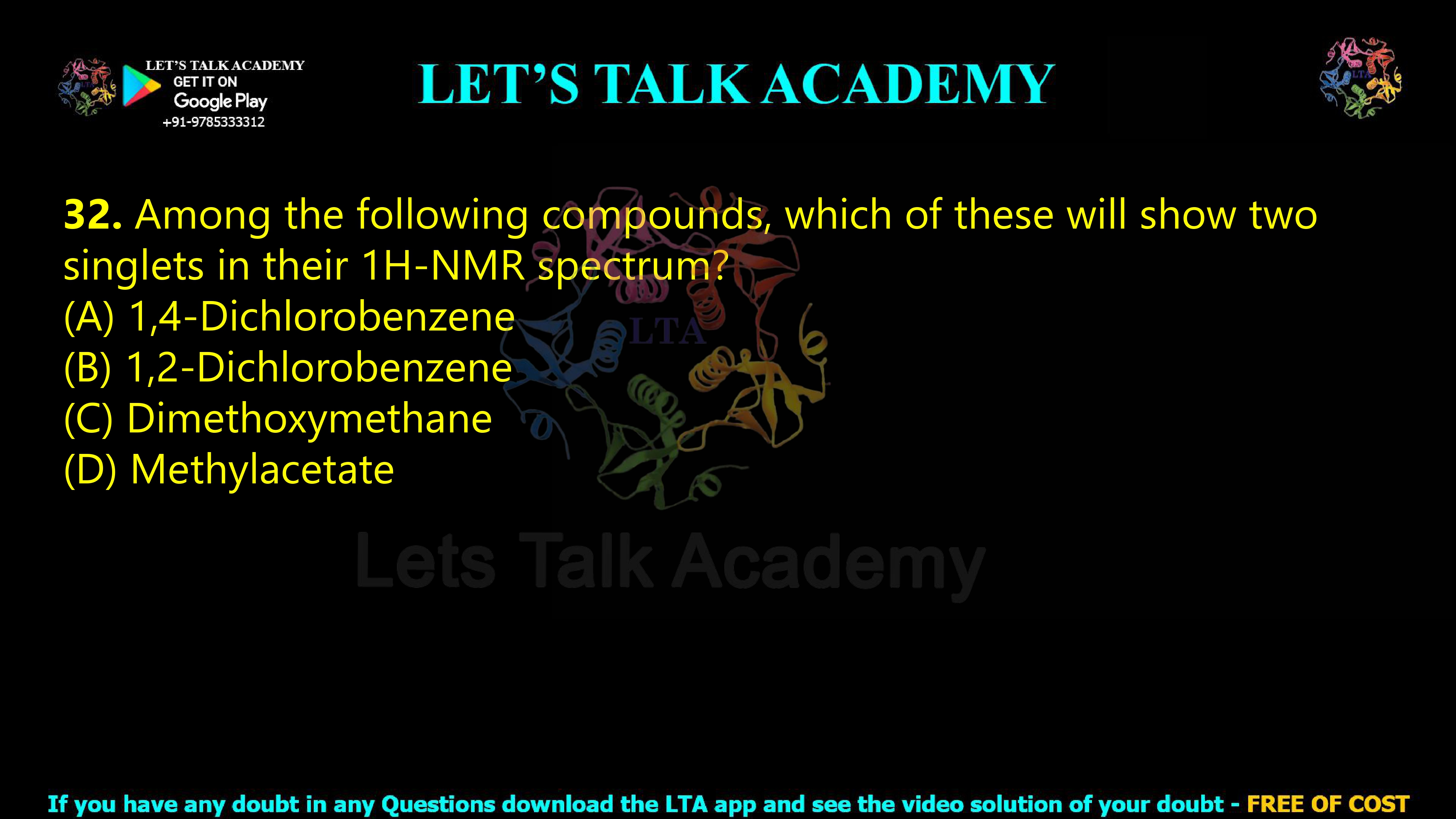
31. Among the following compounds, which of these will show two singlets in their 1H-NMR spectrum?
(A) 1,4-Dichlorobenzene
(B) 1,2-Dichlorobenzene
(C) Dimethoxymethane
(D) Methylacetate
Which Compounds Show Two Singlets in Their ¹H NMR Spectrum?
Correct Answer
Correct Options: (C) Dimethoxymethane and (D) Methyl acetate
Both dimethoxymethane and methyl acetate show two singlets in their ¹H NMR spectra. The reason is that each compound contains exactly two chemically distinct sets of protons, and neither proton set undergoes significant splitting by neighboring non-equivalent hydrogens under the usual first-order interpretation.
Dimethoxymethane has the structure:
CH3O–CH2–OCH3
The two terminal methoxy groups are equivalent and together form one set of six protons. The central methylene group forms a second set of two protons. Both signals appear as singlets.
Methyl acetate has the structure:
CH3–C(=O)–O–CH3
The acetyl methyl group and methoxy methyl group are chemically different and therefore produce two separate signals. Neither methyl group has neighboring hydrogen atoms on an adjacent atom that produce ordinary vicinal splitting, so both signals appear as singlets.
Therefore:
Correct Answer: (C) and (D)
How to Identify a Compound That Shows Two Singlets in ¹H NMR
Two Conditions Must Be Satisfied
To determine whether a compound will show exactly two singlets in its proton NMR spectrum, two separate questions must be answered. First, the molecule must contain exactly two chemically distinct proton environments. Second, each of these proton environments must appear without observable splitting into doublets, triplets, quartets or more complex multiplets.
The number of signals and the multiplicity of signals are related to different concepts. The number of signals depends on the number of chemically non-equivalent proton sets, whereas the splitting pattern depends mainly on spin-spin coupling with neighboring non-equivalent protons.
Therefore, a molecule that gives two singlets must satisfy the following pattern:
Two chemically different proton sets + no effective splitting of either set = two singlets
This principle immediately makes dimethoxymethane and methyl acetate the strongest candidates among the given options.
Understanding What a Singlet Means in ¹H NMR Spectroscopy
A Singlet Is an Unsplit Proton Signal
In ¹H NMR spectroscopy, a singlet is a signal that appears as a single resonance line. Under the basic n + 1 rule, a set of protons with no neighboring non-equivalent protons is expected to appear as a singlet.
The basic relationship is:
Multiplicity = n + 1
where n represents the number of equivalent neighboring protons that cause splitting.
If:
n = 0
then:
n + 1 = 1
A one-line signal is a singlet.
However, this rule must be applied carefully. Aromatic systems often show coupling patterns that are more complicated than simple n + 1 predictions. Therefore, molecular symmetry, chemical equivalence and proton coupling must all be considered before identifying a signal as a singlet.
Option (A): 1,4-Dichlorobenzene
Why 1,4-Dichlorobenzene Does Not Show Two Singlets
Option (A) is incorrect. The structure of 1,4-dichlorobenzene contains two identical chlorine atoms positioned opposite each other on the benzene ring.
The structure can be represented as:
Cl–C6H4–Cl
with the chlorine substituents occupying the 1 and 4 positions.
The molecule possesses a high degree of symmetry. Because the two substituents are identical, the aromatic protons are related by symmetry and do not generate two independent singlet signals of the type required by the question.
The important point is that 1,4-dichlorobenzene does not contain two separate isolated aliphatic proton environments that each give an unsplit resonance. Therefore, it cannot be selected as a compound showing two singlets.
In simplified proton-equivalence analysis, the high molecular symmetry makes the aromatic hydrogens chemically equivalent, producing a single proton environment rather than two independent proton environments.
Therefore:
1,4-Dichlorobenzene → Not two singlets
Hence, Option (A) is incorrect.
Option (B): 1,2-Dichlorobenzene
Why 1,2-Dichlorobenzene Does Not Show Two Singlets
Option (B) is incorrect. In 1,2-dichlorobenzene, the two chlorine atoms occupy adjacent positions on the benzene ring.
The molecule contains aromatic protons that are divided into different chemical environments. However, having two types of proton environments does not automatically mean that the spectrum will contain two singlets.
The aromatic protons are located close enough to undergo spin-spin coupling with neighboring aromatic hydrogens. In particular, ortho coupling between adjacent aromatic protons is generally significant. Meta coupling may also contribute to the detailed spectral pattern.
As a result, the aromatic proton signals are split and generally appear as complex multiplets rather than two clean singlets.
The essential reasoning is:
Different aromatic proton environments + proton-proton coupling → Split signals, not two singlets
Therefore:
1,2-Dichlorobenzene → Does not show two singlets
Hence, Option (B) is incorrect.
Option (C): Dimethoxymethane
Why Dimethoxymethane Shows Two Singlets
Option (C) is correct. Dimethoxymethane has the molecular structure:
CH3O–CH2–OCH3
This molecule contains eight hydrogen atoms, but the number of ¹H NMR signals is not determined by the total number of hydrogen atoms. Instead, the signals are counted by identifying chemically distinct proton environments.
Dimethoxymethane contains two types of protons:
Set 1: Two equivalent OCH3 groups = 6H
Set 2: Central O–CH2–O group = 2H
The two methoxy groups are equivalent because the molecule is symmetrical. Therefore, all six methyl protons produce one NMR signal.
The central methylene protons are in a different chemical environment because the carbon is bonded to two oxygen atoms. These two protons produce a second NMR signal.
Therefore:
Number of chemically distinct proton sets = 2
The next step is to determine the splitting pattern of each signal.
Why the Six Methoxy Protons Give a Singlet
The six methoxy protons belong to two equivalent CH3 groups:
CH3O– and –OCH3
The carbon atoms of these methyl groups are directly attached to oxygen. There are no ordinary vicinal hydrogens on an adjacent carbon that split these methyl proton signals.
Although the central CH2 group is present elsewhere in the molecule, it is separated from each methyl group by an oxygen atom. In standard introductory ¹H NMR analysis, coupling across oxygen is not considered significant for this problem.
Therefore, the six equivalent methoxy protons produce:
One singlet integrating to 6H
Why the Central CH₂ Protons Give a Singlet
The central methylene group has the environment:
O–CH2–O
This carbon is located between two oxygen atoms. There are no directly adjacent carbon atoms carrying hydrogens that would produce normal vicinal splitting.
Therefore, the central CH2 signal remains unsplit and appears as:
One singlet integrating to 2H
The complete proton NMR pattern of dimethoxymethane is therefore:
Singlet 1: 6H from two equivalent OCH3 groups
Singlet 2: 2H from the central O–CH2–O group
Thus:
Dimethoxymethane → Two singlets
Therefore, Option (C) is correct.
Option (D): Methyl Acetate
Why Methyl Acetate Shows Two Singlets
Option (D) is correct. Methyl acetate, also known as methyl ethanoate, has the structure:
CH3–C(=O)–O–CH3
The molecule contains two methyl groups, but these methyl groups are not chemically equivalent because they are present in very different electronic environments.
The first methyl group is directly attached to a carbonyl carbon:
CH3–C(=O)–
The second methyl group is directly attached to oxygen:
–O–CH3
Therefore, methyl acetate contains exactly two chemically distinct proton environments.
These can be represented as:
Set 1: Acetyl methyl protons = 3H
Set 2: Methoxy methyl protons = 3H
Because these two proton sets experience different electronic environments, they appear at different chemical shifts.
Why the Acetyl CH₃ Group Gives a Singlet
The acetyl methyl group has the structure:
CH3–C(=O)–
The carbon directly adjacent to this methyl group is the carbonyl carbon. A carbonyl carbon has no hydrogen atoms attached to it.
Therefore, the acetyl methyl protons have no neighboring protons that can produce ordinary vicinal splitting.
Using the basic n + 1 concept:
n = 0
Therefore:
n + 1 = 1
The acetyl methyl group produces:
One singlet integrating to 3H
Why the Methoxy CH₃ Group Gives a Singlet
The second methyl group has the environment:
–C(=O)–O–CH3
This methyl group is directly attached to an oxygen atom. There are no neighboring hydrogen atoms on an adjacent carbon that produce ordinary vicinal coupling.
Therefore, the methoxy methyl protons also remain unsplit and produce:
One singlet integrating to 3H
The complete proton NMR pattern of methyl acetate is therefore:
Singlet 1: 3H from CH3–C(=O)–
Singlet 2: 3H from –O–CH3
Thus:
Methyl acetate → Two singlets
Therefore, Option (D) is correct.
Detailed Comparison of All Four Compounds
| Option | Compound | Proton NMR Behaviour | Two Singlets? |
|---|---|---|---|
| A | 1,4-Dichlorobenzene | Highly symmetrical aromatic proton environment | No |
| B | 1,2-Dichlorobenzene | Aromatic proton coupling produces split signals | No |
| C | Dimethoxymethane | One 6H singlet and one 2H singlet | Yes |
| D | Methyl acetate | Two separate 3H singlets | Yes |
¹H NMR Pattern of Dimethoxymethane
Two Proton Environments Produce Two Singlets
Dimethoxymethane contains two equivalent methoxy groups and one central methylene group:
CH3O–CH2–OCH3
The two methoxy groups are related by molecular symmetry, so their six protons are chemically equivalent. They produce one singlet with an integration of 6H.
The central CH2 group is chemically different and produces a second singlet with an integration of 2H.
Therefore:
Dimethoxymethane: 2 signals = 2 singlets
Integration ratio = 6H : 2H = 3 : 1
¹H NMR Pattern of Methyl Acetate
Two Different Methyl Groups Produce Two Singlets
Methyl acetate contains an acetyl methyl group and a methoxy methyl group:
CH3–C(=O)–O–CH3
The acetyl methyl protons form one chemically equivalent set, while the methoxy methyl protons form a second chemically equivalent set.
Neither set has neighboring protons that produce normal vicinal splitting. Therefore, both signals are singlets.
Thus:
Methyl acetate: 2 signals = 2 singlets
Integration ratio = 3H : 3H = 1 : 1
Why Having Two Proton Environments Does Not Always Mean Two Singlets
Signal Number and Signal Splitting Must Be Analyzed Separately
A molecule may contain two chemically distinct proton environments and still fail to show two singlets. This is because each signal may be split by neighboring protons.
For example, 1,2-dichlorobenzene contains different aromatic proton environments, but the aromatic hydrogens undergo spin-spin coupling. As a result, the signals are split rather than appearing as simple singlets.
Therefore, two separate questions must always be considered:
How many chemically distinct proton environments are present?
Does each proton environment undergo spin-spin splitting?
Only when there are exactly two proton environments and both remain unsplit will the spectrum show exactly two singlets.
Final Answer
Among the given compounds, dimethoxymethane and methyl acetate show two singlets in their ¹H NMR spectra.
Dimethoxymethane has the structure:
CH3O–CH2–OCH3
Its six equivalent methoxy protons produce one singlet, while the central two methylene protons produce a second singlet.
Methyl acetate has the structure:
CH3–C(=O)–O–CH3
Its acetyl methyl protons produce one singlet, while its methoxy methyl protons produce another singlet.
Therefore:
(A) 1,4-Dichlorobenzene – Incorrect
(B) 1,2-Dichlorobenzene – Incorrect
(C) Dimethoxymethane – Correct
(D) Methyl acetate – Correct
Correct Answer: (C) and (D)


