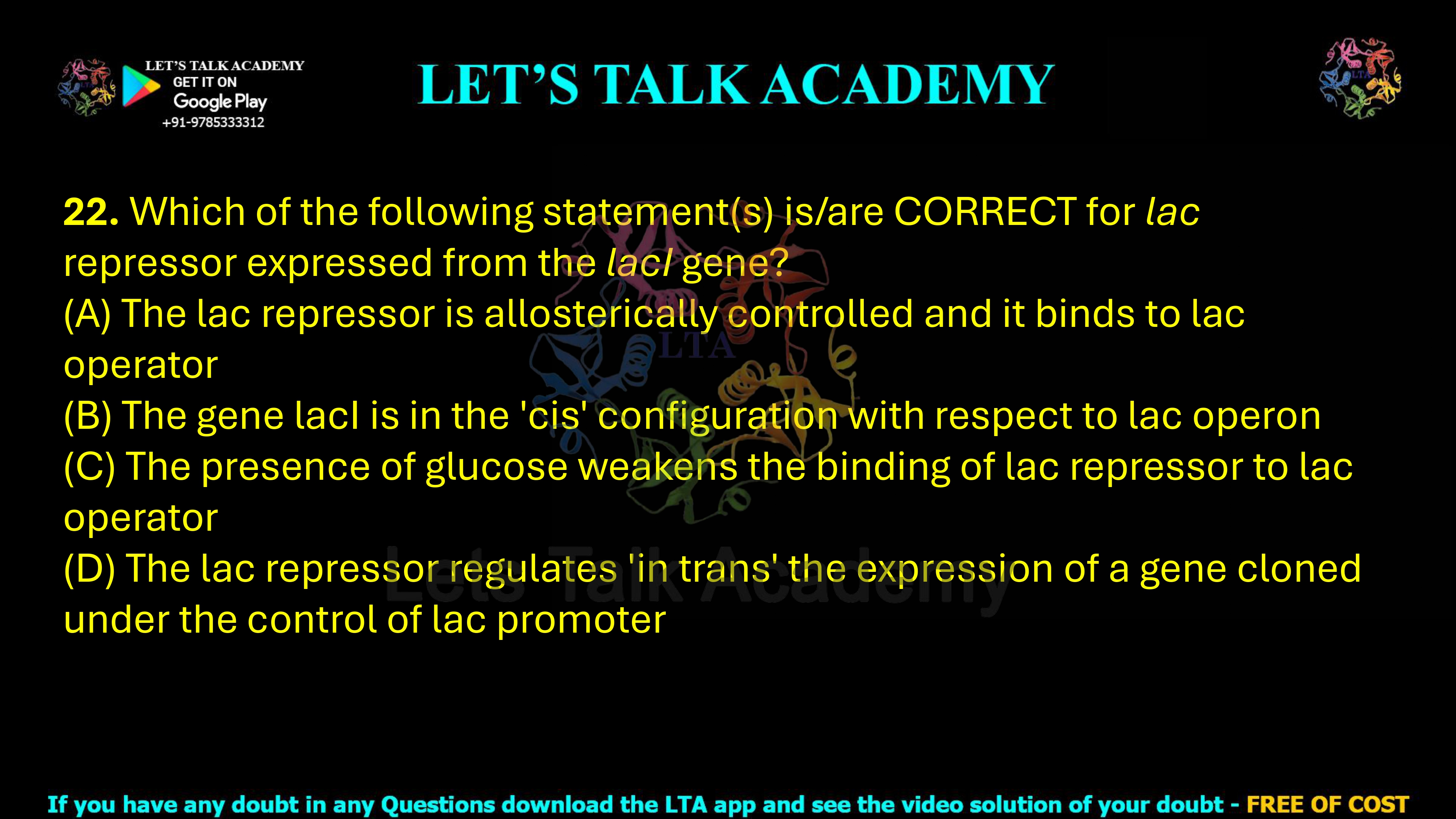
22. Which of the following statement(s) is/are CORRECT for lac repressor expressed from the lacI gene?
(A) The lac repressor is allosterically controlled and it binds to lac operator
(B) The gene lacI is in the ‘cis’ configuration with respect to lac operon
(C) The presence of glucose weakens the binding of lac repressor to lac operator
(D) The lac repressor regulates ‘in trans’ the expression of a gene cloned under the control of lac promoter
Lac Repressor Expressed from lacI Gene: Allosteric Control, Operator Binding and Trans-Acting Regulation Explained
Introduction
The lac operon is one of the most important and extensively studied models of gene regulation in bacteria. It explains how bacterial cells regulate gene expression according to the availability of nutrients, particularly lactose and glucose. A central component of this regulatory system is the lac repressor, a regulatory protein encoded by the lacI gene.
The lac repressor is an allosterically regulated DNA-binding protein. In the absence of an inducer, the repressor binds to the lac operator and inhibits transcription of genes controlled by the lac promoter. When an inducer such as allolactose binds to the repressor, it causes a conformational change that reduces the affinity of the repressor for the operator, allowing transcription to proceed.
An equally important concept is the distinction between cis-acting and trans-acting regulatory elements. The lac operator is a DNA sequence and therefore acts only on genes physically linked to it, making it cis-acting. In contrast, the lac repressor is a diffusible protein produced by the lacI gene. It can move through the cytoplasm and regulate any compatible lac operator present in the same cell. Therefore, the lac repressor acts in trans.
Based on these principles, statements (A) and (D) are correct. Statement (B) incorrectly describes lacI in terms of cis regulation, while statement (C) incorrectly attributes the effect of glucose to weakening of repressor-operator binding.
Correct Answer
Correct Statements: (A) and (D)
Incorrect Statements: (B) and (C)
Detailed Explanation
The lacI gene encodes the lac repressor protein. This repressor is a diffusible regulatory molecule that recognizes and binds specific operator DNA sequences associated with the lac regulatory system. In the absence of an inducer, the repressor binds to the operator and prevents efficient transcription from the lac promoter.
The lac repressor is allosterically regulated because the binding of an inducer molecule changes its conformation and alters its DNA-binding ability. In the natural lac system, allolactose acts as the physiological inducer. When allolactose binds the repressor, the repressor undergoes a conformational change and its affinity for the operator decreases.
Because the repressor is a protein that can diffuse within the bacterial cell, it is a trans-acting regulatory factor. This means that a lac repressor produced from one lacI gene can regulate another compatible lac promoter-operator system elsewhere in the same cell, including a cloned gene placed under the control of a lac promoter.
Glucose regulates the lac operon through a different regulatory mechanism involving cellular cAMP levels and the CAP/CRP regulatory protein. The presence of glucose does not directly weaken the binding of the lac repressor to the lac operator. Therefore, glucose regulation and inducer-mediated control of the lac repressor must be treated as distinct regulatory mechanisms.
Explanation of Option (A): The Lac Repressor Is Allosterically Controlled and It Binds to Lac Operator
This statement is correct.
The lac repressor is a classic example of an allosteric regulatory protein. An allosteric protein has distinct functional sites through which the binding of one molecule can alter the activity or binding behavior of the protein at another site.
The lac repressor contains a DNA-binding region that recognizes the lac operator and an inducer-binding region that interacts with molecules such as allolactose. In the absence of an inducer, the repressor has a high affinity for the operator and binds to the operator DNA. This binding interferes with productive transcription of the lac structural genes.
When allolactose binds to the lac repressor, the protein undergoes an allosteric conformational change. This change reduces the affinity of the repressor for the operator, allowing the operator to become accessible and transcription to increase.
The basic relationship can be represented as:
Absence of inducer → Lac repressor binds operator → Transcription repressed
Presence of inducer → Inducer binds repressor → Repressor affinity for operator decreases → Transcription permitted
Therefore, the lac repressor is both allosterically controlled and capable of binding the lac operator. Hence, statement (A) is correct.
Explanation of Option (B): The Gene lacI Is in the ‘Cis’ Configuration with Respect to lac Operon
This statement is incorrect in the regulatory context of the question.
The crucial concept is that the product of the lacI gene is a diffusible protein. Although the lacI gene is located near the lac operon on the bacterial chromosome, its regulatory effect is not restricted to genes physically linked to the same DNA molecule.
A lac repressor synthesized from lacI can diffuse through the cytoplasm and bind compatible operator sequences located elsewhere in the same bacterial cell. For this reason, the lacI gene product is described as trans-acting.
In contrast, the lac operator is a DNA sequence that cannot diffuse away from its physical position. It influences only the linked promoter and genes on the same DNA molecule and is therefore a cis-acting regulatory element.
Thus:
lacI gene product, the lac repressor → Trans-acting
lac operator DNA sequence → Cis-acting
Therefore, statement (B) is incorrect when cis and trans are being used to describe the regulatory behavior of the lac system.
Explanation of Option (C): The Presence of Glucose Weakens the Binding of Lac Repressor to Lac Operator
This statement is incorrect.
Glucose does not directly control the binding of the lac repressor to the operator. The binding of the lac repressor is primarily regulated by the presence or absence of an inducer such as allolactose.
When lactose is available, some of it is converted into allolactose. Allolactose binds to the lac repressor and causes an allosteric conformational change that reduces repressor binding to the operator.
Glucose acts through a different regulatory pathway known as catabolite repression. When glucose concentration is high, intracellular cAMP levels are generally low. Under these conditions, efficient formation of the active cAMP-CAP complex is reduced, and strong activation of transcription from the lac promoter does not occur.
When glucose concentration is low, cAMP concentration increases. cAMP binds to CAP, also called CRP, and the cAMP-CAP complex binds near the lac promoter to stimulate transcription.
Therefore:
Allolactose → Controls lac repressor binding
Glucose availability → Influences cAMP-CAP-mediated positive regulation
The presence of glucose does not directly weaken lac repressor binding to the operator. Hence, statement (C) is incorrect.
Explanation of Option (D): Lac Repressor Regulates in Trans a Gene Cloned under the Control of Lac Promoter
This statement is correct.
The lac repressor is a soluble and diffusible protein. Once produced from the lacI gene, it can move through the bacterial cytoplasm and interact with compatible operator sequences located on other DNA molecules in the same cell.
Suppose a foreign gene is cloned into a plasmid and placed under the control of a lac promoter-operator regulatory system. The lac repressor produced by a functional lacI gene can bind to the operator associated with this cloned construct and repress expression of the foreign gene.
The lacI gene and the regulated gene do not have to be physically present on the same DNA molecule. The lacI gene may be located on the bacterial chromosome, while the cloned target gene may be located on a plasmid. Because the repressor protein can diffuse from its site of synthesis to the target operator, regulation occurs in trans.
Therefore:
lacI gene → Produces diffusible lac repressor → Repressor reaches another lac operator → Gene expression regulated in trans
Hence, statement (D) is correct.
Summary of All Statements
| Option | Statement | Correct/Incorrect | Reason |
|---|---|---|---|
| (A) | Lac repressor is allosterically controlled and binds the lac operator | Correct | The repressor binds the operator and its DNA-binding affinity is altered by inducer binding. |
| (B) | lacI is in cis configuration with respect to the lac operon | Incorrect | The lacI gene produces a diffusible repressor whose regulatory action is trans-acting. |
| (C) | Glucose weakens lac repressor binding to the operator | Incorrect | Inducer binding controls the repressor; glucose mainly acts through the cAMP-CAP regulatory pathway. |
| (D) | Lac repressor regulates in trans a cloned gene under lac promoter control | Correct | The diffusible repressor can regulate a compatible promoter-operator system elsewhere in the same cell. |
What Is the lac Operon?
The lac operon is an inducible bacterial gene-regulatory system involved in the utilization of lactose. It contains three major structural genes: lacZ, lacY and lacA. These genes are transcribed together as a polycistronic mRNA.
The lacZ gene encodes β-galactosidase, an enzyme that cleaves lactose and also participates in the formation of allolactose. The lacY gene encodes lactose permease, which promotes the entry of lactose into the cell. The lacA gene encodes thiogalactoside transacetylase.
The expression of these genes is controlled by regulatory elements that include the promoter and operator, along with regulatory proteins such as the lac repressor and the cAMP-CAP complex.
Major Components of the lac Regulatory System
| Component | Type | Major Function |
|---|---|---|
| lacI | Regulatory gene | Encodes the lac repressor |
| Lac repressor | Diffusible protein | Binds the operator and represses transcription |
| lac promoter | DNA sequence | Site associated with transcription initiation |
| lac operator | Cis-acting DNA sequence | Binding site for the lac repressor |
| lacZ | Structural gene | Encodes β-galactosidase |
| lacY | Structural gene | Encodes lactose permease |
| lacA | Structural gene | Encodes thiogalactoside transacetylase |
How Does the Lac Repressor Work?
Condition 1: Lactose Is Absent
When lactose is absent, no significant amount of the natural inducer allolactose is available. The lac repressor therefore remains capable of binding strongly to the operator.
Operator-bound repressor interferes with productive transcription of the lac structural genes. Consequently, expression of the lactose-utilization genes remains very low.
No lactose → Active repressor → Operator occupied → lac genes repressed
Condition 2: Lactose Is Present
When lactose becomes available, a small amount can be converted into allolactose. Allolactose binds to the lac repressor and changes its conformation.
The altered repressor has reduced affinity for the operator. This relieves negative regulation and allows transcription to occur, although the final level of transcription also depends strongly on glucose availability and cAMP-CAP regulation.
Lactose available → Allolactose formed → Repressor changes conformation → Operator repression relieved
Why Is the Lac Repressor Called an Allosteric Protein?
An allosteric protein is regulated when the binding of a molecule at one site changes the behavior of another functional site. The lac repressor demonstrates this principle clearly.
The inducer binds to a regulatory site on the lac repressor rather than simply competing with operator DNA for the same binding site. Inducer binding causes a conformational change that alters the DNA-binding properties of the repressor.
Therefore, the regulatory sequence is:
Inducer binding → Conformational change in repressor → Reduced operator affinity → Increased possibility of transcription
This is why the lac repressor is considered a classic example of allosteric control in gene regulation.
Cis-Acting and Trans-Acting Regulation
Understanding the difference between cis-acting and trans-acting components is essential for solving lac operon questions. A cis-acting element is usually a DNA sequence whose regulatory effect is restricted to genes physically linked on the same DNA molecule. A trans-acting factor is generally a diffusible molecule that can act on compatible targets located elsewhere in the cell.
| Feature | Cis-Acting Element | Trans-Acting Factor |
|---|---|---|
| Typical Nature | DNA sequence | Diffusible protein or RNA |
| Can diffuse through the cell? | No | Yes |
| Acts on another DNA molecule? | Generally no | Yes, if a compatible target is present |
| Lac system example | lac operator | Lac repressor |
Why Is the lac Operator Cis-Acting?
The lac operator is a specific DNA sequence. Because it is physically part of a DNA molecule, it cannot diffuse through the cytoplasm and regulate a separate operator elsewhere.
An operator mutation generally affects the expression of genes physically linked to that particular operator. For this reason, the operator is described as cis-acting.
This behavior is fundamentally different from that of the lac repressor, which is a protein and can diffuse to different compatible operator sites.
Why Does the Lac Repressor Act in Trans?
The lac repressor is synthesized as a protein from the lacI gene. After translation, it is not permanently attached to the DNA molecule from which lacI was transcribed. It can diffuse throughout the bacterial cell.
Therefore, a functional lacI gene on one DNA molecule can produce repressor molecules that regulate a lac operator on another DNA molecule. This property is called trans-acting regulation.
This principle is especially important in genetic complementation experiments and recombinant DNA technology.
Role of Glucose in lac Operon Regulation
Glucose influences lac operon expression through catabolite repression, not by directly weakening the interaction between the lac repressor and operator.
When glucose is abundant, cellular cAMP levels are low. As a result, the cAMP-CAP complex is not efficiently formed, and strong positive activation of the lac promoter is reduced.
When glucose is scarce, cAMP levels rise. cAMP binds CAP, and the resulting cAMP-CAP complex binds to a regulatory DNA site near the lac promoter. This interaction promotes efficient transcription.
Therefore:
High glucose → Low cAMP → Reduced CAP activation → Lower lac transcription
Low glucose → High cAMP → cAMP-CAP binding → Stronger transcriptional activation
Difference Between Lactose and Glucose Regulation of the lac Operon
| Regulatory Signal | Main Regulatory Molecule | Primary Effect |
|---|---|---|
| Lactose availability | Allolactose and lac repressor | Controls negative repression at the operator |
| Glucose availability | cAMP and CAP/CRP | Controls positive transcriptional activation |
The two mechanisms work together. Strong expression of the lac operon is favored when lactose is available to relieve repression and glucose is scarce enough to support effective cAMP-CAP activation.
Regulation of a Cloned Gene by the Lac Repressor
The lac regulatory system is widely used to control the expression of cloned genes. A gene of interest can be placed downstream of a lac promoter and compatible operator sequence on a plasmid.
If the bacterial cell produces functional lac repressor from lacI, the repressor can diffuse through the cytoplasm and bind to the operator controlling the cloned gene. The lacI gene and the cloned gene do not have to be located on the same DNA molecule.
This demonstrates trans regulation clearly:
Chromosomal lacI → Lac repressor protein → Diffusion through cell → Binding to plasmid operator → Regulation of cloned gene
This principle forms the basis of many inducible gene-expression systems used in molecular biology and biotechnology.
Negative and Positive Regulation of the lac Operon
The lac operon is controlled by both negative and positive regulatory mechanisms. The lac repressor provides negative regulation because its binding reduces transcription. The cAMP-CAP complex provides positive regulation because its binding promotes efficient transcription.
| Regulatory System | Regulator | Effect |
|---|---|---|
| Negative regulation | Lac repressor | Represses transcription by binding the operator |
| Positive regulation | cAMP-CAP complex | Promotes efficient transcription |
lac Operon Expression under Different Nutrient Conditions
| Lactose | Glucose | Repressor Status | General Level of lac Operon Expression |
|---|---|---|---|
| Absent | Present | Bound to operator | Very low |
| Absent | Absent | Bound to operator | Very low |
| Present | Present | Repression relieved | Low to moderate |
| Present | Absent | Repression relieved | High |
Biological Significance
The lac operon allows bacteria to avoid wasting energy. When lactose is absent, the lac repressor keeps the lactose-utilization genes largely switched off. When lactose becomes available, inducer-mediated allosteric regulation reduces repression.
At the same time, the glucose-sensitive cAMP-CAP system allows the bacterium to consider whether its preferred carbon source is available. As a result, the lac operon integrates two different environmental signals: the availability of lactose and the availability of glucose.
The lac repressor is particularly important because its diffusible nature allows it to regulate compatible operator sequences in trans. This property has made the lac regulatory system highly valuable not only for understanding basic genetics but also for controlling recombinant gene expression.
Final Answer
The lac repressor encoded by the lacI gene is an allosterically controlled DNA-binding protein that binds to the lac operator. Because it is a diffusible protein, it acts in trans and can regulate a gene cloned under the control of a compatible lac promoter-operator system.
(A) Lac repressor is allosterically controlled and binds the lac operator → Correct
(B) lacI is a cis-acting regulator with respect to the lac operon → Incorrect
(C) Glucose weakens lac repressor binding to the operator → Incorrect
(D) Lac repressor can regulate a cloned gene in trans → Correct
Correct Statements: (A) and (D)


