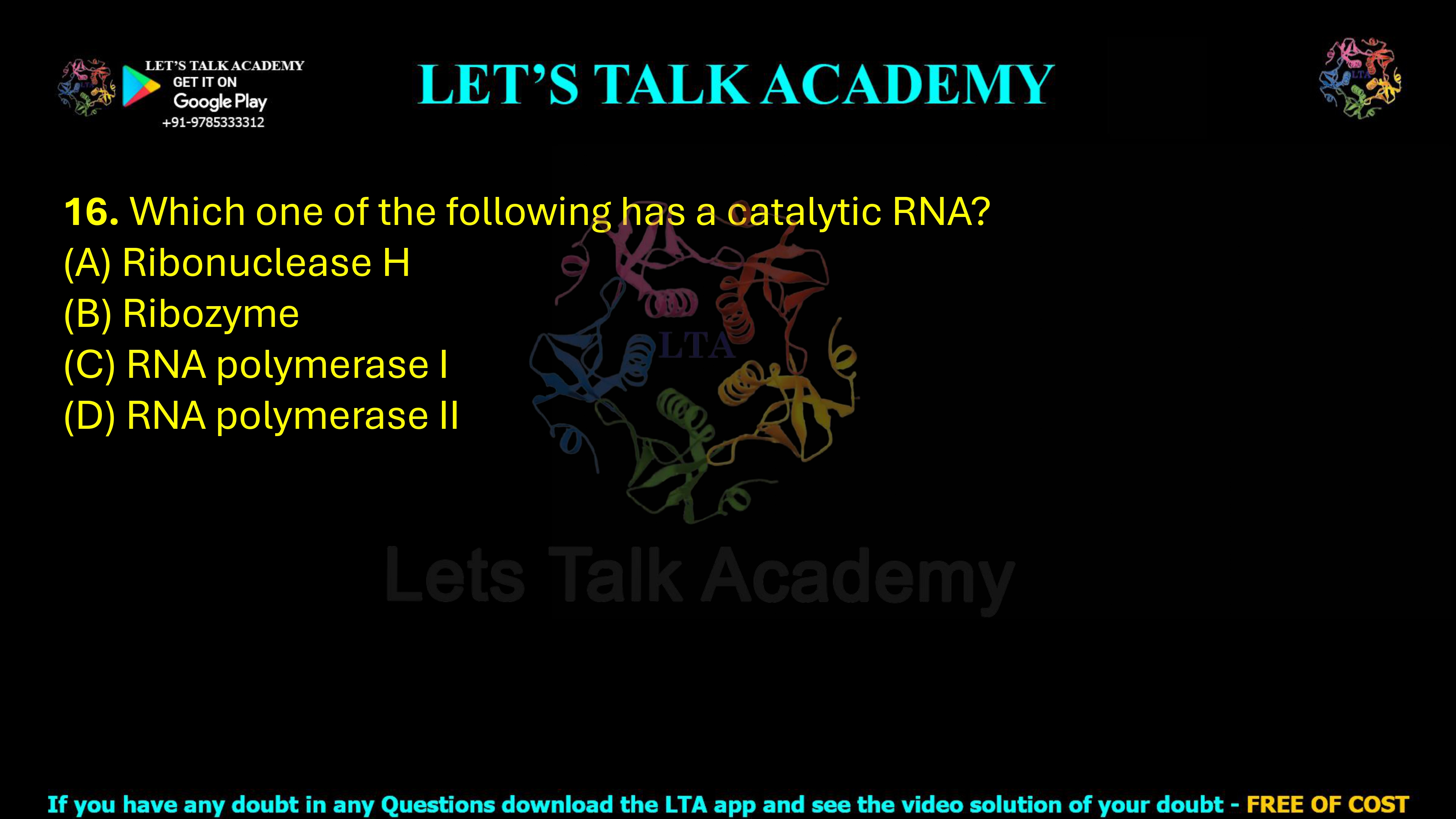
16. Which one of the following has a catalytic RNA?
(A) Ribonuclease H
(B) Ribozyme
(C) RNA polymerase I
(D) RNA polymerase II
Catalytic RNA: Which One of the Following Is a Ribozyme?
Introduction
For a long time, biological catalysts were believed to be exclusively proteins. Enzymes were defined as protein molecules capable of accelerating biochemical reactions without being permanently consumed. This traditional view changed dramatically with the discovery that certain RNA molecules can also perform catalytic functions. Such catalytically active RNA molecules are known as ribozymes.
Ribozymes demonstrate that RNA is not merely an intermediate molecule carrying genetic information from DNA to proteins. Some RNA molecules can recognize specific substrates, promote chemical reactions, cleave phosphodiester bonds, join RNA fragments, and participate directly in essential cellular processes. The catalytic activity of RNA has also provided strong support for the RNA world hypothesis, which proposes that RNA may have served both informational and catalytic roles during the early evolution of life.
Correct Answer
Correct Answer: (B) Ribozyme
Detailed Explanation
A ribozyme is an RNA molecule capable of catalyzing a biochemical reaction. The term combines the words ribonucleic acid and enzyme. Unlike conventional enzymes, which are composed of proteins, ribozymes use their specific three-dimensional RNA structures to create catalytic sites and accelerate chemical reactions.
Many ribozymes catalyze reactions involving RNA itself. These reactions include RNA cleavage, RNA ligation, and RNA splicing. Some of the best-known examples include self-splicing introns, RNase P RNA, hammerhead ribozymes, and the ribosomal RNA responsible for peptide bond formation in the ribosome.
Therefore, among the given options, only a ribozyme represents catalytic RNA.
Explanation of Option (A): Ribonuclease H
This option is incorrect.
Ribonuclease H, commonly called RNase H, is an enzyme that specifically degrades the RNA strand of an RNA-DNA hybrid. It plays important roles in several biological processes, including DNA replication, removal of RNA primers, retroviral replication, and nucleic acid metabolism.
Although RNase H acts on RNA-containing substrates, the enzyme itself is a protein. The presence of RNA as a substrate does not make an enzyme a catalytic RNA. A catalytic RNA must itself be composed of RNA and directly perform the catalytic function.
Therefore:
RNase H = Protein enzyme that acts on RNA-DNA hybrids
Since Ribonuclease H is not itself a catalytic RNA, option (A) is incorrect.
Explanation of Option (B): Ribozyme
This option is correct.
A ribozyme is, by definition, a catalytically active RNA molecule. It can fold into a precise three-dimensional structure that forms an active site capable of binding substrates and accelerating specific chemical reactions.
Ribozymes are involved in several important cellular and molecular processes. For example, the RNA component of RNase P catalyzes the processing of precursor tRNA molecules. Certain introns can catalyze their own removal from RNA transcripts. In addition, the peptidyl transferase center of the ribosome is formed primarily by ribosomal RNA, making the ribosome an important example of RNA-mediated catalysis.
Therefore:
Ribozyme = Catalytic RNA
Hence, option (B) is the correct answer.
Explanation of Option (C): RNA Polymerase I
This option is incorrect.
RNA polymerase I is a large multisubunit protein enzyme present in eukaryotic cells. Its major function is the transcription of ribosomal RNA genes. It synthesizes a large precursor rRNA that is processed to produce 18S, 5.8S, and 28S rRNAs.
Although RNA polymerase I synthesizes RNA, the catalytic machinery of the enzyme is made of protein subunits. Therefore, it is an RNA-synthesizing protein enzyme and not a catalytic RNA molecule.
Thus:
RNA polymerase I = Protein enzyme that synthesizes rRNA
For this reason, option (C) is incorrect.
Explanation of Option (D): RNA Polymerase II
This option is incorrect.
RNA polymerase II is also a multisubunit protein enzyme. It is responsible for the transcription of most protein-coding genes in eukaryotes and produces precursor messenger RNA. It also transcribes several classes of non-coding RNAs.
RNA polymerase II catalyzes the formation of phosphodiester bonds during RNA synthesis, but the catalyst itself is a protein complex rather than an RNA molecule. Therefore, RNA polymerase II cannot be classified as catalytic RNA.
Thus:
RNA polymerase II = Protein enzyme that synthesizes pre-mRNA and several non-coding RNAs
Therefore, option (D) is incorrect.
Summary of Each Option
| Option | Molecule | Nature | Major Function | Correct/Incorrect |
|---|---|---|---|---|
| (A) | Ribonuclease H | Protein enzyme | Degrades RNA in RNA-DNA hybrids | Incorrect |
| (B) | Ribozyme | Catalytic RNA | Catalyzes specific biochemical reactions | Correct |
| (C) | RNA polymerase I | Protein enzyme | Synthesizes the precursor of major rRNAs | Incorrect |
| (D) | RNA polymerase II | Protein enzyme | Synthesizes pre-mRNA and several non-coding RNAs | Incorrect |
What Is a Ribozyme?
A ribozyme is an RNA molecule that possesses enzymatic activity. Like protein enzymes, ribozymes depend on their specific three-dimensional structures for catalytic function. The RNA chain folds through intramolecular base pairing and other molecular interactions to form a functional catalytic center.
The discovery of ribozymes changed the traditional understanding of biological catalysis. Before their discovery, proteins were considered the only biological macromolecules capable of acting as enzymes. Ribozymes demonstrated that RNA can perform both informational and catalytic functions.
Major Examples of Catalytic RNA
RNase P RNA
RNase P is involved in the maturation of precursor tRNA molecules. Its RNA component performs the catalytic cleavage that removes the extra 5′ leader sequence from precursor tRNA. This was one of the most important discoveries demonstrating that RNA itself can act as an enzyme.
Self-Splicing Group I Introns
Some Group I introns can catalyze their own removal from precursor RNA molecules. These introns undergo a series of transesterification reactions that excise the intron and join the neighboring exons.
Self-Splicing Group II Introns
Group II introns are also catalytic RNAs capable of promoting their own excision. Their splicing mechanism involves the formation of a lariat-like intermediate and shows important mechanistic similarities to spliceosomal RNA splicing.
Hammerhead Ribozyme
The hammerhead ribozyme is a small catalytic RNA motif capable of site-specific RNA cleavage. It was originally identified in certain plant pathogenic RNAs and has become an important model for understanding the structural basis of RNA catalysis.
Ribosomal RNA and Peptide Bond Formation
One of the most biologically important examples of RNA catalysis occurs in the ribosome. The peptidyl transferase center of the large ribosomal subunit is formed primarily by ribosomal RNA. This rRNA catalyzes peptide bond formation during protein synthesis.
Therefore, the ribosome is often described as a ribozyme because its central catalytic activity is performed by RNA rather than ribosomal proteins.
Important Catalytic RNAs and Their Functions
| Catalytic RNA | Major Function |
|---|---|
| RNase P RNA | Processes the 5′ end of precursor tRNA |
| Group I intron | Catalyzes self-splicing |
| Group II intron | Catalyzes self-splicing through a lariat intermediate |
| Hammerhead ribozyme | Catalyzes site-specific RNA cleavage |
| Large-subunit rRNA | Catalyzes peptide bond formation |
How Can RNA Act as an Enzyme?
RNA can perform catalytic functions because it is not restricted to a simple linear structure. A single RNA molecule can fold into complex secondary and tertiary structures through complementary base pairing, base stacking, hydrogen bonding, and interactions with metal ions.
This folding can create specific binding pockets and catalytic centers. The nitrogenous bases and ribose groups of RNA can participate in acid-base chemistry, while metal ions such as magnesium can stabilize negative charges and assist in catalysis. These properties allow certain RNA molecules to accelerate chemical reactions in a manner similar to protein enzymes.
Ribozyme and Protein Enzyme Comparison
| Feature | Ribozyme | Protein Enzyme |
|---|---|---|
| Basic Composition | RNA | Protein |
| Catalytic Activity | Present | Present |
| Three-Dimensional Folding | Required | Required |
| Example | RNase P RNA | DNA polymerase |
| Major Reactions | RNA cleavage, splicing and peptide bond formation | Wide range of biochemical reactions |
Ribozymes and the RNA World Hypothesis
The existence of catalytic RNA is highly significant for understanding the early evolution of life. Modern cells generally use DNA for long-term information storage and proteins for most catalytic functions. This creates an evolutionary question because proteins are synthesized using genetic information, while the replication and expression of genetic information require enzymes.
The RNA world hypothesis proposes that early life may have depended mainly on RNA molecules capable of both storing genetic information and catalyzing chemical reactions. The existence of modern ribozymes provides strong evidence that RNA can perform both of these functions.
Catalytic RNAs such as self-splicing introns, RNase P RNA, and the ribosomal peptidyl transferase center are considered important molecular remnants of the ancient catalytic capabilities of RNA.
Difference Between RNase H and a Ribozyme
RNase H and ribozymes can both participate in reactions involving RNA, but they are fundamentally different. RNase H is a protein enzyme whose substrate contains RNA. A ribozyme, in contrast, is itself made of RNA and directly performs the catalytic reaction.
| Feature | RNase H | Ribozyme |
|---|---|---|
| Molecular Nature | Protein | RNA |
| Catalytic Activity | Yes | Yes |
| Is It Catalytic RNA? | No | Yes |
| Major Function | Degrades RNA in RNA-DNA hybrids | Depends on the specific ribozyme |
Biological Significance
The discovery of catalytic RNA expanded the known functional capabilities of nucleic acids. RNA is now understood to be much more than a passive messenger between DNA and proteins. Depending on its sequence and structure, RNA can store information, regulate gene expression, recognize other molecules, and catalyze biochemical reactions.
Ribozymes also have important applications in biotechnology and biomedical research. Engineered catalytic RNAs can be designed to recognize and cleave specific RNA sequences, making them valuable tools for studying gene function and exploring RNA-targeted therapeutic strategies.
Final Answer
A ribozyme is an RNA molecule capable of catalyzing a biochemical reaction. The other options are protein enzymes rather than catalytic RNA molecules.
Ribozyme = Catalytic RNA
Correct Answer: (B) Ribozyme


