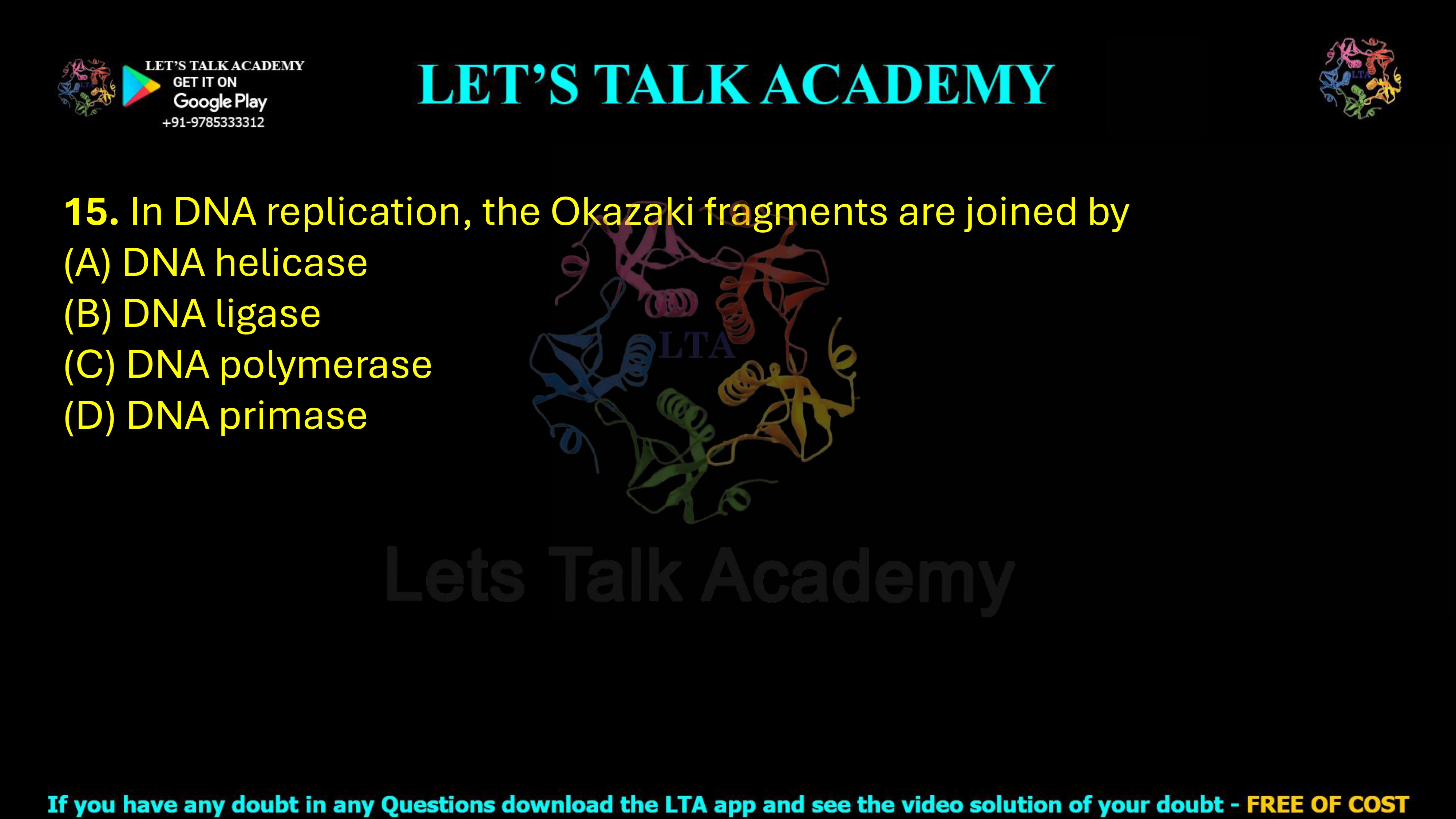
15. In DNA replication, the Okazaki fragments are joined by
(A) DNA helicase
(B) DNA ligase
(C) DNA polymerase
(D) DNA primase
Okazaki Fragments in DNA Replication: Which Enzyme Joins Them Together?
Introduction
DNA replication is the fundamental biological process through which a cell produces an accurate copy of its genetic material before cell division. Although the basic principle of copying DNA appears simple, the antiparallel structure of the DNA double helix creates an important challenge for the replication machinery. DNA polymerases can synthesize a new DNA strand only in the 5′ to 3′ direction, whereas the two parental DNA strands run in opposite directions.
As a result, the two newly synthesized DNA strands are produced differently. The leading strand is synthesized continuously in the same general direction as movement of the replication fork, while the lagging strand is synthesized discontinuously as a series of short DNA segments called Okazaki fragments. These fragments cannot remain separate because the final daughter DNA molecule must contain a continuous sugar-phosphate backbone.
The enzyme responsible for sealing the remaining breaks between adjacent Okazaki fragments is DNA ligase. It catalyzes the formation of a phosphodiester bond between neighboring DNA fragments and converts the discontinuously synthesized lagging strand into a continuous DNA strand.
Correct Answer
Correct Answer: (B) DNA ligase
Detailed Explanation
Okazaki fragments are short stretches of newly synthesized DNA formed on the lagging strand during DNA replication. Because DNA polymerase can add nucleotides only to a free 3′-OH group and synthesize DNA exclusively in the 5′ to 3′ direction, the lagging strand cannot be copied continuously toward the replication fork. Instead, it is synthesized in separate segments.
Each Okazaki fragment begins with an RNA primer synthesized by primase. DNA polymerase then extends the primer by adding deoxyribonucleotides. After synthesis of the fragments, the RNA primers are removed and the resulting gaps are filled with DNA. Even after this processing, a break called a nick remains in the sugar-phosphate backbone between adjacent fragments.
DNA ligase seals this nick by catalyzing the formation of a phosphodiester bond between the 3′-OH end of one DNA fragment and the 5′-phosphate end of the neighboring fragment. Therefore, DNA ligase is the enzyme that ultimately joins Okazaki fragments into one continuous lagging strand.
Explanation of Option (A): DNA Helicase
This option is incorrect.
DNA helicase does not join Okazaki fragments. Its major function is to unwind the parental DNA double helix at the replication fork. It disrupts the hydrogen bonding and base-pairing interactions between complementary DNA strands, allowing the two parental strands to separate and serve as templates for new DNA synthesis.
Without helicase activity, the replication machinery would not gain access to the nucleotide sequences of the parental strands. However, helicase does not form phosphodiester bonds between adjacent DNA fragments and therefore cannot connect Okazaki fragments.
Explanation of Option (B): DNA Ligase
This option is correct.
DNA ligase is the enzyme directly responsible for joining adjacent Okazaki fragments. Once the RNA primers have been removed and replaced with DNA, a nick remains between neighboring DNA segments. At this position, one fragment provides a free 3′-OH group while the adjacent fragment provides a 5′-phosphate group.
DNA ligase uses energy to activate the 5′-phosphate and catalyzes formation of a new phosphodiester bond. This reaction restores the continuity of the sugar-phosphate backbone and converts the separate Okazaki fragments into a continuous DNA strand.
Therefore:
Okazaki fragments → Joined by DNA ligase
Explanation of Option (C): DNA Polymerase
This option is incorrect.
DNA polymerase plays an essential role in synthesizing DNA and extending Okazaki fragments, but it is not the enzyme that seals the final nick between adjacent fragments. DNA polymerase adds nucleotides to an existing 3′-OH end and forms phosphodiester bonds during chain elongation.
In bacteria, DNA polymerase III performs most of the synthesis of Okazaki fragments, while DNA polymerase I removes RNA primers through its 5′ to 3′ exonuclease activity and replaces the removed RNA with DNA. However, after this replacement process, a final nick remains in the DNA backbone. DNA ligase is required to seal that nick.
Explanation of Option (D): DNA Primase
This option is incorrect.
DNA primase synthesizes short RNA primers required to initiate DNA synthesis. DNA polymerases cannot start a completely new DNA strand because they require a pre-existing 3′-OH group. Primase solves this problem by producing an RNA primer that provides the necessary starting point for DNA polymerase.
On the lagging strand, primase must repeatedly synthesize new RNA primers because each Okazaki fragment requires its own initiation site. Therefore, primase helps start Okazaki fragment synthesis but does not join completed fragments.
Summary of Each Option
| Option | Enzyme | Main Function in DNA Replication | Correct/Incorrect |
|---|---|---|---|
| (A) | DNA helicase | Unwinds the parental DNA double helix | Incorrect |
| (B) | DNA ligase | Joins Okazaki fragments by sealing nicks | Correct |
| (C) | DNA polymerase | Synthesizes DNA and extends Okazaki fragments | Incorrect |
| (D) | DNA primase | Synthesizes RNA primers | Incorrect |
Why Are Okazaki Fragments Formed?
The formation of Okazaki fragments is a direct consequence of two fundamental properties of DNA replication. First, the two strands of DNA are antiparallel. Second, DNA polymerases can synthesize DNA only in the 5′ to 3′ direction.
At a replication fork, one template strand is oriented in a way that allows continuous DNA synthesis toward the advancing fork. This produces the leading strand. The opposite template has the reverse orientation, so new DNA must be synthesized discontinuously away from the replication fork in short segments. These short segments are the Okazaki fragments.
Leading Strand and Lagging Strand Synthesis
| Feature | Leading Strand | Lagging Strand |
|---|---|---|
| Mode of Synthesis | Continuous | Discontinuous |
| Direction of New DNA Synthesis | 5′ to 3′ | 5′ to 3′ |
| Number of Primers | Usually one per replication origin and fork direction | Many |
| Okazaki Fragments | Absent | Present |
| Requirement for Extensive Fragment Joining | No | Yes |
Step-by-Step Formation and Joining of Okazaki Fragments
Step 1: DNA Unwinding by Helicase
DNA helicase separates the two parental DNA strands at the replication fork. This creates single-stranded templates that can be copied by the replication machinery.
Step 2: RNA Primer Synthesis by Primase
Primase synthesizes a short RNA primer on the lagging-strand template. This primer provides a free 3′-OH group required by DNA polymerase.
Step 3: Extension by DNA Polymerase
DNA polymerase extends the RNA primer in the 5′ to 3′ direction, producing one Okazaki fragment. As the replication fork continues to open, another primer is synthesized and another fragment is produced.
Step 4: Removal of RNA Primers
The RNA primers must be removed because the final chromosome should contain DNA rather than RNA at these positions. In bacteria, DNA polymerase I plays an important role in removing the RNA primers and replacing them with DNA nucleotides.
Step 5: Formation of a Nick
After the RNA primer has been replaced with DNA, the nucleotide sequence is complete, but the sugar-phosphate backbone is still interrupted by a nick between adjacent fragments.
Step 6: Sealing by DNA Ligase
DNA ligase catalyzes formation of the final phosphodiester bond and permanently connects the neighboring Okazaki fragments. This creates a continuous lagging strand.
How Does DNA Ligase Join Okazaki Fragments?
DNA ligase acts at a nick where the nucleotide bases are already correctly paired but the phosphodiester backbone is interrupted. The enzyme joins a 3′-hydroxyl group on one nucleotide to a neighboring 5′-phosphate group.
The overall result can be represented as:
3′-OH + 5′-phosphate → phosphodiester bond
This reaction requires energy. Different DNA ligases use different cofactors. Many bacterial DNA ligases use NAD+, whereas ATP-dependent DNA ligases are common in eukaryotes and also occur in some other organisms.
Major Enzymes Involved in Bacterial DNA Replication
| Enzyme | Major Function |
|---|---|
| DNA helicase | Unwinds the DNA double helix |
| DNA primase | Synthesizes RNA primers |
| DNA polymerase III | Performs most new DNA synthesis |
| DNA polymerase I | Removes RNA primers and fills the resulting gaps with DNA |
| DNA ligase | Seals nicks and joins Okazaki fragments |
| DNA gyrase | Relieves topological stress ahead of the replication fork |
DNA Polymerase and DNA Ligase Are Not the Same
DNA polymerase and DNA ligase both participate in DNA replication, but their functions are fundamentally different. DNA polymerase synthesizes DNA by adding nucleotides to a growing strand. DNA ligase does not synthesize a long nucleotide sequence; instead, it seals a pre-existing nick between two adjacent DNA segments.
Therefore, DNA polymerase helps create and process the Okazaki fragments, whereas DNA ligase performs the final joining step that converts them into a continuous DNA strand.
Biological Significance
The activity of DNA ligase is essential for maintaining the structural continuity of newly replicated DNA. Without DNA ligase, the lagging strand would remain as a collection of disconnected fragments even after all nucleotides had been correctly synthesized.
DNA ligase is also important beyond DNA replication. It participates in several DNA repair pathways by sealing breaks generated during removal and replacement of damaged DNA. In biotechnology, DNA ligase is widely used to join DNA fragments during recombinant DNA construction and molecular cloning.
Competitive Examination Perspective
For competitive examinations, the functions of the major DNA replication enzymes should be clearly distinguished. Helicase unwinds DNA, primase synthesizes RNA primers, DNA polymerase synthesizes new DNA, and DNA ligase joins Okazaki fragments by sealing nicks in the sugar-phosphate backbone. Therefore, whenever a question asks which enzyme connects Okazaki fragments during lagging-strand synthesis, the correct answer is DNA ligase.
Final Answer
Okazaki fragments are formed during discontinuous synthesis of the lagging strand. After primer removal and DNA replacement, DNA ligase seals the remaining nicks by forming phosphodiester bonds between adjacent fragments.
Okazaki fragments → Joined by DNA ligase
Correct Answer: (B) DNA ligase


