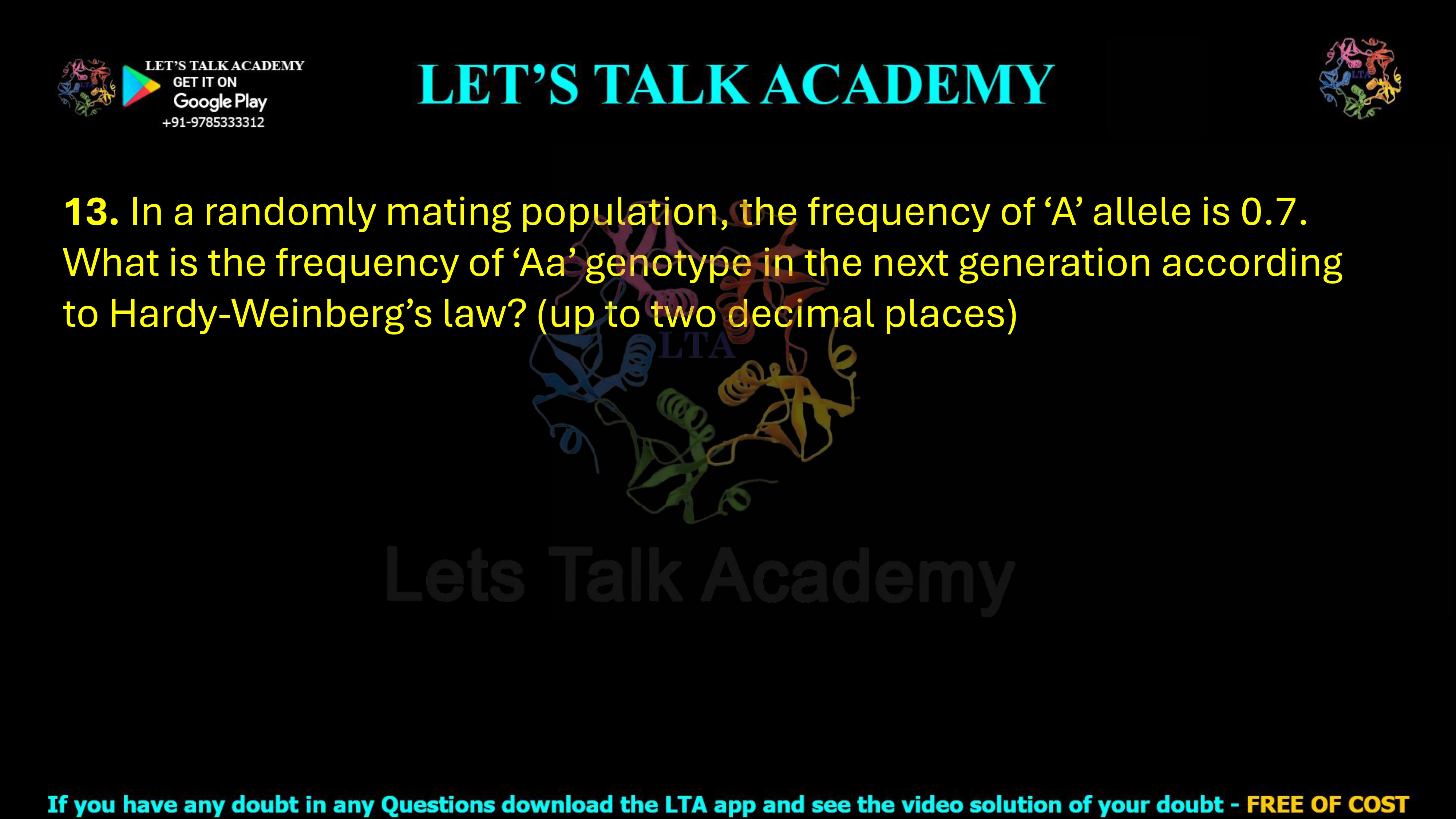
13. In a randomly mating population, the frequency of ‘A’ allele is 0.7. What is the frequency of ‘Aa’ genotype in the next generation according to Hardy-Weinberg’s law? (up to two decimal places)
Hardy-Weinberg Equilibrium: Calculating the Frequency of the Heterozygous (Aa) Genotype
Introduction
The Hardy-Weinberg Equilibrium is one of the most important principles in population genetics. Proposed independently by G. H. Hardy and Wilhelm Weinberg in 1908, this principle explains how allele frequencies and genotype frequencies remain constant from one generation to the next in an ideal population where no evolutionary forces are acting. It serves as the mathematical foundation for studying genetic variation, evolution, inheritance, and population structure.
According to Hardy-Weinberg equilibrium, if a gene has two alleles, represented by A and a, their frequencies are denoted by p and q, respectively. These frequencies satisfy the relationship p + q = 1. The expected genotype frequencies in the next generation are given by the famous Hardy-Weinberg equation:
p² + 2pq + q² = 1
Here, p² represents the frequency of homozygous dominant individuals (AA), 2pq represents the frequency of heterozygous individuals (Aa), and q² represents the frequency of homozygous recessive individuals (aa).
Correct Answer
Correct Answer: 0.42
Detailed Explanation
Since the population follows Hardy-Weinberg equilibrium, genotype frequencies are calculated using the equation:
p² + 2pq + q² = 1
where:
- p = Frequency of allele A
- q = Frequency of allele a
- 2pq = Frequency of heterozygous genotype Aa
The question provides the frequency of allele A.
p = 0.7
Since:
p + q = 1
Therefore,
q = 1 − 0.7 = 0.3
The frequency of the heterozygous genotype is calculated using:
2pq = 2 × 0.7 × 0.3
2pq = 2 × 0.21 = 0.42
Thus, the expected frequency of genotype Aa in the next generation is 0.42.
Step-by-Step Calculation
Step 1: Determine Allele Frequencies
| Allele | Frequency |
|---|---|
| A (p) | 0.70 |
| a (q) | 1 − 0.70 = 0.30 |
Step 2: Apply Hardy-Weinberg Formula
Heterozygous Frequency = 2pq
= 2 × 0.70 × 0.30
= 0.42
Complete Genotype Frequencies
| Genotype | Formula | Frequency |
|---|---|---|
| AA | p² = (0.70)² | 0.49 |
| Aa | 2pq = 2 × 0.70 × 0.30 | 0.42 |
| aa | q² = (0.30)² | 0.09 |
Verification:
0.49 + 0.42 + 0.09 = 1.00
This confirms that the calculated genotype frequencies satisfy the Hardy-Weinberg equilibrium equation.
Hardy-Weinberg Formula Summary
| Expression | Meaning |
|---|---|
| p + q = 1 | Total allele frequency |
| p² | Frequency of genotype AA |
| 2pq | Frequency of genotype Aa |
| q² | Frequency of genotype aa |
| p² + 2pq + q² = 1 | Total genotype frequency |
Assumptions of Hardy-Weinberg Equilibrium
| Assumption | Description |
|---|---|
| Large Population | No genetic drift |
| Random Mating | Individuals mate randomly |
| No Mutation | No new alleles arise |
| No Migration | No gene flow into or out of the population |
| No Natural Selection | All genotypes have equal reproductive success |
Biological Significance
The Hardy-Weinberg principle provides the baseline model for understanding genetic variation in populations. It allows geneticists to predict expected genotype frequencies from allele frequencies and serves as a reference for detecting evolutionary forces such as natural selection, mutation, migration, genetic drift, and non-random mating. It also plays a crucial role in medical genetics, evolutionary biology, conservation genetics, and population genomics.
Final Answer
Given:
Frequency of allele A (p) = 0.70
Frequency of allele a (q) = 0.30
Using Hardy-Weinberg equilibrium:
Frequency of genotype Aa = 2pq
= 2 × 0.70 × 0.30
= 0.42
Correct Answer: 0.42


