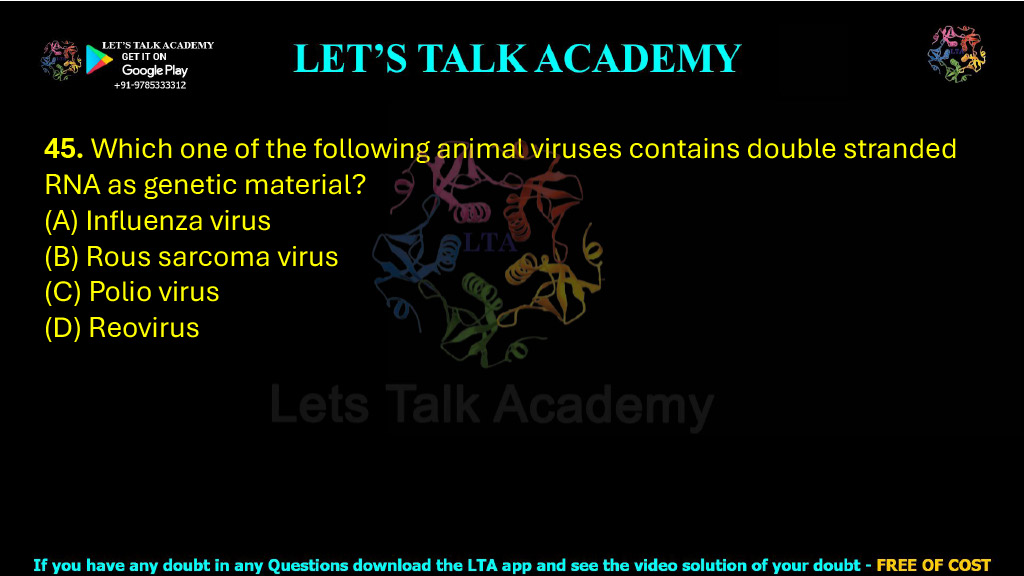
45. Which one of the following animal viruses contains double stranded RNA as genetic material?
(A) Influenza virus
(B) Rous sarcoma virus
(C) Polio virus
(D) Reovirus
Which Animal Virus Contains Double-Stranded RNA as Genetic Material? Complete Explanation of Reovirus
Introduction
Viruses are classified based on the type of nucleic acid they contain as their genetic material. Their genomes may consist of double-stranded DNA (dsDNA), single-stranded DNA (ssDNA), double-stranded RNA (dsRNA), positive-sense single-stranded RNA (+ssRNA), negative-sense single-stranded RNA (−ssRNA), or RNA genomes that replicate through a DNA intermediate using reverse transcriptase. This classification, known as the Baltimore Classification, is one of the most important systems used in virology because it explains how different viruses replicate and synthesize messenger RNA.
Among animal viruses, only a limited number possess a double-stranded RNA (dsRNA) genome. The best-known example is the Reovirus family, which includes Rotavirus, one of the leading causes of severe gastroenteritis in infants and young children worldwide. In contrast, Influenza virus contains a negative-sense single-stranded RNA genome, Polio virus possesses a positive-sense single-stranded RNA genome, and Rous sarcoma virus is a retrovirus containing positive-sense single-stranded RNA along with reverse transcriptase.
Correct Answer
Correct Option: (D) Reovirus
Detailed Explanation
Reovirus belongs to the family Reoviridae and is the classic example of an animal virus possessing a double-stranded RNA (dsRNA) genome. Unlike most RNA viruses, whose genomes consist of a single RNA strand, Reoviruses possess segmented double-stranded RNA molecules enclosed within a double-layered protein capsid.
The most medically important member of the Reoviridae family is Rotavirus, which is responsible for acute viral gastroenteritis in infants and young children. Because host cells cannot directly translate double-stranded RNA, Reoviruses carry their own RNA-dependent RNA polymerase (RdRp) inside the viral particle. This enzyme synthesizes positive-sense messenger RNA from the dsRNA genome immediately after infection, allowing viral proteins to be produced.
The Baltimore classification places Reoviruses in Group III, which includes all viruses possessing double-stranded RNA genomes.
Explanation of Each Option
Option (A): Influenza Virus
This option is incorrect. Influenza virus belongs to the family Orthomyxoviridae and contains a negative-sense single-stranded RNA (−ssRNA) genome divided into eight segments. It requires an RNA-dependent RNA polymerase for replication but does not contain double-stranded RNA.
Option (B): Rous Sarcoma Virus
This option is incorrect. Rous sarcoma virus belongs to the family Retroviridae. It possesses a positive-sense single-stranded RNA (+ssRNA) genome and carries the enzyme reverse transcriptase, which converts viral RNA into DNA during replication.
Option (C): Polio Virus
This option is incorrect. Poliovirus belongs to the family Picornaviridae and contains a positive-sense single-stranded RNA (+ssRNA) genome. Its RNA functions directly as messenger RNA immediately after entering the host cell.
Option (D): Reovirus
This option is correct. Reoviruses possess a segmented double-stranded RNA (dsRNA) genome and therefore represent the correct answer.
Why Option (D) is Correct
Reovirus is the only virus among the given options that possesses a double-stranded RNA genome. Its replication strategy requires an RNA-dependent RNA polymerase because host cells cannot directly translate dsRNA molecules into proteins.
Comparison of All Options
| Option | Virus | Genome Type | Status |
|---|---|---|---|
| A | Influenza virus | Negative-sense ssRNA | Incorrect |
| B | Rous sarcoma virus | Positive-sense ssRNA (Retrovirus) | Incorrect |
| C | Polio virus | Positive-sense ssRNA | Incorrect |
| D | Reovirus | Double-stranded RNA | Correct |
Baltimore Classification of the Given Viruses
| Virus | Baltimore Group | Genome |
|---|---|---|
| Reovirus | Group III | Double-stranded RNA (dsRNA) |
| Influenza virus | Group V | Negative-sense ssRNA |
| Polio virus | Group IV | Positive-sense ssRNA |
| Rous sarcoma virus | Group VI | Positive-sense ssRNA with reverse transcriptase |
Important RNA Viruses for Competitive Examinations
| Virus | Genome Type | Family |
|---|---|---|
| Reovirus | Double-stranded RNA | Reoviridae |
| Rotavirus | Double-stranded RNA | Reoviridae |
| Influenza virus | Negative-sense ssRNA | Orthomyxoviridae |
| Poliovirus | Positive-sense ssRNA | Picornaviridae |
| Rous sarcoma virus | Retrovirus (+ssRNA) | Retroviridae |
Biological Significance
The type of viral genome determines how a virus replicates and produces messenger RNA inside host cells. Reoviruses require their own RNA-dependent RNA polymerase because host cells cannot transcribe double-stranded RNA into mRNA. Understanding viral genome organization is essential for antiviral drug development, vaccine production, molecular diagnostics, and the study of viral evolution. Genome classification also provides important clues about viral replication strategies and pathogenicity.
Final Answer
Among the given viruses, only Reovirus possesses a double-stranded RNA (dsRNA) genome.
Correct Option: (D) Reovirus


