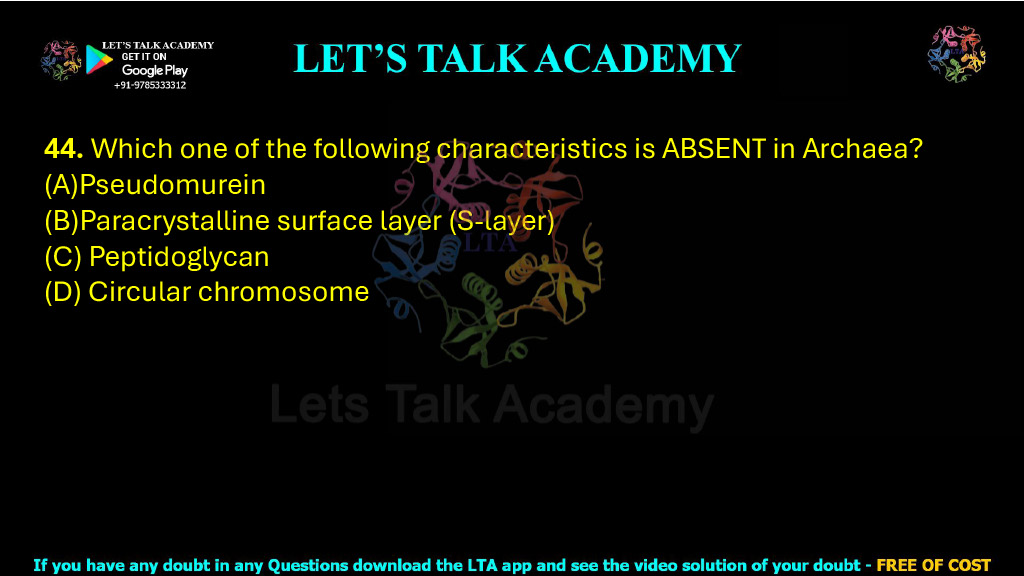
44. Which one of the following characteristics is ABSENT in Archaea?
(A)Pseudomurein
(B)Paracrystalline surface layer (S-layer)
(C) Peptidoglycan
(D) Circular chromosome
Which Characteristic is Absent in Archaea? Pseudomurein, S-Layer, Peptidoglycan, and Circular Chromosome Explained
Introduction
Archaea constitute one of the three domains of life, alongside Bacteria and Eukarya. Although archaeal cells resemble bacteria in being unicellular and lacking a membrane-bound nucleus, they differ profoundly in their molecular biology, cell wall composition, membrane lipids, gene expression machinery, and evolutionary history. Because of these unique features, Archaea are recognized as a separate domain rather than a subgroup of bacteria.
One of the most distinctive characteristics of Archaea is the composition of their cell wall. Unlike bacteria, which possess a rigid cell wall made primarily of peptidoglycan (murein), Archaea completely lack true peptidoglycan. Instead, many archaeal species possess a cell wall composed of pseudomurein, while others have a proteinaceous paracrystalline surface layer (S-layer) as the main structural component. In addition, archaeal chromosomes are generally circular, resembling bacterial chromosomes, although their DNA replication and transcription machinery share many similarities with eukaryotes.
Correct Answer
Correct Option: (C) Peptidoglycan
Detailed Explanation
Archaea possess several structural and biochemical features that distinguish them from bacteria. One of the most important differences lies in the composition of the cell wall. Bacterial cell walls contain peptidoglycan, a polymer composed of alternating N-acetylglucosamine (NAG) and N-acetylmuramic acid (NAM) residues linked by β-(1→4) glycosidic bonds and cross-linked by short peptide chains.
In contrast, Archaea completely lack true peptidoglycan. Instead, many methanogenic archaea possess pseudomurein (pseudopeptidoglycan), which contains N-acetylglucosamine (NAG) and N-acetyltalosaminuronic acid (NAT) linked by β-(1→3) glycosidic bonds. These structural differences make archaeal cell walls resistant to lysozyme and β-lactam antibiotics such as penicillin that specifically target bacterial peptidoglycan.
Many archaeal species also possess a paracrystalline surface layer (S-layer), composed of protein or glycoprotein subunits. The S-layer serves as the primary cell wall component in numerous archaeal species, providing structural support, protection, and maintenance of cell shape.
Like bacteria, most archaea possess a single circular chromosome, although their DNA replication proteins and transcription machinery resemble those of eukaryotic organisms.
Therefore, the only characteristic absent in Archaea is peptidoglycan.
Explanation of Each Option
Option (A): Pseudomurein
This option is incorrect because pseudomurein is present in many methanogenic archaea. It performs a structural role similar to bacterial peptidoglycan but differs significantly in chemical composition and bonding.
Option (B): Paracrystalline Surface Layer (S-layer)
This option is incorrect. The S-layer is one of the most common cell envelope structures in Archaea. It consists of regularly arranged protein or glycoprotein subunits that provide mechanical strength and protection.
Option (C): Peptidoglycan
This option is correct. True peptidoglycan is completely absent in Archaea. This is one of the most important characteristics distinguishing Archaea from Bacteria.
Option (D): Circular Chromosome
This option is incorrect. Most archaeal species possess circular chromosomes similar to bacteria, although their genetic machinery shares many similarities with eukaryotes.
Why Option (C) is Correct
Peptidoglycan is an exclusive feature of bacterial cell walls. Archaeal cell walls either contain pseudomurein or consist of an S-layer made of proteins or glycoproteins. Consequently, peptidoglycan is absent in all archaeal species.
Comparison of All Options
| Option | Characteristic | Present in Archaea? |
|---|---|---|
| A | Pseudomurein | Yes (in many species) |
| B | Paracrystalline S-layer | Yes |
| C | Peptidoglycan | No |
| D | Circular chromosome | Yes |
Comparison Between Bacteria and Archaea
| Feature | Bacteria | Archaea |
|---|---|---|
| Cell Wall | Peptidoglycan | Pseudomurein or S-layer |
| Cell Membrane Lipids | Ester-linked fatty acids | Ether-linked isoprenoids |
| Chromosome | Circular | Circular |
| Sensitivity to Lysozyme | Usually sensitive | Usually resistant |
| Sensitivity to β-lactam Antibiotics | Usually sensitive | Generally resistant |
Pseudomurein vs Peptidoglycan
| Feature | Peptidoglycan | Pseudomurein |
|---|---|---|
| Sugar Components | NAG + NAM | NAG + NAT |
| Glycosidic Bond | β-(1→4) | β-(1→3) |
| Occurs In | Bacteria | Some Archaea |
| Lysozyme Sensitivity | Yes | No |
Biological Significance
The absence of peptidoglycan is a defining feature of Archaea and contributes significantly to their ability to survive in extreme environments. Because archaeal cell walls differ chemically from bacterial cell walls, many antibiotics that inhibit bacterial peptidoglycan synthesis are ineffective against Archaea. Their unique membrane lipids and cell wall structures also provide enhanced stability under conditions of extreme temperature, salinity, and acidity, making many archaeal species successful extremophiles.
Final Answer
Archaea possess pseudomurein (in many species), paracrystalline S-layers, and circular chromosomes. However, they completely lack the bacterial cell wall polymer peptidoglycan.
Correct Option: (C) Peptidoglycan


