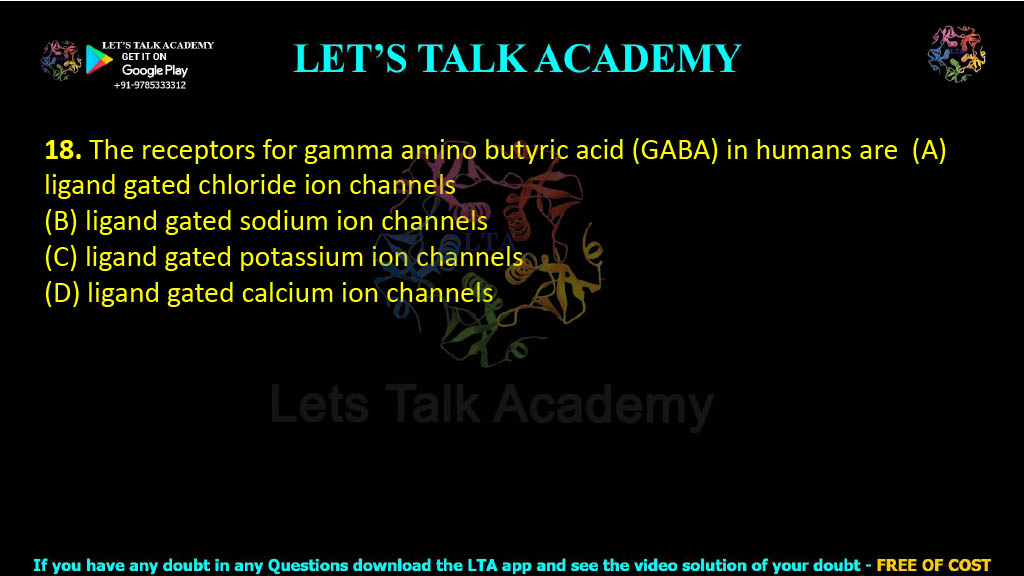
18. The receptors for gamma amino butyric acid (GABA) in humans are
(A) ligand gated chloride ion channels
(B) ligand gated sodium ion channels
(C) ligand gated potassium ion channels
(D) ligand gated calcium ion channels
GABA Receptors Are Ligand-Gated Chloride Ion Channels
Introduction
The human nervous system functions through rapid communication between billions of neurons. This communication occurs at specialized junctions called synapses, where chemical messengers known as neurotransmitters transmit signals from one neuron to another. Depending on their function, neurotransmitters either stimulate neuronal activity (excitatory neurotransmitters) or suppress neuronal activity (inhibitory neurotransmitters). The balance between excitation and inhibition is essential for maintaining normal brain function, controlling movement, regulating emotions, and preventing excessive neuronal firing.
Gamma-aminobutyric acid (GABA) is the principal inhibitory neurotransmitter in the mammalian central nervous system. It decreases neuronal excitability by binding to specific receptors present on the postsynaptic membrane. Among its receptors, GABAA receptors are ligand-gated chloride ion channels that mediate rapid inhibitory synaptic transmission.
Correct Answer
Correct Option: (A) Ligand-gated chloride ion channels
Detailed Explanation
Gamma-aminobutyric acid (GABA) serves as the major inhibitory neurotransmitter in the central nervous system. When GABA binds to the GABAA receptor, it opens a ligand-gated chloride ion channel located on the postsynaptic membrane. Chloride ions (Cl−) move into the neuron according to their electrochemical gradient, making the inside of the neuron more negative. This process, known as hyperpolarization, reduces the likelihood that the neuron will generate an action potential.
The rapid inhibitory action of GABAA receptors is essential for maintaining neuronal stability and preventing uncontrolled excitation. Dysfunction of GABA-mediated signaling is associated with epilepsy, anxiety disorders, insomnia, Huntington’s disease, and several other neurological conditions.
Although another receptor, GABAB, also responds to GABA, it is a G-protein-coupled receptor rather than a ligand-gated ion channel. Since this question specifically asks about ligand-gated receptors, the correct answer is the ligand-gated chloride ion channel.
Explanation of Each Option
Option (A): Ligand-Gated Chloride Ion Channels
This statement is correct. GABAA receptors are ligand-gated chloride ion channels. Activation of these receptors allows chloride ions to enter neurons, producing hyperpolarization and inhibiting neuronal firing.
Option (B): Ligand-Gated Sodium Ion Channels
This statement is incorrect. Sodium channels are generally associated with excitatory neurotransmission. Neurotransmitters such as acetylcholine acting on nicotinic receptors permit sodium influx and depolarize neurons. GABA receptors do not function as ligand-gated sodium channels.
Option (C): Ligand-Gated Potassium Ion Channels
This statement is incorrect. Potassium channels contribute to neuronal inhibition in some signaling pathways, but GABAA receptors themselves are not potassium channels. Potassium channel activation may occur indirectly through GABAB receptor-mediated G-protein signaling.
Option (D): Ligand-Gated Calcium Ion Channels
This statement is incorrect. Calcium channels play important roles in neurotransmitter release, muscle contraction, and intracellular signaling. However, GABAA receptors are chloride channels rather than calcium channels.
Why Option (A) is Correct
The GABAA receptor is an ionotropic receptor that forms a ligand-gated chloride channel. Binding of GABA rapidly increases chloride permeability, hyperpolarizes the neuron, and suppresses action potential generation. Therefore, ligand-gated chloride ion channels correctly describe GABA receptors in this context.
Why the Other Options are Incorrect
Why Option (B) is Incorrect
Sodium channels generally mediate excitatory responses rather than inhibitory neurotransmission.
Why Option (C) is Incorrect
Although GABAB receptor activation can indirectly open potassium channels through G-proteins, GABAA receptors themselves are chloride channels.
Why Option (D) is Incorrect
Calcium channels participate in intracellular signaling and neurotransmitter release but are not the ligand-gated receptors activated directly by GABA.
Comparison of All Options
| Option | Channel Type | Associated with GABAA Receptor? | Correct or Incorrect |
|---|---|---|---|
| A | Chloride Ion Channel | Yes | Correct |
| B | Sodium Ion Channel | No | Incorrect |
| C | Potassium Ion Channel | No | Incorrect |
| D | Calcium Ion Channel | No | Incorrect |
Types of GABA Receptors
| Receptor | Type | Mechanism | Effect |
|---|---|---|---|
| GABAA | Ionotropic | Ligand-gated chloride channel | Rapid inhibition |
| GABAB | Metabotropic | G-protein-coupled receptor | Slow inhibitory response |
Major Neurotransmitters and Their Receptors
| Neurotransmitter | Main Receptor Type | Primary Function |
|---|---|---|
| GABA | Chloride channel / GPCR | Inhibitory |
| Glutamate | AMPA, NMDA, Kainate | Excitatory |
| Acetylcholine | Nicotinic and Muscarinic | Excitatory or Modulatory |
| Glycine | Ligand-gated chloride channel | Inhibitory |
Biological Significance of GABA
GABA is essential for maintaining the balance between neuronal excitation and inhibition. By reducing excessive neuronal firing, it protects the brain from hyperexcitability and contributes to normal motor coordination, memory, emotional regulation, sleep, and sensory processing. Drugs such as benzodiazepines, barbiturates, and several anesthetics enhance GABAA receptor activity, making them valuable in the treatment of anxiety, epilepsy, insomnia, and seizure disorders.
Final Answer
Correct Option: (A) Ligand-gated chloride ion channels
The GABAA receptor is a ligand-gated chloride ion channel. Binding of GABA opens the chloride channel, allowing chloride ions to enter the neuron, causing hyperpolarization and inhibition of neuronal activity. This mechanism makes GABA the principal inhibitory neurotransmitter of the human central nervous system.


