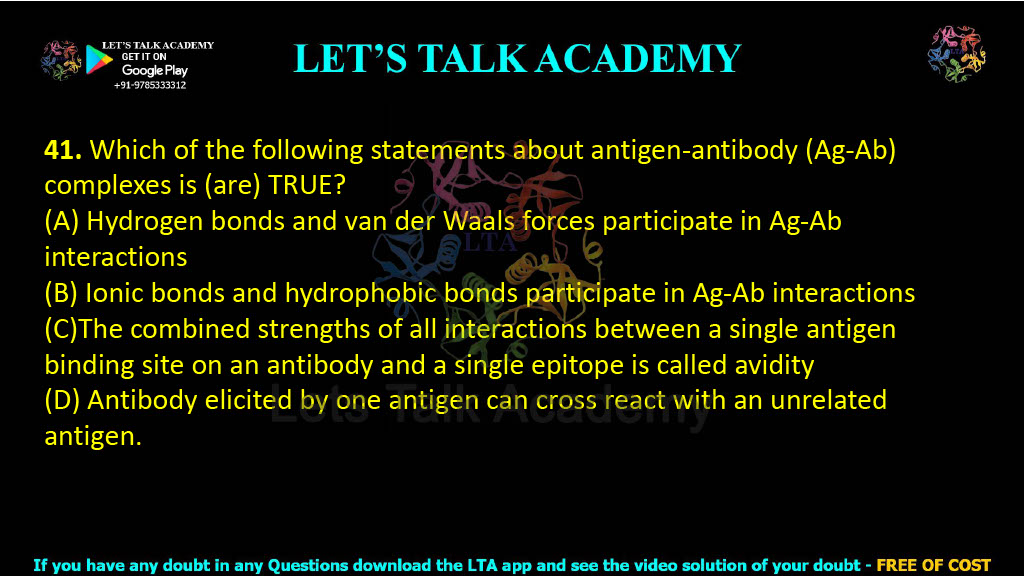
41. Which of the following statements about antigen-antibody (Ag-Ab) complexes is (are) TRUE?
(A) Hydrogen bonds and van der Waals forces participate in Ag-Ab interactions
(B) Ionic bonds and hydrophobic bonds participate in Ag-Ab interactions
(C)The combined strengths of all interactions between a single antigen binding site on an antibody and a single epitope is called avidity
(D) Antibody elicited by one antigen can cross react with an unrelated antigen.
Antigen-Antibody (Ag-Ab) Complexes
Introduction
The interaction between an antigen (Ag) and an antibody (Ab) is one of the most fundamental concepts in immunology. This highly specific interaction enables the immune system to recognize pathogens, neutralize toxins, activate complement proteins, promote phagocytosis, and eliminate infectious microorganisms. Antigen-antibody binding is extremely specific because the antigen-binding site (paratope) of the antibody recognizes a complementary region on the antigen known as the epitope.
Unlike covalent chemical reactions, antigen-antibody complexes are stabilized entirely through multiple non-covalent interactions. These weak interactions include hydrogen bonds, ionic interactions, hydrophobic interactions, and van der Waals forces. Although each interaction is individually weak, their combined effect creates a highly stable antigen-antibody complex. Two important terms frequently tested in immunology are affinity and avidity. Affinity describes the strength of binding between one antibody-binding site and one antigenic epitope, whereas avidity represents the overall strength resulting from multiple antigen-antibody interactions.
Correct Answer
Correct Options: (A) and (B)
Detailed Explanation
Antigen-antibody binding is entirely mediated through non-covalent forces. These interactions are reversible and allow antibodies to bind specifically to antigens without permanently altering either molecule. The four major forces responsible for antigen-antibody binding are hydrogen bonds, ionic interactions, hydrophobic interactions, and van der Waals forces. The combination of these forces provides high specificity and reversible binding, which is essential for efficient immune responses.
The term affinity refers to the binding strength between a single antigen-binding site (paratope) on an antibody and a single epitope on an antigen. In contrast, avidity refers to the total binding strength generated by all antigen-binding sites interacting simultaneously with multiple epitopes. Therefore, affinity and avidity are distinct concepts and should not be confused.
Cross-reactivity occurs when antibodies recognize structurally similar epitopes present on different antigens. However, antibodies do not normally bind completely unrelated antigens. Cross-reactivity requires sufficient structural similarity between the epitopes.
Explanation of Each Option
Option (A): Hydrogen Bonds and Van der Waals Forces Participate in Ag-Ab Interactions
This statement is correct. Hydrogen bonds stabilize antigen-antibody binding through interactions between polar groups, while van der Waals forces arise from temporary dipole interactions when antigen and antibody surfaces fit closely together.
Option (B): Ionic Bonds and Hydrophobic Bonds Participate in Ag-Ab Interactions
This statement is correct. Ionic interactions occur between oppositely charged amino acid residues, whereas hydrophobic interactions result from the association of non-polar amino acid side chains. Together with hydrogen bonds and van der Waals forces, these interactions stabilize the antigen-antibody complex.
Option (C): The Combined Strengths of All Interactions Between a Single Antigen-Binding Site on an Antibody and a Single Epitope is Called Avidity
This statement is incorrect. The interaction between one antigen-binding site and one epitope is called affinity. Avidity refers to the overall strength generated when multiple binding sites interact simultaneously with multiple epitopes.
Option (D): Antibody Elicited by One Antigen Can Cross React with an Unrelated Antigen
This statement is incorrect. Cross-reactivity occurs only when different antigens possess structurally similar or identical epitopes. Completely unrelated antigens generally do not cross-react with the same antibody.
Why Options (A) and (B) are Correct
Antigen-antibody complexes are stabilized through four major non-covalent interactions:
- Hydrogen bonds
- Ionic interactions
- Hydrophobic interactions
- Van der Waals forces
Since Options (A) and (B) describe these interactions correctly, both statements are true.
Why the Other Options are Incorrect
Why Option (C) is Incorrect
The definition given describes affinity, not avidity. Affinity involves one antigen-binding site and one epitope, whereas avidity represents the cumulative binding strength of multiple interactions.
Why Option (D) is Incorrect
Cross-reactivity requires structural similarity between epitopes. Antibodies generally do not bind completely unrelated antigens because antibody specificity depends on molecular complementarity.
Comparison of All Options
| Option | Statement | Correct or Incorrect |
|---|---|---|
| A | Hydrogen bonds and van der Waals forces participate in Ag-Ab interaction | Correct |
| B | Ionic and hydrophobic interactions participate in Ag-Ab interaction | Correct |
| C | Definition describes avidity | Incorrect (describes affinity) |
| D | Cross-reacts with unrelated antigen | Incorrect |
Non-Covalent Forces Involved in Antigen-Antibody Binding
| Interaction | Role |
|---|---|
| Hydrogen Bonds | Stabilize polar interactions |
| Ionic Interactions | Attraction between oppositely charged groups |
| Hydrophobic Interactions | Association of non-polar amino acid residues |
| Van der Waals Forces | Short-range molecular attraction |
Difference Between Affinity and Avidity
| Feature | Affinity | Avidity |
|---|---|---|
| Definition | Strength of one paratope binding one epitope | Total strength of all antigen-antibody interactions |
| Number of Binding Sites | Single | Multiple |
| Depends On | Single binding interaction | Overall multivalent interaction |
| Importance | Measures intrinsic binding strength | Determines overall stability of immune complex |
Factors Affecting Antigen-Antibody Binding
| Factor | Effect |
|---|---|
| Shape Complementarity | Increases specificity |
| Charge Distribution | Enhances ionic interactions |
| Hydrophobic Surface Area | Strengthens hydrophobic interactions |
| Temperature | Influences binding stability |
| pH | Affects ionic and hydrogen bonding |
Biological Significance of Antigen-Antibody Interactions
Antigen-antibody interactions are fundamental to immune defense, vaccination, diagnostic testing, and therapeutic antibody development. High-affinity antibodies efficiently neutralize pathogens, activate complement proteins, promote opsonization, and enhance pathogen clearance. Modern diagnostic techniques such as ELISA, Western blotting, immunofluorescence, immunohistochemistry, and rapid antigen tests all rely on highly specific antigen-antibody interactions. Monoclonal antibodies used in cancer therapy, autoimmune diseases, and infectious diseases also depend on precise antigen recognition.
Final Answer
Correct Options: (A) and (B)
Antigen-antibody complexes are stabilized by hydrogen bonds, ionic interactions, hydrophobic interactions, and van der Waals forces. Option (C) is incorrect because it defines affinity rather than avidity, while Option (D) is incorrect because antibody cross-reactivity occurs only with antigens possessing structurally similar epitopes, not completely unrelated antigens.


