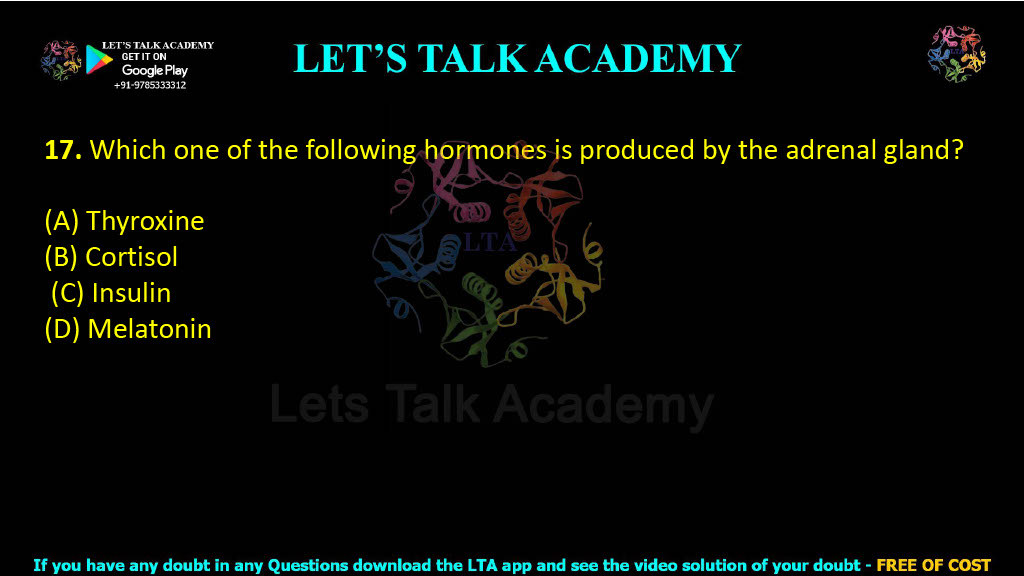
17. Which one of the following hormones is produced by the adrenal gland?
(A) Thyroxine
(B) Cortisol
(C) Insulin
(D) Melatonin
Cortisol Is Produced by the Adrenal Gland
Introduction
The endocrine system is a highly coordinated network of glands that produces hormones responsible for regulating growth, metabolism, reproduction, immunity, stress responses, electrolyte balance, and homeostasis. Hormones act as chemical messengers that travel through the bloodstream and influence the activities of target organs. Every endocrine gland synthesizes a unique set of hormones that perform highly specialized physiological functions.
The adrenal glands, also known as suprarenal glands, are paired endocrine organs located above each kidney. Each adrenal gland consists of two functionally distinct regions: the adrenal cortex and the adrenal medulla. The adrenal cortex produces steroid hormones such as cortisol, aldosterone, and adrenal androgens, whereas the adrenal medulla secretes catecholamines including epinephrine and norepinephrine. Among these hormones, cortisol is the principal glucocorticoid that regulates glucose metabolism, immune function, protein metabolism, lipid metabolism, and the body’s response to physical and psychological stress.
Correct Answer
Correct Option: (B) Cortisol
Detailed Explanation
Cortisol is the major glucocorticoid hormone synthesized and secreted by the zona fasciculata of the adrenal cortex. Its secretion is regulated by the hypothalamic-pituitary-adrenal (HPA) axis. In response to stress, the hypothalamus releases corticotropin-releasing hormone (CRH), which stimulates the anterior pituitary gland to secrete adrenocorticotropic hormone (ACTH). ACTH then stimulates the adrenal cortex to release cortisol into the bloodstream.
Cortisol plays an essential role in maintaining blood glucose levels by stimulating gluconeogenesis in the liver. It also promotes protein breakdown, enhances fat metabolism, suppresses excessive inflammatory responses, modulates immune function, and helps the body adapt to physical and emotional stress. In addition, cortisol contributes to maintaining normal blood pressure and supports cardiovascular function during stressful conditions.
Since cortisol is synthesized exclusively by the adrenal cortex, Option (B) is the correct answer.
Explanation of Each Option
Option (A): Thyroxine
This statement is incorrect. Thyroxine (T4) is produced by the thyroid gland. It regulates basal metabolic rate, growth, development, oxygen consumption, and energy metabolism. It is not synthesized by the adrenal gland.
Option (B): Cortisol
This statement is correct. Cortisol is the principal glucocorticoid hormone secreted by the adrenal cortex. It regulates metabolism, immune responses, stress adaptation, and maintenance of blood glucose concentration.
Option (C): Insulin
This statement is incorrect. Insulin is synthesized by the β-cells of the pancreatic islets of Langerhans. It lowers blood glucose by promoting glucose uptake into muscle and adipose tissue and by stimulating glycogen synthesis.
Option (D): Melatonin
This statement is incorrect. Melatonin is secreted by the pineal gland. It regulates circadian rhythms, sleep-wake cycles, and seasonal biological rhythms.
Why Option (B) is Correct
The adrenal cortex synthesizes cortisol under the influence of ACTH. Cortisol is the body’s primary stress hormone and is essential for regulating carbohydrate, protein, and lipid metabolism while suppressing excessive inflammation and supporting normal physiological homeostasis.
Why the Other Options are Incorrect
Why Option (A) is Incorrect
Thyroxine is secreted by the thyroid gland, not by the adrenal gland.
Why Option (C) is Incorrect
Insulin is produced by pancreatic β-cells and functions in blood glucose regulation.
Why Option (D) is Incorrect
Melatonin is synthesized by the pineal gland and regulates biological rhythms rather than adrenal function.
Comparison of All Options
| Option | Hormone | Produced By | Correct or Incorrect |
|---|---|---|---|
| A | Thyroxine | Thyroid gland | Incorrect |
| B | Cortisol | Adrenal cortex | Correct |
| C | Insulin | Pancreatic β-cells | Incorrect |
| D | Melatonin | Pineal gland | Incorrect |
Hormones Secreted by the Adrenal Gland
| Region | Hormone | Major Function |
|---|---|---|
| Zona Glomerulosa | Aldosterone | Regulates sodium, potassium, and blood pressure |
| Zona Fasciculata | Cortisol | Stress response and metabolism |
| Zona Reticularis | Adrenal Androgens | Development of secondary sexual characteristics |
| Adrenal Medulla | Epinephrine and Norepinephrine | Fight-or-flight response |
Major Endocrine Glands and Their Hormones
| Endocrine Gland | Major Hormone |
|---|---|
| Thyroid Gland | Thyroxine (T₄), Triiodothyronine (T₃) |
| Pancreas | Insulin, Glucagon |
| Pineal Gland | Melatonin |
| Adrenal Gland | Cortisol, Aldosterone, Epinephrine, Norepinephrine |
Physiological Functions of Cortisol
| Function | Physiological Importance |
|---|---|
| Gluconeogenesis | Maintains blood glucose during fasting |
| Protein Metabolism | Promotes amino acid mobilization |
| Lipid Metabolism | Stimulates fat breakdown |
| Immune Regulation | Suppresses excessive inflammation |
| Stress Adaptation | Helps the body respond to physical and emotional stress |
Biological Significance of Cortisol
Cortisol is essential for maintaining metabolic homeostasis and enabling the body to respond effectively to stressful situations. It ensures a continuous supply of glucose to vital organs such as the brain, regulates inflammatory responses, supports cardiovascular stability, and coordinates the body’s adaptation to physiological stress. Both cortisol deficiency and cortisol excess can lead to serious endocrine disorders such as Addison’s disease and Cushing’s syndrome, highlighting its critical role in human physiology.
Final Answer
Correct Option: (B) Cortisol
Cortisol is the principal glucocorticoid hormone produced by the adrenal cortex. It regulates metabolism, immune function, stress responses, and maintenance of blood glucose levels, making it the correct answer to this question.


