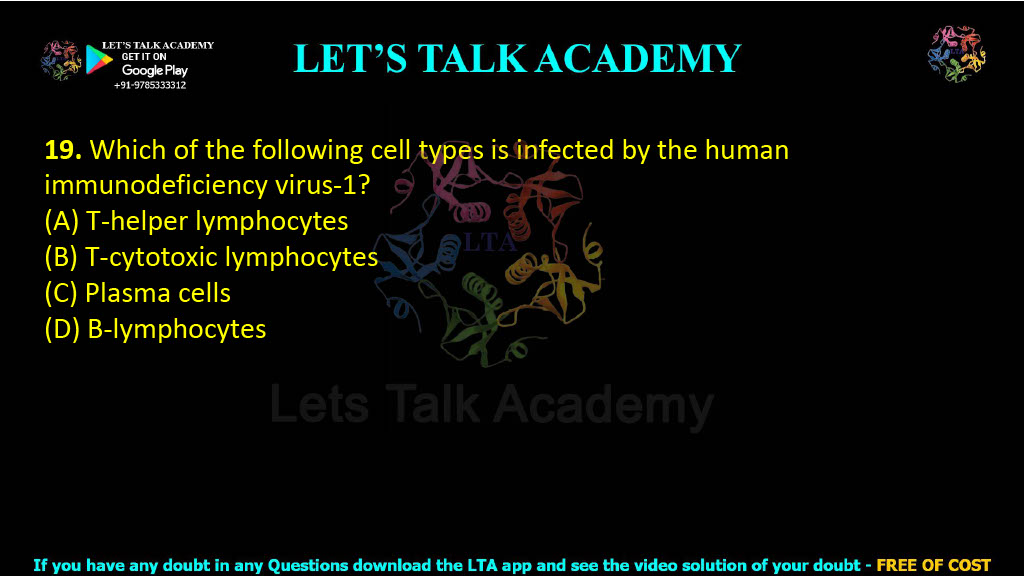
19. Which of the following cell types is infected by the human immunodeficiency virus-1?
(A) T-helper lymphocytes
(B) T-cytotoxic lymphocytes
(C) Plasma cells
(D) B-lymphocytes
HIV-1 Primarily Infects T-Helper Lymphocytes
Introduction
The Human Immunodeficiency Virus type 1 (HIV-1) is a retrovirus that attacks the human immune system and causes Acquired Immunodeficiency Syndrome (AIDS). HIV infection gradually weakens the body’s immune defenses by destroying cells responsible for coordinating adaptive immune responses. As immune function declines, infected individuals become increasingly susceptible to opportunistic infections and certain cancers that rarely affect healthy individuals.
The primary target of HIV-1 is the CD4+ T-helper lymphocyte. Viral entry begins when the HIV envelope glycoprotein gp120 binds to the CD4 receptor and subsequently interacts with chemokine co-receptors such as CCR5 or CXCR4. This interaction allows the virus to enter host cells, replicate, and progressively reduce the number of functional CD4+ T cells. Since these lymphocytes regulate both cell-mediated and humoral immunity, their destruction leads to profound immunodeficiency.
Correct Answer
Correct Option: (A) T-helper lymphocytes
Detailed Explanation
HIV-1 primarily infects CD4+ T-helper lymphocytes, which are central regulators of the adaptive immune system. These cells express the CD4 receptor on their surface, which serves as the primary receptor for HIV entry. The viral envelope glycoprotein gp120 first binds to the CD4 molecule and then interacts with either the CCR5 or CXCR4 co-receptor. This interaction allows fusion of the viral envelope with the host cell membrane through the action of another viral glycoprotein, gp41.
Once inside the cell, HIV releases its RNA genome, which is converted into DNA by the viral enzyme reverse transcriptase. The viral DNA integrates into the host genome with the help of integrase and subsequently directs the production of new viral particles. Continuous viral replication eventually destroys CD4+ T-helper cells, leading to a progressive decline in immune function. As CD4 cell numbers fall, both humoral and cell-mediated immunity become severely impaired, resulting in the development of AIDS.
Although HIV can also infect macrophages and dendritic cells because they express CD4 along with appropriate co-receptors, the principal target responsible for immune deficiency is the CD4+ T-helper lymphocyte.
Explanation of Each Option
Option (A): T-helper Lymphocytes
This statement is correct. CD4+ T-helper lymphocytes are the primary targets of HIV-1 because they express the CD4 receptor along with CCR5 or CXCR4 co-receptors required for viral entry. Progressive depletion of these cells is the hallmark of HIV infection.
Option (B): T-cytotoxic Lymphocytes
This statement is incorrect. Cytotoxic T lymphocytes (CD8+ T cells) do not express CD4 receptors and therefore are not the primary targets of HIV-1. Instead, these cells help destroy HIV-infected cells during the immune response.
Option (C): Plasma Cells
This statement is incorrect. Plasma cells are terminally differentiated B cells responsible for antibody secretion. They are not the primary cells infected by HIV-1.
Option (D): B-lymphocytes
This statement is incorrect. Mature B lymphocytes do not express sufficient CD4 receptors for productive HIV infection. Although B-cell function becomes abnormal during HIV infection due to loss of T-helper cell support, they are not the principal targets of the virus.
Why Option (A) is Correct
HIV-1 specifically recognizes the CD4 receptor present on T-helper lymphocytes. Viral attachment, fusion, replication, and destruction of these cells gradually impair immune function, making CD4+ T-helper lymphocytes the principal target of HIV infection.
Why the Other Options are Incorrect
Why Option (B) is Incorrect
CD8+ cytotoxic T cells eliminate infected cells but are not the primary cells infected by HIV.
Why Option (C) is Incorrect
Plasma cells produce antibodies but do not serve as the major site of HIV replication.
Why Option (D) is Incorrect
B lymphocytes become functionally impaired during HIV infection, but they are not the primary targets because they lack the appropriate CD4 receptor required for efficient viral entry.
Comparison of All Options
| Option | Cell Type | Primary HIV-1 Target? | Correct or Incorrect |
|---|---|---|---|
| A | T-helper lymphocytes (CD4+) | Yes | Correct |
| B | T-cytotoxic lymphocytes (CD8+) | No | Incorrect |
| C | Plasma cells | No | Incorrect |
| D | B-lymphocytes | No | Incorrect |
Major Steps of HIV Infection
| Step | Process |
|---|---|
| Attachment | gp120 binds to CD4 receptor |
| Co-receptor Binding | Interaction with CCR5 or CXCR4 |
| Fusion | gp41 mediates viral entry |
| Reverse Transcription | Viral RNA is converted into DNA |
| Integration | Integrase inserts viral DNA into host genome |
| Replication | Host cell produces new viral particles |
Functions of CD4+ T-Helper Cells
| Function | Importance |
|---|---|
| Activation of B cells | Promotes antibody production |
| Activation of CD8+ T cells | Enhances antiviral immunity |
| Activation of macrophages | Improves pathogen destruction |
| Cytokine secretion | Coordinates immune responses |
| Immune regulation | Maintains adaptive immunity |
Biological Significance of CD4+ T-Helper Cells
CD4+ T-helper lymphocytes are often described as the “master regulators” of adaptive immunity because they coordinate interactions among B cells, cytotoxic T cells, macrophages, and other immune cells through cytokine secretion. Their progressive depletion by HIV results in severe impairment of both humoral and cell-mediated immunity, making patients highly susceptible to opportunistic infections and certain malignancies. Monitoring CD4 cell count is therefore one of the most important indicators of HIV disease progression and treatment response.
Final Answer
Correct Option: (A) T-helper lymphocytes
HIV-1 primarily infects CD4+ T-helper lymphocytes because these cells express the CD4 receptor and appropriate chemokine co-receptors required for viral entry. Progressive destruction of these cells weakens the immune system and ultimately leads to Acquired Immunodeficiency Syndrome (AIDS).


