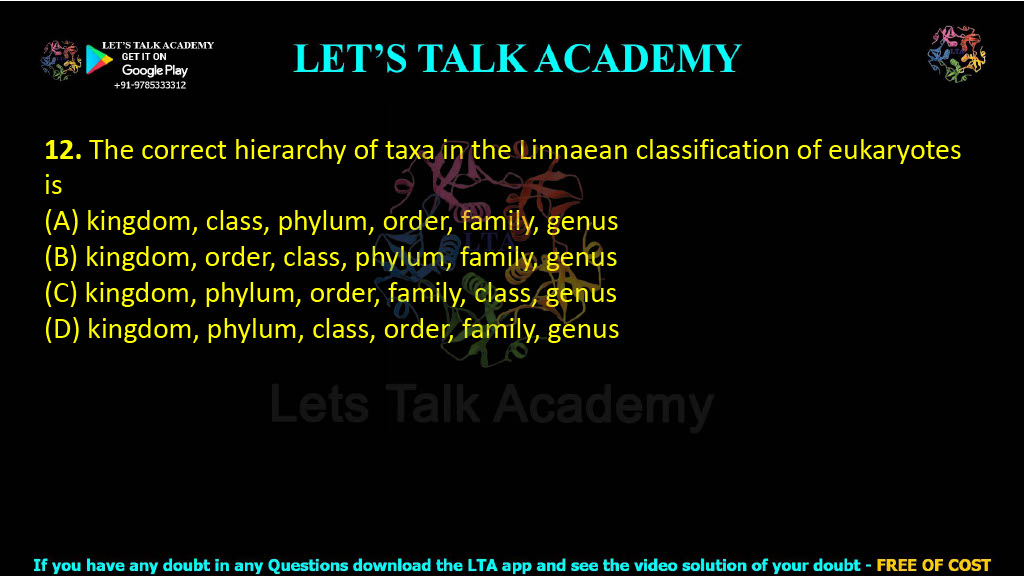
12. The correct hierarchy of taxa in the Linnaean classification of eukaryotes is
(A) kingdom, class, phylum, order, family, genus
(B) kingdom, order, class, phylum, family, genus
(C) kingdom, phylum, order, family, class, genus
(D) kingdom, phylum, class, order, family, genus
Correct Hierarchy of Taxa in the Linnaean Classification
Introduction
Biological classification is a systematic method of organizing living organisms into different groups based on their similarities, evolutionary relationships, morphology, physiology, genetics, and biochemical characteristics. The modern system of biological nomenclature originated from the pioneering work of Carolus Linnaeus, who introduced the hierarchical classification system and the binomial nomenclature that is still used worldwide. The Linnaean system provides a standardized framework that enables scientists to identify, classify, and communicate about organisms efficiently.
The Linnaean hierarchy arranges organisms into progressively smaller taxonomic categories. Each lower category contains organisms that are more closely related than those in the higher category. The major taxonomic ranks traditionally include Kingdom, Phylum, Class, Order, Family, Genus, and Species.
Correct Answer
Correct Option: (D) Kingdom → Phylum → Class → Order → Family → Genus
Detailed Explanation
The Linnaean classification system follows a fixed hierarchical arrangement in which organisms are grouped from broad categories to increasingly specific categories. The standard sequence is:
Kingdom → Phylum → Class → Order → Family → Genus → Species
Each taxonomic level represents a progressively narrower group of organisms. Organisms belonging to the same kingdom share only general characteristics, whereas organisms within the same genus are closely related and often resemble one another in morphology, genetics, and evolutionary history. The species represents the basic unit of biological classification because members of the same species can naturally interbreed and produce fertile offspring.
Since the question asks only up to the genus level, the correct hierarchy is:
Kingdom → Phylum → Class → Order → Family → Genus
Therefore, Option (D) is the correct answer.
Explanation of Each Option
Option (A): Kingdom → Class → Phylum → Order → Family → Genus
This statement is incorrect. In biological classification, Phylum always comes before Class. Reversing these two taxonomic ranks disrupts the accepted Linnaean hierarchy.
Option (B): Kingdom → Order → Class → Phylum → Family → Genus
This statement is incorrect. This sequence places Order before Class and Phylum, which is not recognized in biological taxonomy. Order is a lower taxonomic category than Class.
Option (C): Kingdom → Phylum → Order → Family → Class → Genus
This statement is incorrect. Here, Class has been incorrectly placed after Family. In the Linnaean system, Class always follows Phylum and precedes Order.
Option (D): Kingdom → Phylum → Class → Order → Family → Genus
This statement is correct. This sequence accurately follows the Linnaean taxonomic hierarchy from broader to more specific categories.
Why Option (D) is Correct
The accepted Linnaean hierarchy is:
Kingdom → Phylum → Class → Order → Family → Genus → Species
Since the question ends at the genus level, the correct sequence is:
Kingdom → Phylum → Class → Order → Family → Genus
Why the Other Options are Incorrect
Why Option (A) is Incorrect
Class cannot precede Phylum because Phylum is a higher taxonomic category.
Why Option (B) is Incorrect
Order is incorrectly placed above both Class and Phylum.
Why Option (C) is Incorrect
Class cannot appear after Family because Family is a lower taxonomic category.
Comparison of All Options
| Option | Hierarchy | Correct or Incorrect |
|---|---|---|
| A | Kingdom → Class → Phylum → Order → Family → Genus | Incorrect |
| B | Kingdom → Order → Class → Phylum → Family → Genus | Incorrect |
| C | Kingdom → Phylum → Order → Family → Class → Genus | Incorrect |
| D | Kingdom → Phylum → Class → Order → Family → Genus | Correct |
Complete Linnaean Hierarchy
| Rank | Description |
|---|---|
| Domain | Highest modern taxonomic category |
| Kingdom | Largest traditional taxonomic group |
| Phylum | Groups related classes |
| Class | Groups related orders |
| Order | Groups related families |
| Family | Groups related genera |
| Genus | Groups closely related species |
| Species | Basic unit of classification |
Example of Human Classification
| Taxonomic Rank | Human Classification |
|---|---|
| Kingdom | Animalia |
| Phylum | Chordata |
| Class | Mammalia |
| Order | Primates |
| Family | Hominidae |
| Genus | Homo |
| Species | Homo sapiens |
Importance of Taxonomic Hierarchy
The hierarchical classification system enables scientists to identify organisms accurately, understand evolutionary relationships, compare biodiversity, and organize biological information efficiently. Closely related organisms share more taxonomic categories and generally possess greater genetic, anatomical, and physiological similarities. Modern molecular techniques, including DNA sequencing and phylogenetic analysis, continue to refine this classification while maintaining the fundamental hierarchical framework introduced by Linnaeus.
Final Answer
Correct Option: (D) Kingdom → Phylum → Class → Order → Family → Genus
The Linnaean classification system follows the hierarchy Kingdom → Phylum → Class → Order → Family → Genus → Species. Since the question asks only up to the genus level, the correct sequence is Kingdom → Phylum → Class → Order → Family → Genus.


