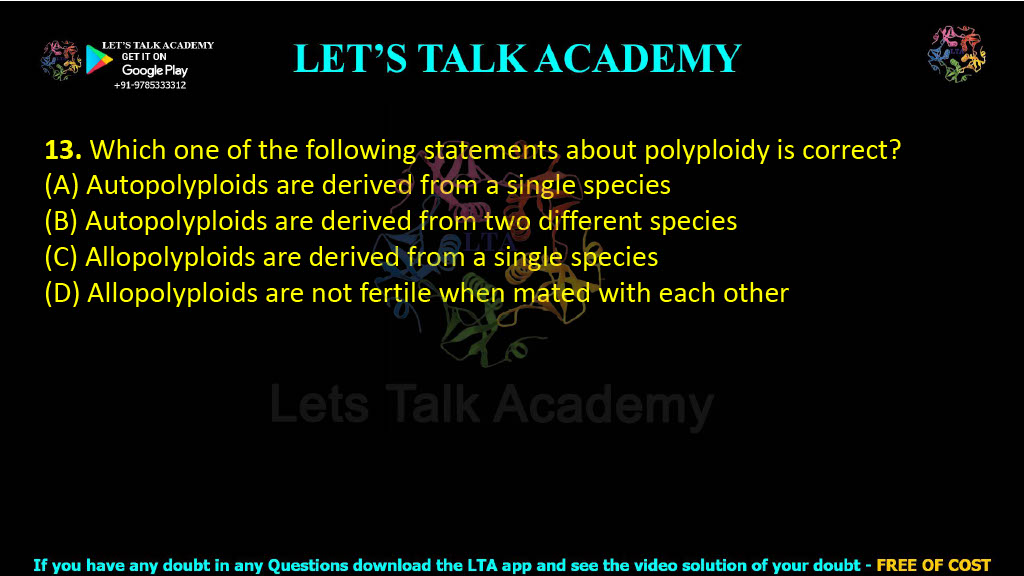
13. Which one of the following statements about polyploidy is correct?
(A) Autopolyploids are derived from a single species
(B) Autopolyploids are derived from two different species
(C) Allopolyploids are derived from a single species
(D) Allopolyploids are not fertile when mated with each other
Autopolyploids Are Derived from a Single Species
Introduction
Polyploidy is a condition in which an organism possesses more than two complete sets of chromosomes. It is one of the most important mechanisms of genome evolution, particularly in plants, where it has contributed significantly to the origin of new species, increased genetic diversity, improved adaptability, and enhanced agricultural productivity. Many economically important crop plants such as wheat, cotton, potato, banana, sugarcane, and canola are polyploids.
Polyploidy is broadly classified into two major types: autopolyploidy and allopolyploidy. Autopolyploids arise through chromosome duplication within a single species, whereas allopolyploids originate from hybridization between two different species followed by chromosome doubling. Understanding these two forms of polyploidy is essential for genetics, plant breeding, cytogenetics, and evolutionary biology.
Correct Answer
Correct Option: (A) Autopolyploids are derived from a single species
Detailed Explanation
Polyploidy refers to the presence of more than two complete chromosome sets in an organism. It commonly results from chromosome doubling caused by errors during mitosis or meiosis, or by treatment with spindle inhibitors such as colchicine. Polyploid organisms may possess three (triploid), four (tetraploid), six (hexaploid), or even higher multiples of the basic chromosome set.
Autopolyploids originate from chromosome duplication within the same species. Since all chromosome sets are derived from one species, the duplicated chromosomes are homologous. Examples include autotetraploid potato and autotetraploid alfalfa. Autopolyploids generally exhibit larger cell size, increased organ size, and enhanced vegetative growth.
Allopolyploids originate through hybridization between two different species followed by chromosome doubling. Initially, hybrids are often sterile because chromosomes from different species cannot pair properly during meiosis. However, chromosome doubling restores homologous pairing, making the resulting allopolyploid fertile. Classical examples include bread wheat, cotton, tobacco, and triticale.
Therefore, the correct statement is that autopolyploids are derived from a single species.
Explanation of Each Option
Option (A): Autopolyploids are Derived from a Single Species
This statement is correct. Autopolyploids possess multiple chromosome sets originating from the same species due to chromosome duplication. Since all chromosomes belong to one species, this condition is termed autopolyploidy.
Option (B): Autopolyploids are Derived from Two Different Species
This statement is incorrect. Polyploids derived from two different species are called allopolyploids, not autopolyploids.
Option (C): Allopolyploids are Derived from a Single Species
This statement is incorrect. Allopolyploids always arise through hybridization between two or more different species followed by chromosome doubling.
Option (D): Allopolyploids are Not Fertile When Mated with Each Other
This statement is incorrect. Newly formed interspecific hybrids are usually sterile because homologous chromosome pairing cannot occur during meiosis. However, after chromosome doubling, fertile allopolyploids are produced because each chromosome acquires a homologous partner. Therefore, established allopolyploids are generally fertile.
Why Option (A) is Correct
Autopolyploidy results from duplication of the chromosome complement of a single species. Since all chromosome sets originate from one species, autopolyploids possess multiple homologous chromosome sets derived from the same ancestral genome.
Why the Other Options are Incorrect
Why Option (B) is Incorrect
Two different parental species give rise to allopolyploids, not autopolyploids.
Why Option (C) is Incorrect
Allopolyploids require hybridization between different species before chromosome doubling occurs.
Why Option (D) is Incorrect
Chromosome doubling restores homologous chromosome pairing, making mature allopolyploids fertile.
Comparison of All Options
| Option | Statement | Correct or Incorrect |
|---|---|---|
| A | Autopolyploids are derived from a single species | Correct |
| B | Autopolyploids are derived from two different species | Incorrect |
| C | Allopolyploids are derived from a single species | Incorrect |
| D | Allopolyploids are not fertile when mated with each other | Incorrect |
Autopolyploidy vs Allopolyploidy
| Feature | Autopolyploid | Allopolyploid |
|---|---|---|
| Origin | Single species | Two or more different species |
| Chromosome Source | Identical genome duplicated | Different parental genomes |
| Method of Formation | Chromosome duplication | Hybridization followed by chromosome doubling |
| Chromosome Pairing | Multiple homologous chromosomes | Homologous pairing restored after doubling |
| Examples | Autotetraploid potato, alfalfa | Bread wheat, cotton, tobacco, triticale |
Examples of Polyploid Crops
| Crop | Type of Polyploidy | Ploidy Level |
|---|---|---|
| Bread Wheat | Allopolyploid | Hexaploid (6n) |
| Cotton | Allopolyploid | Tetraploid (4n) |
| Potato | Autopolyploid | Tetraploid (4n) |
| Banana | Autopolyploid/Triploid | Triploid (3n) |
| Triticale | Allopolyploid | Hybrid of wheat and rye |
Biological Significance of Polyploidy
Polyploidy has played a crucial role in plant evolution by increasing genetic diversity, promoting reproductive isolation, and facilitating rapid speciation. Polyploid plants often exhibit larger fruits, flowers, and leaves, improved stress tolerance, enhanced disease resistance, and increased agricultural productivity. Because chromosome duplication creates additional copies of genes, polyploids also provide raw material for evolutionary innovation through gene diversification and functional specialization.
Final Answer
Correct Option: (A) Autopolyploids are derived from a single species.
Autopolyploids possess multiple chromosome sets originating from the same species through chromosome duplication. In contrast, allopolyploids are produced by hybridization between different species followed by chromosome doubling, which restores fertility and enables stable inheritance.


