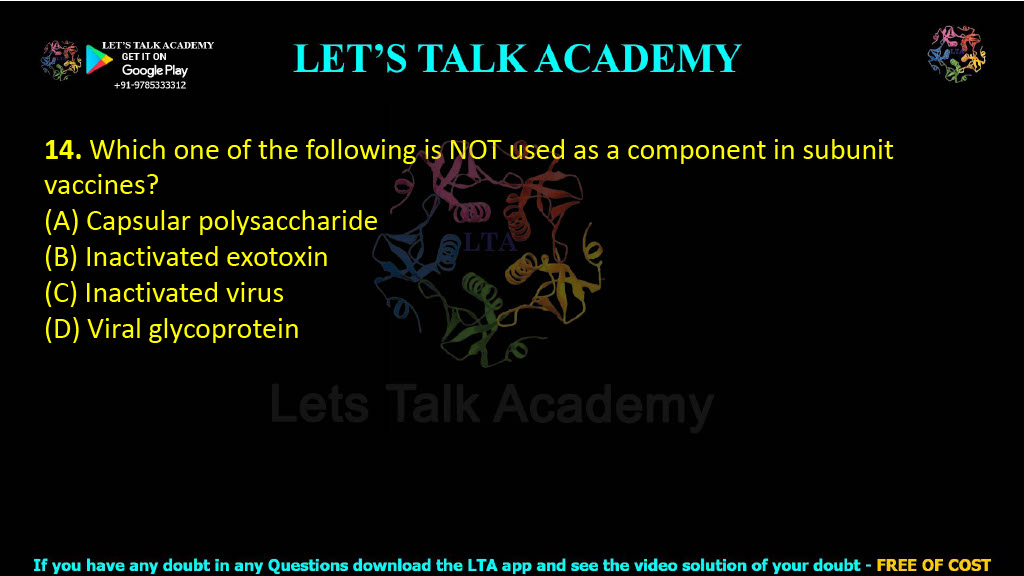
14. Which one of the following is NOT used as a component in subunit vaccines?
(A) Capsular polysaccharide
(B) Inactivated exotoxin
(C) Inactivated virus
(D) Viral glycoprotein
Subunit Vaccines Do Not Contain Inactivated Viruses
Introduction
Vaccination is one of the greatest achievements in modern medicine and has dramatically reduced the burden of infectious diseases worldwide. Vaccines stimulate the immune system to recognize and eliminate pathogens without causing severe disease. Depending on the material used to induce immunity, vaccines are broadly classified into live attenuated vaccines, inactivated vaccines, subunit vaccines, toxoid vaccines, conjugate vaccines, recombinant protein vaccines, viral vector vaccines, and nucleic acid vaccines.
Subunit vaccines are among the safest vaccine platforms because they contain only selected antigenic components of a pathogen rather than the complete microorganism. Since only immunogenic molecules are used, subunit vaccines eliminate the possibility of causing infection while effectively stimulating protective immune responses. These vaccines frequently contain purified proteins, polysaccharides, recombinant antigens, or toxoids.
Correct Answer
Correct Option: (C) Inactivated virus
Detailed Explanation
Subunit vaccines contain only specific antigenic portions of a pathogen that are capable of stimulating protective immunity. Instead of introducing the entire microorganism, these vaccines include purified proteins, surface glycoproteins, polysaccharides, or detoxified bacterial toxins. Because only selected antigenic molecules are administered, subunit vaccines are highly safe and cannot replicate inside the host.
An inactivated virus, however, consists of the entire viral particle that has been chemically or physically killed so that it cannot replicate. Although the virus is non-infectious, it still contains all viral structural components. Vaccines prepared from whole killed viruses belong to the category of inactivated (killed) vaccines, not subunit vaccines.
Therefore, an inactivated virus is not considered a component of a subunit vaccine.
Explanation of Each Option
Option (A): Capsular Polysaccharide
This statement is incorrect because capsular polysaccharides are important components of several subunit vaccines. These purified polysaccharides stimulate protective immunity against encapsulated bacteria such as Streptococcus pneumoniae, Neisseria meningitidis, and Haemophilus influenzae. Many modern vaccines use polysaccharide-protein conjugates to improve immune responses, especially in children.
Option (B): Inactivated Exotoxin
This statement is incorrect. Detoxified bacterial exotoxins, known as toxoids, are widely used as vaccine antigens. Chemical treatment with formaldehyde eliminates toxicity while preserving antigenicity. Tetanus and diphtheria vaccines are classical examples of toxoid-based subunit vaccines.
Option (C): Inactivated Virus
This statement is correct. An inactivated virus contains the complete virus particle, although it has lost its ability to replicate. Since subunit vaccines contain only selected antigenic components rather than the whole pathogen, an inactivated virus is not classified as a subunit vaccine component.
Option (D): Viral Glycoprotein
This statement is incorrect. Viral surface glycoproteins are excellent antigens because they are recognized by neutralizing antibodies. Recombinant viral glycoproteins are commonly used in subunit vaccines, including vaccines against hepatitis B virus and human papillomavirus.
Why Option (C) is Correct
Subunit vaccines contain only purified antigenic molecules such as proteins, glycoproteins, polysaccharides, or toxoids. Whole inactivated viruses contain the complete viral structure and therefore belong to the category of inactivated vaccines rather than subunit vaccines.
Why the Other Options are Incorrect
Why Option (A) is Incorrect
Purified bacterial capsular polysaccharides are commonly used as antigens in subunit and conjugate vaccines.
Why Option (B) is Incorrect
Detoxified exotoxins retain antigenicity and are important components of toxoid vaccines, which are considered subunit vaccines.
Why Option (D) is Incorrect
Purified viral glycoproteins are major antigens used in recombinant subunit vaccines because they stimulate protective antibody responses.
Comparison of All Options
| Option | Vaccine Component | Used in Subunit Vaccine? | Correct or Incorrect |
|---|---|---|---|
| A | Capsular Polysaccharide | Yes | Incorrect |
| B | Inactivated Exotoxin (Toxoid) | Yes | Incorrect |
| C | Inactivated Virus | No | Correct |
| D | Viral Glycoprotein | Yes | Incorrect |
Types of Vaccine Components
| Vaccine Type | Main Component | Example |
|---|---|---|
| Live Attenuated Vaccine | Weakened live pathogen | MMR vaccine |
| Inactivated Vaccine | Whole killed microorganism | Inactivated polio vaccine |
| Subunit Vaccine | Purified antigenic protein or polysaccharide | Hepatitis B vaccine |
| Toxoid Vaccine | Detoxified bacterial toxin | Tetanus vaccine |
| Conjugate Vaccine | Polysaccharide linked to protein carrier | Hib vaccine |
Advantages of Subunit Vaccines
| Advantage | Importance |
|---|---|
| High Safety | No live pathogen is present |
| No Risk of Reversion | Cannot revert to a virulent form |
| Specific Immune Response | Contains only protective antigens |
| Suitable for Immunocompromised Individuals | Safer than live vaccines |
| Recombinant Production | Allows large-scale, highly purified antigen preparation |
Biological Significance of Subunit Vaccines
Subunit vaccines provide effective immunity while minimizing adverse reactions because they contain only selected antigenic molecules responsible for inducing protective immune responses. Recombinant DNA technology has enabled the large-scale production of highly purified vaccine antigens such as hepatitis B surface antigen and human papillomavirus virus-like particles. These vaccines have significantly reduced the incidence of infectious diseases while maintaining an excellent safety profile.
Final Answer
Correct Option: (C) Inactivated virus
An inactivated virus consists of the entire killed viral particle and therefore belongs to the category of inactivated vaccines. In contrast, subunit vaccines contain only selected antigenic components such as capsular polysaccharides, detoxified exotoxins (toxoids), or viral glycoproteins, making them highly safe and immunogenic.


