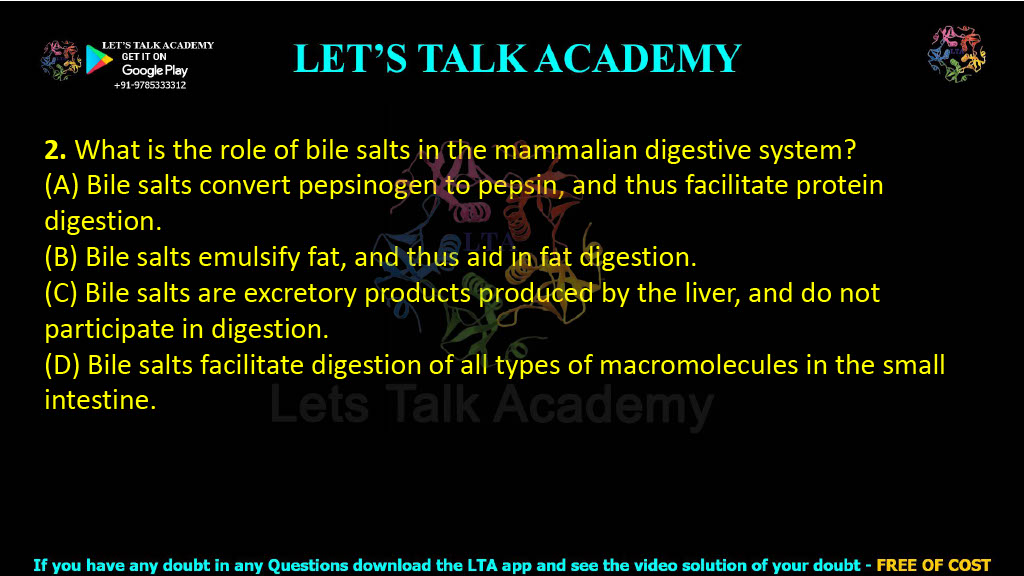
2. What is the role of bile salts in the mammalian digestive system?
(A) Bile salts convert pepsinogen to pepsin, and thus facilitate protein digestion.
(B) Bile salts emulsify fat, and thus aid in fat digestion.
(C) Bile salts are excretory products produced by the liver, and do not participate in digestion.
(D) Bile salts facilitate digestion of all types of macromolecules in the small intestine.
What Is the Role of Bile Salts in the Mammalian Digestive System?
Understanding the Role of Bile Salts in the Mammalian Digestive System
Bile salts are one of the most important non-enzymatic components involved in the digestion of dietary lipids. They are synthesized by the liver from cholesterol and stored in the gallbladder until required for digestion. Whenever fatty food enters the duodenum, the hormone cholecystokinin (CCK) stimulates the gallbladder to release bile into the small intestine. Although bile salts are not digestive enzymes, they are indispensable because they prepare fats for enzymatic digestion. Their primary role is to emulsify fats, making them easier for pancreatic lipase to digest efficiently.
Unlike carbohydrates and proteins, fats are hydrophobic and naturally aggregate into large globules in the aqueous environment of the intestine. Digestive enzymes cannot efficiently act on these large fat masses because only the outer surface is exposed. Bile salts overcome this limitation by breaking large fat globules into thousands of tiny droplets through the process of emulsification. This greatly increases the total surface area available for pancreatic lipase, significantly improving the rate and efficiency of lipid digestion.
Structure and Properties of Bile Salts
Bile salts are amphipathic molecules, meaning they possess both hydrophilic (water-attracting) and hydrophobic (fat-attracting) regions. This unique structural property enables them to surround lipid droplets while simultaneously interacting with the watery intestinal environment. As a result, fats remain suspended as tiny droplets rather than merging back into large globules. This detergent-like action is the foundation of their biological function in digestion.
How Bile Salts Help in Fat Digestion
Once fats are emulsified, pancreatic lipase can efficiently hydrolyze triglycerides into fatty acids and monoglycerides. Without emulsification, pancreatic lipase would have access to only a very small surface area, making fat digestion extremely slow and inefficient. Therefore, although bile salts do not chemically digest fats, they play an essential supportive role by allowing digestive enzymes to function optimally.
Role of Bile Salts in Nutrient Absorption
The importance of bile salts extends beyond digestion. After triglycerides are broken down into fatty acids and monoglycerides, these products remain poorly soluble in water. Bile salts organize them into microscopic structures called micelles. Micelles transport fatty acids, cholesterol, phospholipids, and fat-soluble vitamins (A, D, E, and K) across the watery intestinal lumen to the brush border of intestinal epithelial cells, where absorption occurs. Without micelle formation, efficient lipid absorption would not be possible.
Analysis of Every Option
Option (A): Bile salts convert pepsinogen to pepsin, and thus facilitate protein digestion.
This statement is incorrect because pepsinogen activation occurs exclusively in the stomach. Hydrochloric acid (HCl), secreted by gastric parietal cells, converts inactive pepsinogen into active pepsin. Bile salts are released into the small intestine and have no involvement in protein digestion or enzyme activation within the stomach. Protein digestion is primarily performed by pepsin in the stomach and pancreatic proteases such as trypsin and chymotrypsin in the small intestine.
Option (B): Bile salts emulsify fat, and thus aid in fat digestion.
This is the correct answer. Bile salts function as natural emulsifying agents that divide large fat globules into tiny droplets, dramatically increasing the surface area available for pancreatic lipase. They also facilitate micelle formation, which is essential for the absorption of fatty acids, cholesterol, monoglycerides, and fat-soluble vitamins. Therefore, bile salts play a crucial role in both fat digestion and absorption.
Option (C): Bile salts are excretory products produced by the liver, and do not participate in digestion.
This statement is incorrect because bile salts actively participate in digestion. Although bile serves as a route for excretion of bilirubin, cholesterol, certain drugs, and toxins, bile salts themselves are physiologically important digestive molecules. Their principal role is emulsification of dietary lipids and promotion of lipid absorption. Therefore, they cannot be regarded merely as waste products.
Option (D): Bile salts facilitate digestion of all types of macromolecules in the small intestine.
This statement is also incorrect because bile salts specifically assist in lipid digestion. Carbohydrates are digested by pancreatic amylase and intestinal disaccharidases, proteins are digested by pancreatic proteases and brush-border peptidases, while nucleic acids are digested by pancreatic nucleases. Bile salts are specialized molecules that assist only in the digestion and absorption of fats.
Biological Importance of Bile Salts
Efficient digestion and absorption of lipids would be impossible without bile salts. Their emulsifying action ensures maximum enzymatic activity, while micelle formation guarantees absorption of essential nutrients. Approximately 95% of bile salts are reabsorbed from the terminal ileum and returned to the liver through the enterohepatic circulation, allowing them to be recycled multiple times during digestion. This recycling mechanism conserves energy and maintains an adequate supply of bile salts for future meals.
Deficiency of bile salts due to liver disease, gallstones, or bile duct obstruction can result in fat malabsorption (steatorrhea), poor absorption of vitamins A, D, E, and K, weight loss, and nutritional deficiencies. Therefore, maintaining normal bile production is essential for healthy digestion and metabolism.
Final Answer
Correct Option: (B) Bile salts emulsify fat, and thus aid in fat digestion.
Bile salts are amphipathic molecules synthesized by the liver that play a fundamental role in lipid digestion. They emulsify large fat globules into tiny droplets, enabling pancreatic lipase to digest triglycerides efficiently. Additionally, they form micelles that facilitate the absorption of fatty acids, cholesterol, monoglycerides, and fat-soluble vitamins. Although bile salts do not chemically digest food themselves, they are indispensable for efficient fat digestion and nutrient absorption in the mammalian digestive system.


