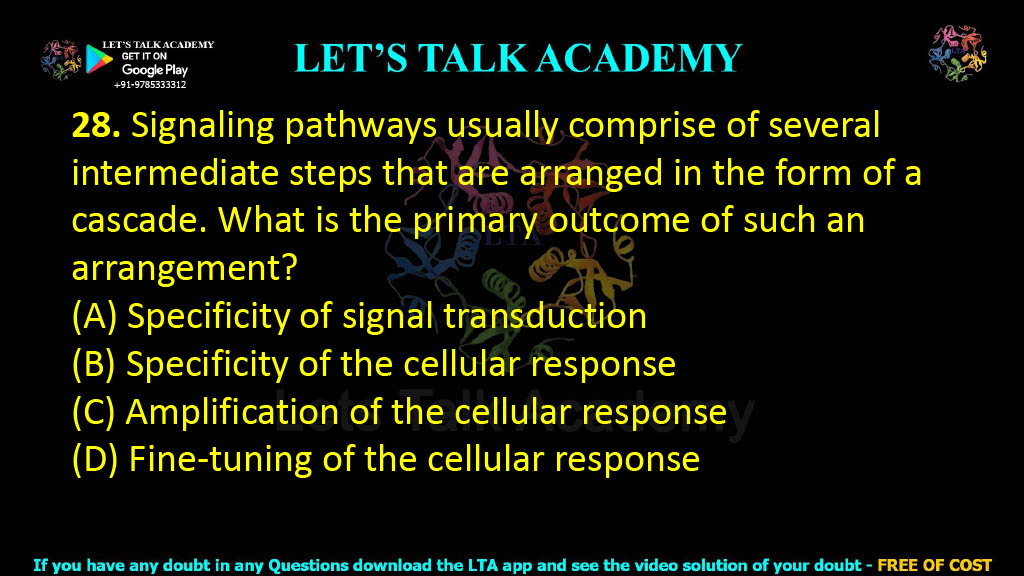
28. Signaling pathways usually comprise of several intermediate steps that are arranged in the form of a cascade. What is the primary outcome of such an arrangement?
(A) Specificity of signal transduction
(B) Specificity of the cellular response
(C) Amplification of the cellular response
(D) Fine-tuning of the cellular response
Signal Transduction Cascades and Signal Amplification
Introduction
Cell signaling is a highly coordinated process through which cells detect external or internal signals and convert them into specific biological responses. Every living cell continuously receives information from hormones, growth factors, neurotransmitters, cytokines, and environmental stimuli. These signals regulate cell growth, differentiation, metabolism, immune responses, apoptosis, and gene expression. Because many signaling molecules are present at extremely low concentrations, cells require mechanisms that efficiently transmit and strengthen these signals. This is achieved through signal transduction cascades.
A signaling cascade consists of a series of sequential molecular events in which one activated molecule activates multiple downstream molecules. These cascades frequently involve protein kinases, phosphatases, G proteins, adaptor proteins, and second messengers such as cyclic AMP (cAMP), IP3, DAG, and calcium ions. The stepwise organization allows a single extracellular signal to generate a large intracellular response. Although signaling cascades also contribute to specificity, regulation, and fine-tuning, their primary biological purpose is signal amplification.
Correct Answer
Correct Option: (C) Amplification of the cellular response
Detailed Explanation
Signal transduction pathways are organized as molecular cascades because each activated signaling component can activate numerous downstream molecules. As the signal progresses through successive steps, its strength increases dramatically. For example, one activated receptor may activate several G proteins, each G protein may stimulate an enzyme that produces thousands of second messenger molecules, and each second messenger can activate multiple protein kinases. These kinases subsequently phosphorylate hundreds of target proteins, ultimately producing a massive biological response from a single extracellular ligand.
This phenomenon is known as signal amplification. It enables cells to detect extremely small quantities of signaling molecules while still generating robust physiological responses. Even minute concentrations of hormones or growth factors can therefore regulate complex cellular activities such as metabolism, proliferation, differentiation, secretion, and apoptosis.
Although signaling cascades also improve specificity, integration, regulation, and fine-tuning of signaling pathways, these are considered secondary advantages. The principal outcome of arranging signaling molecules into a cascade is the exponential amplification of the original signal.
Explanation of Each Option
Option (A): Specificity of Signal Transduction
This statement is incorrect. Signaling specificity is indeed an important property of cellular communication because receptors recognize only particular ligands, and downstream proteins interact selectively with their signaling partners. However, receptor specificity is determined primarily by receptor-ligand recognition, scaffold proteins, and molecular interactions rather than by the cascade arrangement itself. Therefore, specificity is not the primary outcome of a signaling cascade.
Option (B): Specificity of the Cellular Response
This statement is incorrect. Different cell types respond differently to the same signaling molecule because they express different receptors, transcription factors, and intracellular signaling proteins. While signaling cascades contribute to response specificity, their principal function is to increase the strength of signal transmission through sequential activation of multiple downstream molecules.
Option (C): Amplification of the Cellular Response
This statement is correct. Signal amplification is the hallmark of signaling cascades. At every level of the cascade, one activated molecule activates many additional molecules, resulting in exponential multiplication of the original signal. Consequently, a single ligand-receptor interaction can generate thousands or even millions of intracellular signaling events, producing a rapid and powerful cellular response.
Option (D): Fine-Tuning of the Cellular Response
This statement is incorrect. Signaling pathways certainly allow modulation and fine adjustment of cellular responses through positive feedback, negative feedback, cross-talk, scaffold proteins, and phosphatases. However, these regulatory mechanisms are secondary features. The fundamental reason signaling pathways are organized into cascades is to amplify the incoming signal.
Why Option (C) is Correct
Every step of a signaling cascade multiplies the signal by activating multiple downstream molecules. This sequential activation dramatically increases the magnitude of the cellular response, allowing cells to respond efficiently even when extracellular signaling molecules are present at extremely low concentrations. Therefore, amplification of the cellular response is the principal outcome of cascade organization.
Why the Other Options are Incorrect
Why Option (A) is Incorrect
Specificity depends primarily on receptor-ligand interactions and intracellular protein recognition rather than on the cascade arrangement itself.
Why Option (B) is Incorrect
Different cellular responses arise because different cell types express distinct signaling proteins and transcription factors, not because cascades primarily determine response specificity.
Why Option (D) is Incorrect
Fine-tuning is an important regulatory property of signaling pathways but is not their primary biological purpose. Signal amplification remains the defining feature of signaling cascades.
Comparison of All Options
| Option | Statement | Correct or Incorrect | Reason |
|---|---|---|---|
| A | Specificity of signal transduction | Incorrect | Specificity mainly depends on receptor-ligand interactions. |
| B | Specificity of the cellular response | Incorrect | Different responses depend on cell-specific signaling proteins. |
| C | Amplification of the cellular response | Correct | Each signaling molecule activates many downstream molecules. |
| D | Fine-tuning of the cellular response | Incorrect | Fine regulation is secondary to signal amplification. |
How Signal Amplification Occurs
| Step | Amplification Event |
|---|---|
| Ligand Binding | One ligand activates one receptor. |
| G Protein Activation | One receptor activates multiple G proteins. |
| Effector Enzyme Activation | Each G protein activates an enzyme such as adenylyl cyclase. |
| Second Messenger Production | Thousands of cAMP or IP3 molecules are generated. |
| Protein Kinase Activation | Many kinases become activated simultaneously. |
| Target Protein Phosphorylation | Hundreds of proteins are modified to produce the cellular response. |
Advantages of Signaling Cascades
| Advantage | Biological Importance |
|---|---|
| Signal Amplification | Produces large responses from very small stimuli |
| Specificity | Ensures correct target proteins are activated |
| Signal Integration | Combines multiple signaling pathways |
| Fine Regulation | Allows positive and negative feedback control |
| Rapid Response | Quickly activates downstream effectors |
Biological Significance of Signal Amplification
Signal amplification enables cells to respond to hormones and signaling molecules present at extremely low concentrations. For example, binding of a single epinephrine molecule to a GPCR can ultimately activate thousands of glycogen phosphorylase molecules, resulting in rapid glycogen breakdown. Similarly, growth factors activate kinase cascades that regulate cell proliferation, differentiation, and survival. Without amplification, extracellular signals would be too weak to produce meaningful physiological effects.
Final Answer
Correct Option: (C) Amplification of the cellular response
The primary purpose of arranging signaling pathways into molecular cascades is signal amplification. Each activated signaling molecule activates multiple downstream targets, allowing a very small extracellular stimulus to generate a large and highly efficient intracellular response. Although signaling cascades also improve specificity and regulatory control, amplification remains their most important biological outcome.


