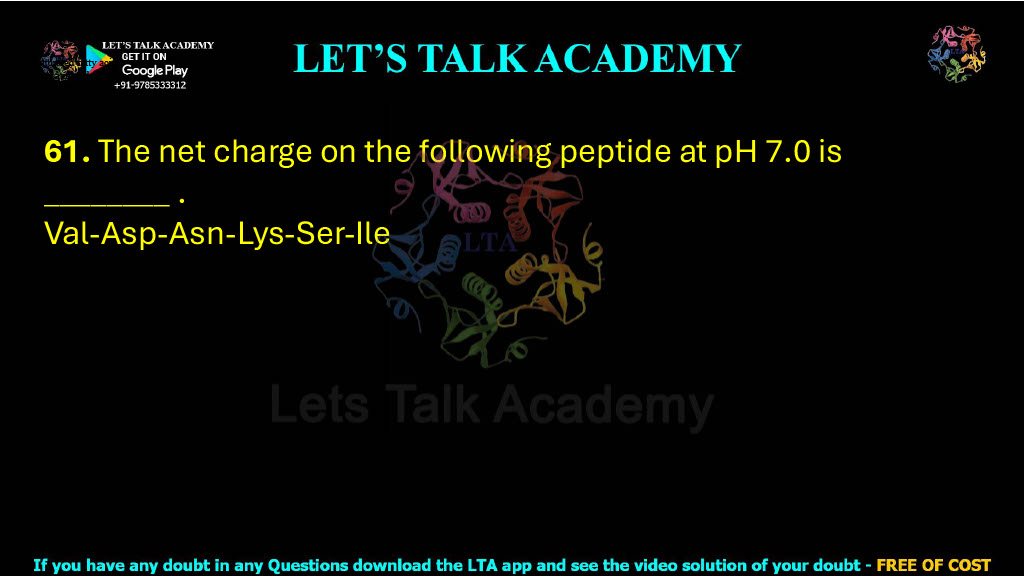
61. The net charge on the following peptide at pH 7.0 is ________ .
Val-Asp-Asn-Lys-Ser-Ile
How to Calculate the Net Charge of a Peptide at pH 7?
Correct Answer
0 (Zero)
Introduction
The net charge of a peptide is determined by the ionization state of all its ionizable groups at a given pH. These include the N-terminal amino group, the C-terminal carboxyl group, and the ionizable side chains of amino acids such as Asp, Glu, Lys, Arg, His, Tyr, and Cys. Since each functional group has a characteristic pKa value, its protonation state changes depending on the surrounding pH. Calculating the overall charge therefore requires evaluating every ionizable group individually and then summing their charges.
At physiological pH (approximately pH 7.0), amino acids with acidic side chains generally carry a negative charge, whereas basic amino acids usually remain positively charged. Neutral amino acids do not contribute to the net charge.
Understanding the Concept Behind the Question
The peptide sequence is:
Val–Asp–Asn–Lys–Ser–Ile
The ionizable groups present are:
- N-terminal amino group (Val)
- Aspartic acid side chain
- Lysine side chain
- C-terminal carboxyl group (Ile)
The remaining amino acids:
- Asparagine (Asn)
- Serine (Ser)
- Valine (Val side chain)
- Isoleucine (Ile side chain)
have non-ionizable side chains at pH 7 and therefore contribute no charge.
Step 1. Determine the Charge on the N-Terminal Amino Group
The N-terminal amino group has a pKa of approximately 9.0.
At pH 7, the amino group remains protonated.
Therefore,
Charge = +1
Step 2. Determine the Charge on Aspartic Acid
Aspartic acid contains a side-chain carboxyl group with a pKa of approximately 3.9.
Since pH 7 is greater than the pKa, the side-chain carboxyl group is deprotonated.
Therefore,
Charge = −1
Step 3. Determine the Charge on Lysine
Lysine possesses an ε-amino group with a pKa of approximately 10.5.
At pH 7, this amino group remains fully protonated.
Therefore,
Charge = +1
Step 4. Determine the Charge on the C-Terminal Carboxyl Group
The C-terminal carboxyl group has a pKa of approximately 2.0.
At pH 7, it is completely deprotonated.
Therefore,
Charge = −1
Step 5. Add All Charges
| Ionizable Group | Charge |
|---|---|
| N-terminal amino group | +1 |
| Asp side chain | −1 |
| Lys side chain | +1 |
| C-terminal carboxyl group | −1 |
Total charge:
(+1) + (−1) + (+1) + (−1) = 0
Final Calculation
Net Charge = 0
Why Do Asparagine, Serine, Valine and Isoleucine Not Contribute?
Although these amino acids possess side chains, they are not ionizable at physiological pH.
- Asparagine contains an amide group.
- Serine contains a hydroxyl group.
- Valine and Isoleucine contain hydrocarbon side chains.
None of these functional groups gain or lose protons significantly around pH 7.
Therefore, they contribute zero net charge.
Formula Used
Net Charge of a Peptide
Net Charge = Sum of all positive charges + Sum of all negative charges
To calculate correctly:
- Identify every ionizable group.
- Determine whether it is protonated or deprotonated at the given pH.
- Assign its corresponding charge.
- Add all charges together.
Biological Importance
The net charge of proteins and peptides strongly influences their solubility, three-dimensional structure, enzyme activity, and interaction with other biomolecules. Charge also determines migration during electrophoresis, protein purification by ion-exchange chromatography, and interactions with DNA, RNA, and cellular membranes.
At physiological pH, many proteins possess a characteristic net charge that affects their biological function and intracellular localization. Consequently, peptide charge calculations are fundamental in biochemistry, molecular biology, structural biology, and biotechnology.
High-Yield Points
- N-terminal amino group at pH 7 → +1
- C-terminal carboxyl group at pH 7 → −1
- Aspartic acid side chain → −1
- Lysine side chain → +1
- Asparagine, Serine, Valine and Isoleucine → 0
- Always evaluate terminal groups separately from side chains.
- Net peptide charge is obtained by summing all ionizable groups.
Frequently Asked Questions
Why is lysine positively charged at pH 7?
The ε-amino group of lysine has a high pKa (~10.5). Since pH 7 is well below its pKa, the amino group remains protonated and carries a +1 charge.
Why is aspartic acid negatively charged at pH 7?
Aspartic acid has a side-chain pKa of approximately 3.9. Because pH 7 is above its pKa, the side-chain carboxyl group loses a proton and becomes negatively charged.
Do terminal groups always contribute to peptide charge?
Yes. Unless chemically modified, both the N-terminal amino group and the C-terminal carboxyl group contribute to the overall charge of the peptide.
Key Takeaways
To determine the net charge of a peptide, every ionizable group must be evaluated individually. In the peptide Val–Asp–Asn–Lys–Ser–Ile, the N-terminal amino group contributes +1, the Asp side chain contributes −1, the Lys side chain contributes +1, and the C-terminal carboxyl group contributes −1. The remaining amino acid side chains are non-ionizable at physiological pH. Summing all charges gives:
(+1) + (−1) + (+1) + (−1) = 0
Thus, the peptide carries no net electrical charge at pH 7.0.
Final Answer
Net Charge = 0
Explanation
At pH 7, the N-terminal amino group remains protonated (+1), the Asp side-chain carboxyl group is deprotonated (−1), the Lys side-chain amino group remains protonated (+1), and the C-terminal carboxyl group is deprotonated (−1). The side chains of Valine, Asparagine, Serine, and Isoleucine are non-ionizable under physiological conditions and therefore contribute no charge. Adding all ionizable groups:
(+1) + (−1) + (+1) + (−1) = 0
Hence, the net charge of the peptide at pH 7.0 is zero.


