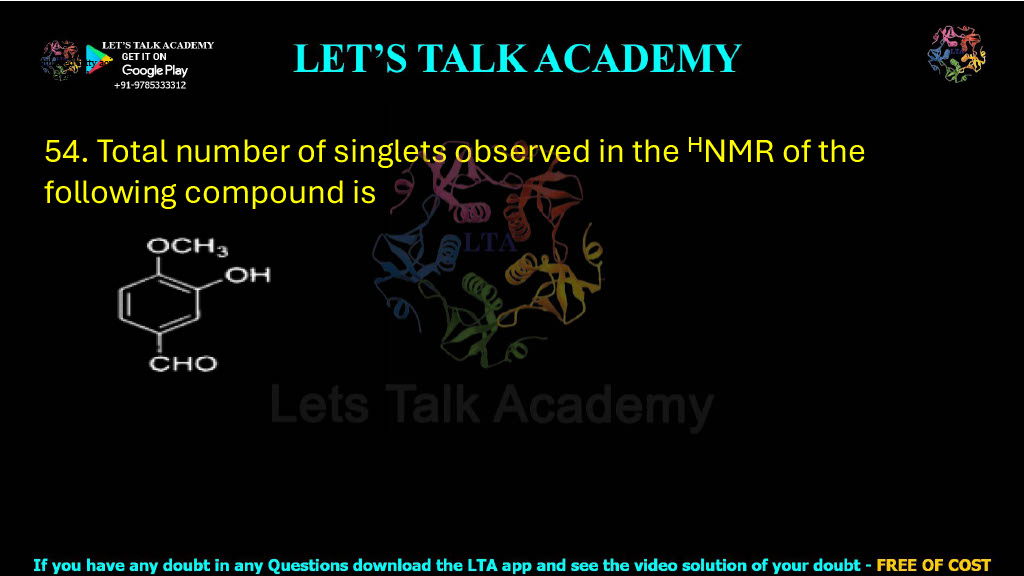
54. Total number of singlets observed in the HNMR of the following compound is
How Many Singlets Are Observed in the ¹H NMR Spectrum of Vanillin?
Correct Answer
3 Singlets
Introduction
Proton Nuclear Magnetic Resonance (¹H NMR) spectroscopy is one of the most powerful analytical techniques used for determining the structure of organic molecules. It provides detailed information about the number of chemically distinct hydrogen atoms, their electronic environments, and their interactions with neighboring protons. One of the key features of an NMR spectrum is spin-spin splitting, which follows the n + 1 rule, where the multiplicity of a signal depends on the number of adjacent nonequivalent hydrogen atoms.
In substituted aromatic compounds such as vanillin (4-hydroxy-3-methoxybenzaldehyde), different functional groups contribute characteristic proton signals. Some protons appear as singlets because they do not have neighboring protons capable of coupling, whereas aromatic protons generally exhibit doublets or doublet of doublets due to ortho and meta coupling.
Understanding the Concept Behind the Question
The given compound is vanillin, which contains the following proton environments:
- One methoxy group (–OCH₃)
- One phenolic hydroxyl group (–OH)
- One aldehyde proton (–CHO)
- Three aromatic protons attached to the benzene ring
Each proton environment must be examined individually to determine whether it appears as a singlet or undergoes spin-spin splitting.
Why the Methoxy Group Appears as a Singlet
The methoxy group (–OCH₃) contains three equivalent hydrogen atoms.
These three protons are attached to a carbon that is bonded directly to oxygen. Since there are no neighboring hydrogen atoms on the adjacent oxygen atom, spin-spin coupling does not occur.
Consequently, all three methoxy protons resonate together as a single sharp singlet, usually observed around δ 3.7–3.9 ppm.
Therefore,
The methoxy group contributes one singlet.
Why the Phenolic OH Appears as a Singlet
The phenolic hydroxyl proton (–OH) is highly exchangeable.
Due to rapid proton exchange with solvent molecules and intermolecular hydrogen bonding, this proton generally does not couple with neighboring aromatic hydrogens.
Instead, it appears as a broad singlet, commonly observed between δ 5–12 ppm, depending on solvent and hydrogen bonding.
Therefore,
The hydroxyl proton contributes one singlet.
Why the Aldehyde Proton Appears as a Singlet
The aldehyde group (–CHO) contains one hydrogen atom attached directly to the carbonyl carbon.
Although aldehydic protons can occasionally exhibit weak long-range coupling, in vanillin the neighboring carbon does not contain an adjacent proton capable of producing significant vicinal splitting.
Hence, for standard competitive examination purposes, the aldehydic proton is treated as a singlet, generally appearing between δ 9.5–10.5 ppm.
Therefore,
The aldehyde proton contributes one singlet.
Why the Aromatic Protons Are Not Singlets
The benzene ring of vanillin contains three aromatic hydrogen atoms.
These aromatic protons are positioned such that they experience ortho and meta spin-spin coupling with neighboring aromatic protons.
As a result, their signals are split into doublets or doublet of doublets, rather than singlets.
Therefore,
The aromatic protons do not contribute any singlets.
Summary of Proton Signals
| Proton Type | Number of Protons | Multiplicity |
|---|---|---|
| Methoxy (–OCH₃) | 3H | Singlet |
| Phenolic –OH | 1H | Broad Singlet |
| Aldehyde (–CHO) | 1H | Singlet |
| Aromatic Protons | 3H | Doublets / Doublet of Doublets |
Thus,
Total Singlets = 3
Biological and Analytical Importance
Proton NMR spectroscopy is indispensable in organic chemistry, medicinal chemistry, pharmaceutical analysis, and natural product research. The characteristic singlets produced by methoxy, aldehyde, and hydroxyl groups allow rapid identification of aromatic aldehydes such as vanillin. Since vanillin is widely used in food chemistry, flavor chemistry, and phytochemical research, its NMR spectrum is considered a classic example for teaching proton splitting patterns and signal assignments.
Understanding the relationship between molecular structure and NMR multiplicity enables chemists to determine unknown structures, confirm synthetic products, and identify naturally occurring compounds with remarkable precision.
High-Yield Points
- Methoxy (–OCH₃) protons usually appear as a singlet.
- Exchangeable –OH protons generally appear as broad singlets.
- Aldehydic (–CHO) proton usually appears near δ 9.5–10.5 ppm.
- Aromatic protons generally exhibit ortho and meta coupling.
- The n + 1 rule applies only to neighboring nonequivalent hydrogen atoms.
- Exchangeable protons (OH and NH) often do not show normal coupling because of rapid proton exchange.
Frequently Asked Questions
Why does the methoxy group appear as a singlet?
The methoxy carbon is bonded to oxygen, and there are no neighboring hydrogen atoms available for spin-spin coupling. Therefore, all three equivalent protons resonate as a singlet.
Why is the hydroxyl proton usually a broad singlet?
Hydroxyl protons undergo rapid exchange with solvent molecules and hydrogen bonding, preventing normal spin-spin coupling with adjacent protons.
Why are the aromatic protons not singlets?
Each aromatic proton has neighboring aromatic hydrogen atoms that produce ortho and meta coupling, resulting in doublets or more complex splitting patterns instead of singlets.
Key Takeaways
The given compound, vanillin (4-hydroxy-3-methoxybenzaldehyde), contains three proton environments that appear as singlets in its ¹H NMR spectrum. The methoxy group (–OCH₃) produces a singlet because its three equivalent protons have no adjacent hydrogens for coupling. The phenolic hydroxyl proton (–OH) appears as a broad singlet due to rapid proton exchange, while the aldehyde proton (–CHO) is observed as a singlet in standard NMR interpretation. The three aromatic protons undergo ortho and meta coupling, so they do not appear as singlets. Consequently, the total number of singlets observed in the spectrum is three.
Final Answer
Correct Answer: 3 Singlets
Explanation
The compound contains one methoxy group (–OCH₃), one phenolic hydroxyl group (–OH), and one aldehyde proton (–CHO). Each of these proton environments appears as a singlet in the ¹H NMR spectrum because they do not undergo significant spin-spin coupling with neighboring hydrogen atoms. The remaining three aromatic protons exhibit ortho and meta coupling, producing split signals rather than singlets. Therefore, the total number of singlets observed in the ¹H NMR spectrum is 3.


