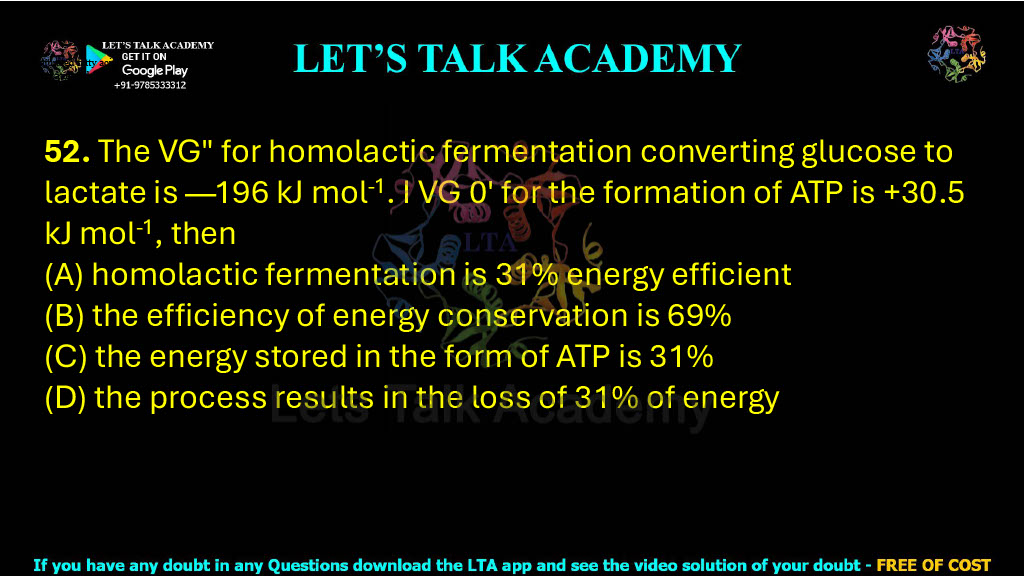
52. The VG” for homolactic fermentation converting glucose to lactate is —196 kJ mol-1. I VG 0′ for the formation of ATP is +30.5 kJ mol-1, then
(A) homolactic fermentation is 31% energy efficient
(B) the efficiency of energy conservation is 69%
(C) the energy stored in the form of ATP is 31%
(D) the process results in the loss of 31% of energy
Energy Efficiency of Homolactic Fermentation
Correct Answer
(A) and (C)
Introduction
Homolactic fermentation is an anaerobic metabolic pathway in which one molecule of glucose is converted into two molecules of lactate. This pathway is particularly important in lactic acid bacteria and in animal muscle cells during oxygen deficiency. Although fermentation releases a considerable amount of free energy, only a fraction of this energy is captured in the form of ATP. The remaining energy is dissipated as heat, maintaining the second law of thermodynamics and ensuring that the overall process remains energetically favorable.
The efficiency of a metabolic pathway is determined by comparing the amount of energy stored in ATP with the total free energy released during the reaction. Since homolactic fermentation produces 2 ATP molecules per glucose, the total energy conserved in ATP can be calculated using the standard free energy of ATP synthesis.
Understanding the Concept Behind the Question
The overall free energy released during homolactic fermentation is:
ΔG°′ = −196 kJ mol⁻¹
The negative sign indicates that the reaction releases energy spontaneously.
During glycolysis followed by homolactic fermentation:
1 Glucose → 2 Lactate + 2 ATP
Thus, the pathway produces 2 ATP molecules.
The free energy required to synthesize one ATP molecule is:
ΔG°′ = +30.5 kJ mol⁻¹
Therefore, the total energy stored in ATP is:
2 × 30.5 = 61 kJ mol⁻¹
The efficiency of energy conservation is calculated by comparing the energy stored in ATP with the total energy released.
Step 1. Calculate the Energy Stored in ATP
ATP produced:
2 ATP
Energy stored in one ATP:
30.5 kJ mol⁻¹
Therefore,
Energy stored = 2 × 30.5
= 61 kJ mol⁻¹
Step 2. Calculate the Energy Conservation Efficiency
Formula:
Efficiency (%) = (Energy stored in ATP / Total energy released) × 100
Substitute the given values:
Efficiency = (61 / 196) × 100
= 31.12%
Approximately,
Efficiency = 31%
Step 3. Calculate the Energy Lost
The remaining energy is released as heat.
Energy lost = 100 − 31
= 69%
Thus, approximately 69% of the energy is dissipated as heat.
Final Calculation
Energy conserved in ATP = 31%
Energy lost as heat = 69%
Why Option (A) Is Correct
Homolactic Fermentation is 31% Energy Efficient
The pathway stores 61 kJ mol⁻¹ out of the total 196 kJ mol⁻¹ released.
Therefore,
Efficiency = (61/196) × 100 ≈ 31%
Hence, homolactic fermentation conserves approximately 31% of the available free energy as ATP.
Therefore,
Option (A) is correct.
Why Option (B) Is Incorrect
Energy Conservation is 69%
The value 69% represents the energy lost as heat, not the energy conserved.
Only 31% of the released free energy is captured in ATP.
Therefore,
Option (B) is incorrect.
Why Option (C) Is Correct
Energy Stored in ATP is 31%
The energy stored chemically in ATP is:
61 kJ mol⁻¹
Relative to the total energy released:
(61/196) × 100 ≈ 31%
Therefore, approximately 31% of the total free energy is conserved in ATP molecules.
Hence,
Option (C) is correct.
Why Option (D) Is Incorrect
Process Results in Loss of 31% Energy
The calculation shows that approximately 69%, not 31%, of the free energy is released as heat.
Therefore,
Option (D) is incorrect.
Formula Used
Energy Stored in ATP
Energy Stored = Number of ATP × ΔG°′ of ATP Formation
Percentage Energy Conservation
Efficiency (%) = (Energy Stored / Total Energy Released) × 100
Percentage Energy Lost
Energy Lost (%) = 100 − Efficiency
Biological Importance
Fermentation pathways illustrate that living cells are not perfectly efficient energy-conserving systems. Although glucose oxidation releases a large amount of free energy, only a portion can be converted into ATP because some energy must always be dissipated as heat to satisfy thermodynamic principles. This heat production also contributes to maintaining body temperature in animals and influences microbial growth under anaerobic conditions.
Homolactic fermentation provides a rapid source of ATP in the absence of oxygen, enabling muscle contraction during intense exercise and allowing anaerobic microorganisms to survive in oxygen-limited environments.
High-Yield Points
- Homolactic fermentation produces 2 ATP per glucose.
- ΔG°′ of ATP formation = +30.5 kJ mol⁻¹.
- Total ATP energy stored:
- 2 × 30.5 = 61 kJ mol⁻¹
- Total free energy released:
- 196 kJ mol⁻¹
- Energy conservation efficiency:
- 31%
- Energy dissipated as heat:
- 69%
Frequently Asked Questions
Why is only 31% of the energy conserved?
Cells cannot convert all released free energy into ATP because some energy must inevitably be lost as heat according to the second law of thermodynamics. This makes the overall reaction spontaneous and thermodynamically favorable.
Why does homolactic fermentation produce only 2 ATP?
Fermentation relies solely on substrate-level phosphorylation during glycolysis. Unlike aerobic respiration, it does not utilize the electron transport chain or oxidative phosphorylation, resulting in a much lower ATP yield.
Why is ATP synthesis assigned a positive ΔG°′?
ATP formation from ADP and inorganic phosphate requires an input of energy. Therefore, ATP synthesis has a positive ΔG°′, whereas ATP hydrolysis has a negative ΔG°′.
Key Takeaways
Homolactic fermentation releases 196 kJ mol⁻¹ of free energy while producing 2 ATP molecules. Since each ATP stores 30.5 kJ mol⁻¹, the total energy conserved is 61 kJ mol⁻¹. The efficiency of energy conservation is therefore 31%, meaning that approximately 69% of the released energy is dissipated as heat. This illustrates an important principle of bioenergetics: living systems conserve only a fraction of the available free energy while maintaining thermodynamic spontaneity.
Final Answer
Correct Options: (A) and (C)
Explanation
Homolactic fermentation releases 196 kJ mol⁻¹ of free energy and generates 2 ATP molecules. The energy stored in ATP is:
2 × 30.5 = 61 kJ mol⁻¹
The efficiency of energy conservation is:
(61 ÷ 196) × 100 = 31.12% ≈ 31%
Thus, approximately 31% of the released energy is conserved in ATP, while the remaining 69% is lost as heat. Therefore, Option (A) (“homolactic fermentation is 31% energy efficient”) and Option (C) (“the energy stored in the form of ATP is 31%”) are both correct.


