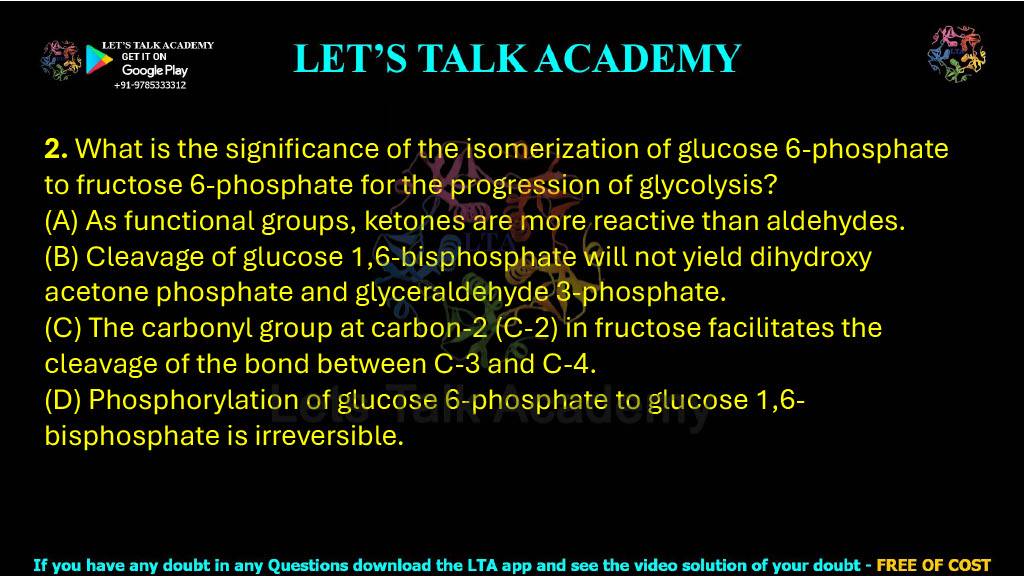
2. What is the significance of the isomerization of glucose 6-phosphate to fructose 6-phosphate for the progression of glycolysis?
(A) As functional groups, ketones are more reactive than aldehydes.
(B) Cleavage of glucose 1,6-bisphosphate will not yield dihydroxy acetone phosphate and glyceraldehyde 3-phosphate.
(C) The carbonyl group at carbon-2 (C-2) in fructose facilitates the cleavage of the bond between C-3 and C-4.
(D) Phosphorylation of glucose 6-phosphate to glucose 1,6-bisphosphate is irreversible.
Correct Answer: (C) The carbonyl group at carbon-2 (C-2) in fructose facilitates the cleavage of the bond between C-3 and C-4.
The Biochemical Logic Behind Step 2 of Glycolysis
To appreciate why Option C is the definitive answer, we have to look ahead at what happens later in the glycolytic pathway during Step 4: Aldol Cleavage.
Preparing for a Symmetrical Split
The ultimate goal of the first phase of glycolysis (the preparatory phase) is to split a 6-carbon sugar into two identical, or readily interconvertible, 3-carbon molecules.
If the pathway attempted to cleave Glucose 6-phosphate directly, the aldol cleavage would happen unevenly because of the position of its carbonyl group at Carbon-1 (C-1). This would produce fragments of unequal lengths and different chemical properties, requiring separate metabolic pathways to process each piece.
The Power of the C-2 Carbonyl
By utilizing phosphohexose isomerase, the cell shifts the carbonyl oxygen from Carbon-1 to Carbon-2. This converts the aldose sugar (glucose) into a ketose sugar (fructose).
This structural rearrangement is crucial for two main reasons:
-
Enabling Symmetric Phosphorylation: It exposes a primary hydroxyl group ($-OH$) at Carbon-1, allowing the enzyme Phosphofructokinase-1 (PFK-1) to easily add a second phosphate group in Step 3, yielding Fructose 1,6-bisphosphate.
-
Facilitating Aldol Cleavage: The presence of the electron-withdrawing carbonyl group at Carbon-2 ($C=O$) acts as a chemical “anchor.” During Step 4, the enzyme Aldolase performs a reverse aldol condensation. The carbonyl at C-2 stabilizes the carbanion intermediate formed during the reaction, which directly facilitates the clean cleavage of the covalent bond between Carbon-3 and Carbon-4.
This precise break yields two symmetrical 3-carbon isomers: Dihydroxyacetone phosphate (DHAP) and Glyceraldehyde 3-phosphate (GAP).
Deep-Dive Analysis: Why the Alternatives Are Incorrect
High-ranking, authoritative educational content must provide a comprehensive analysis of all options to fully satisfy reader curiosity. Let’s break down why the other choices fail structurally or conceptually.
(A) As functional groups, ketones are more reactive than aldehydes.
From an organic chemistry perspective, this statement is actually factually incorrect. Aldehydes are generally more reactive toward nucleophilic attack than ketones. This is because aldehydes have less steric hindrance (only one alkyl group attached to the carbonyl carbon) and less electron-donating stabilization than ketones. Therefore, the reaction does not happen to seek a more reactive functional group.
(B) Cleavage of glucose 1,6-bisphosphate will not yield DHAP and GAP.
This statement is a distractor because “glucose 1,6-bisphosphate” is not a standard intermediate in this pathway. Because Carbon-1 in glucose is part of the aldehyde group, phosphorylating it directly to form a stable 1,6-bisphosphate without isomerization is structurally unfavorable for subsequent symmetrical cleavage.
(D) Phosphorylation of glucose 6-phosphate to glucose 1,6-bisphosphate is irreversible.
This choice is conceptually flawed. First, as noted above, the intermediate formed is Fructose 1,6-bisphosphate, not glucose 1,6-bisphosphate. Second, the isomerization step itself (G6P to F6P) is highly reversible under intracellular conditions. The subsequent phosphorylation step catalyzed by PFK-1 is irreversible, but this choice mischaracterizes both the molecules and the chemical rationale involved.
Quick Reference Summary Table
| Parameter | Glucose 6-Phosphate (G6P) | Fructose 6-Phosphate (F6P) |
| Sugar Type | Aldose | Ketose |
| Carbonyl Position | Carbon-1 (C-1) | Carbon-2 (C-2) |
| Primary Cleavage Site | Asymmetric cleavage | Symmetric cleavage (between C-3 and C-4) |
| Reaction Nature | Reversible Isomerization | Prepares for PFK-1 Phosphorylation |
Key Takeaway: The isomerization of G6P to F6P is a strategic chemical chess move. Moving the carbonyl group to the C-2 position sets up the molecule perfectly for symmetrical phosphorylation and subsequent clean aldol cleavage between C-3 and C-4, maximizing metabolic efficiency.


