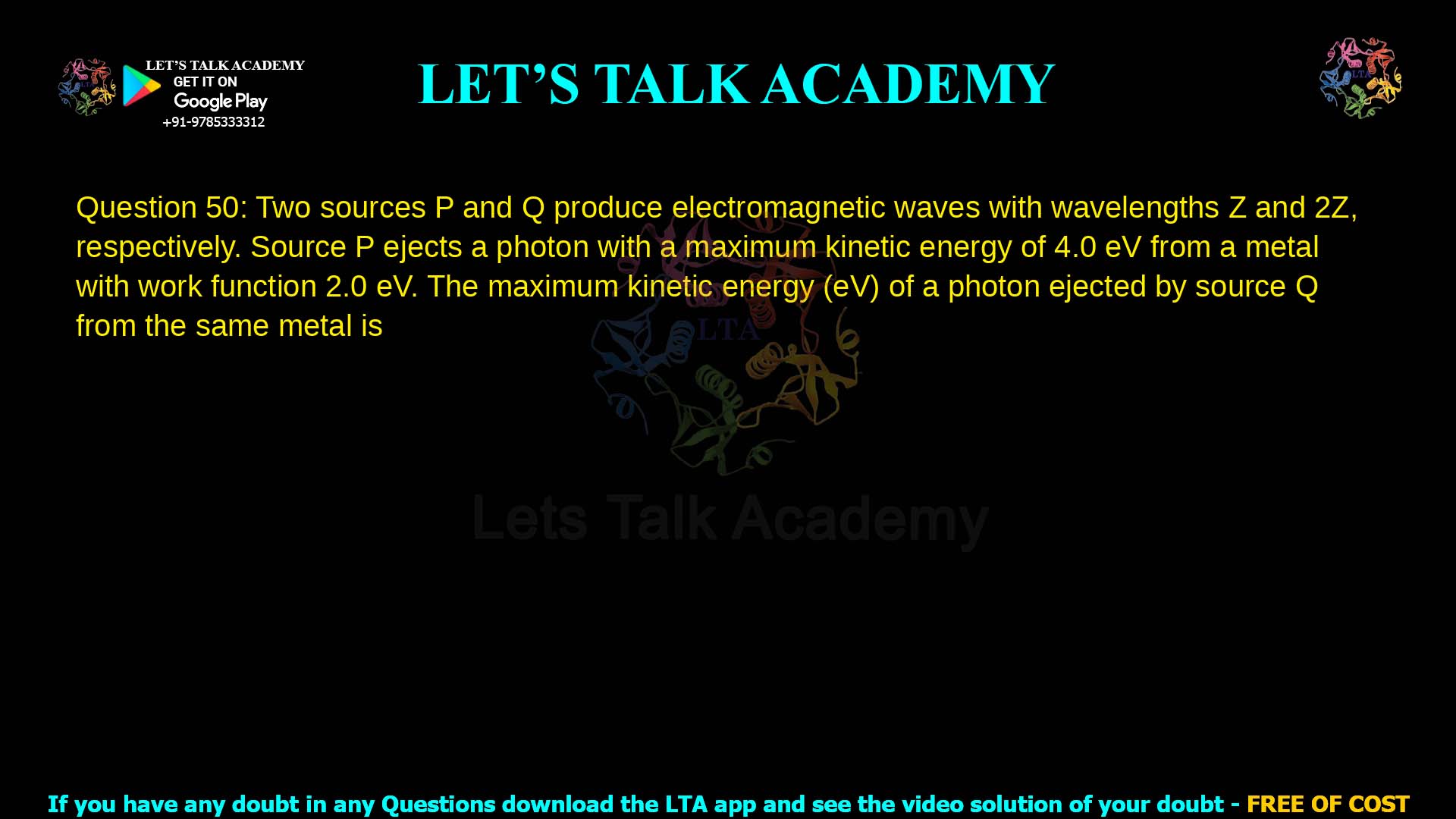
Q.50 Two sources P and Q produce electromagnetic waves with wavelengths Z and 2Z, respectively. Source P ejects a photon with a maximum kinetic energy of 4.0 eV from a metal with work function 2.0 eV. The maximum kinetic energy (eV) of a photon ejected by source Q from the same metal is ________.
Problem Statement
Source P produces electromagnetic waves with wavelength Z and ejects photoelectrons with maximum kinetic energy Kmax,P = 4.0 eV from a metal with work function ϕ = 2.0 eV. Source Q has wavelength 2Z. Find the maximum kinetic energy of photoelectrons ejected by source Q.
Core Concept
Photon energy E ∝ 1/λ (inversely proportional to wavelength)
Since photon energy is inversely proportional to wavelength, doubling the wavelength halves the photon energy.
Detailed Calculation
Step 1: Source P (λ = Z)
Step 2: Source Q (λ = 2Z)
Step 3: Maximum KE for Q
Why Not Other Values?
| Option | Value | Why Incorrect? |
|---|---|---|
| 6.0 eV | Same as P’s photon energy | Ignores wavelength increase (energy halves) |
| 4.0 eV | Same Kmax as P | Violates inverse wavelength relation |
| 3.0 eV | Q’s photon energy | Forgets to subtract work function |
| 2.0 eV | Work function value | Assumes threshold (but EQ = 3.0 > ϕ) |
| 0 eV | No ejection | Incorrect: EQ > ϕ (photoemission occurs) |
Exam Tips (CSIR NET/JEE/NEET)
- Ratio Method: No need for hc value when wavelengths related by simple ratio
- Threshold Check: Always verify E > ϕ for photoemission
- Common Trap: Don’t confuse photon energy with electron KE
- Units Consistent: Keep all energies in eV
Primary Keywords: photoelectric effect maximum kinetic energy, wavelength doubles, work function 2.0 eV
CSIR NET Ready: Perfect for competitive exam practice with step-by-step verification


